Understanding global deforestation
-
106 million acres lost
Between 2004 and 2017 in 24 deforestation fronts—an area roughly the size of California.
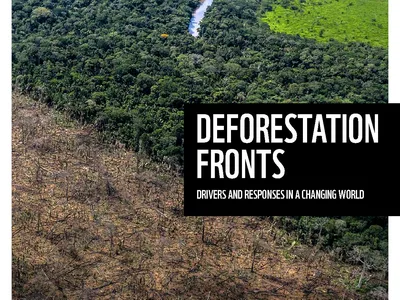
From 2000 to 2018, two-thirds of global forest cover loss occurred in the tropics and subtropics, largely in “deforestation fronts”—hot spots where forests are disappearing at an alarming rate. But the data hasn’t revealed a simple portrait of loss. Rather, it’s illuminated how pressures on forests are kaleidoscopic, driven by interrelated factors that shift over time, says a 2021 WWF report.
Drivers of deforestation vary from region to region, but forests tend to fare better when the responses reinforce one another. Take, for example, the Brazilian Amazon, where diverse protection measures—Indigenous land rights, protected areas, and more reliable forest monitoring—slowed forest loss between 2004 and 2012. But here, as elsewhere, deforestation has oscillated in reaction to political, social, and economic forces. An uptick that began in 2013 likely accelerated in 2018 when the country’s government began dismantling environmental policies.
Still, Brazil was on the right track: tailoring integrated responses to the problem’s underlying causes. The masterpiece of sustained forest protection may not yet exist, but it is likely to include an artful layering of government policy, economic incentives, and the wholehearted participation of local communities.
© WWF
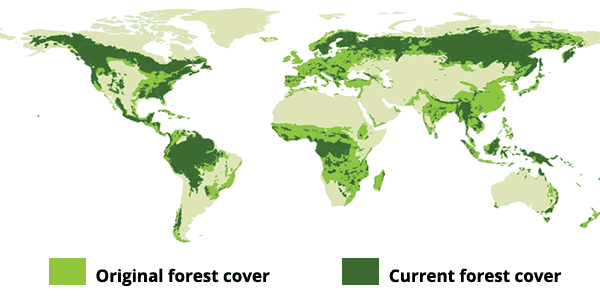
Vanishing forests
While forests covered around 50% of the Earth’s land area 8,000 years ago, today only 30% of land is forested.
MAPS COURTESY OF HTTPS://WWW.GRIDA.NO/RESOURCES/6959, CREATED BY GRID-ARENDAL

© CASSIANO ZAPAROLI (ZAPA)/NAT HAB
Explore more
Keep reading this issue of World Wildlife magazine