On the line: women, work, and the future of sustainable tuna

© Antonio Busiello / WWF-US
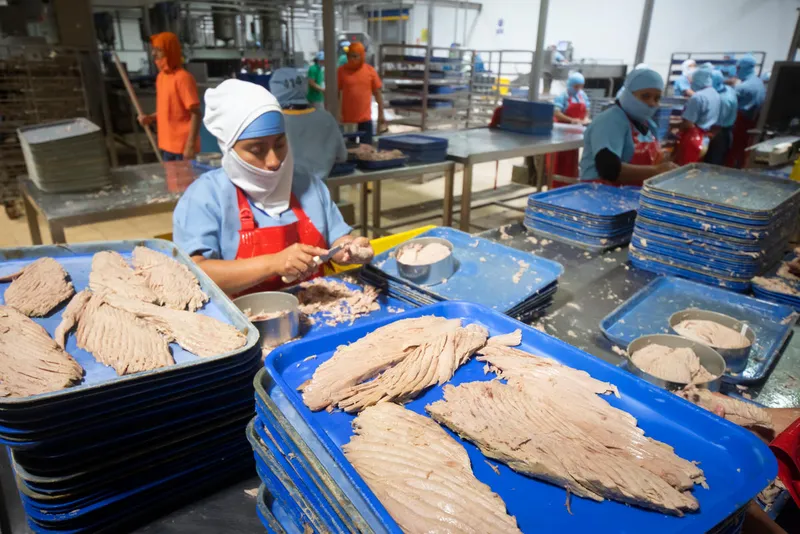
The line moves quickly. A woman in a white coat and rubber gloves trims and sorts tuna with practiced precision, her hands rarely pausing. Around her, dozens of other skilled and focused women work in rhythm. For many of them, this job is more than a paycheck. It’s stability. It’s security. It’s a future tied, quietly but completely, to the health of the ocean.
That connection is easy to miss. But when tuna stocks decline, the consequences ripple far beyond the water. Jobs become less certain, shifts slow, and opportunities shrink. In Ecuador, one of the world’s leading tuna producers, industry leaders and conservation partners have been working to change that trajectory, showing that rebuilding fisheries can also help protect the people—especially women—who depend on them.
A decade ago, the outlook was uncertain. Key tuna species like yellowfin and bigeye were under growing pressure. One challenge came from the widespread use of floating devices that attract fish, which made it easier to catch large numbers quickly, but also led to high catches of young, undersized fish before they had a chance to reproduce. At the same time, efforts to manage the fishery weren’t keeping up. Countries struggled to agree on limits, even as scientists warned that stronger action was needed. The result was a system where demand kept rising, but safeguards lagged behind.
© Antonio Busiello / WWF-US
WWF had already tried to address this through a national effort to improve the fishery. It failed to gain traction amid limited buy-in from both government and industry. So they adopted a new approach: start smaller, focusing on companies willing to lead.
Around the same time, the broader seafood industry was beginning to shift. New expectations were emerging from major buyers and global initiatives like the International Seafood Sustainability Foundation (ISSF), pushing companies to show that their products were responsibly sourced. For forward-looking businesses, sustainability was becoming less about reputation and more about staying competitive.
In Ecuador, a handful of companies stepped forward. Working with WWF, they formed what became TUNACONS, a collaboration designed to improve how tuna is caught, managed, and monitored.
The changes were practical. Companies brought in independent scientists to better understand fish populations. They supported clearer rules on how much fishing could happen and when. They placed trained observers on boats to track what was being caught. And they began testing new types of fishing gear made from biodegradable materials that reduce harm to other marine life.
For the women working in processing plants and across the supply chain, those changes carry real weight. Ecuador’s tuna industry supports tens of thousands of jobs, with women making up a large share of the workforce and increasingly holding leadership roles. Many of these are formal positions with legal protections—jobs that families rely on.
When fisheries are poorly managed, that stability erodes. Fish become harder to find, volumes drop, and processing slows. The effects are felt directly on land. Stronger management helps prevent that cycle. It keeps supply chains moving, supports consistent employment, and creates space for women not only to work, but to advance.
That doesn’t mean the work is done. In 2019, the European Union issued a warning to Ecuador over gaps in monitoring and traceability—a sign that progress can stall without continued effort. Maintaining momentum will require better data, stronger oversight, and ongoing cooperation between industry and government.
Over time, those efforts added up. Today, the group represents a significant share of Ecuador’s tuna fleet, and all its fisheries have achieved Marine Stewardship Council certification—an indication that they meet widely recognized standards for sustainability.
What Ecuador’s experience shows is that change is possible when incentives line up. When markets reward responsible practices, when companies take the lead, and when science is allowed to guide decisions, fisheries can recover.

© Antonio Busiello / WWF-US
Back on the processing line, the pace hasn’t changed. The work is still fast, still precise. But the future behind it is more secure than it once was. The health of tuna stocks, the strength of the industry, and the livelihoods of the women who sustain it are more closely connected than ever—and moving, at last, in the right direction.