Cuando River Basin Report Card
The Cuando River Basin report card aims to strengthen transboundary water governance and inclusive decision-making mechanisms across the four countries that the basin traverses.
© Will Burrard-Lucas / WWF-US
Overall health score of the Cuando River Basin:
C-
Moderate health, but more information and work needed
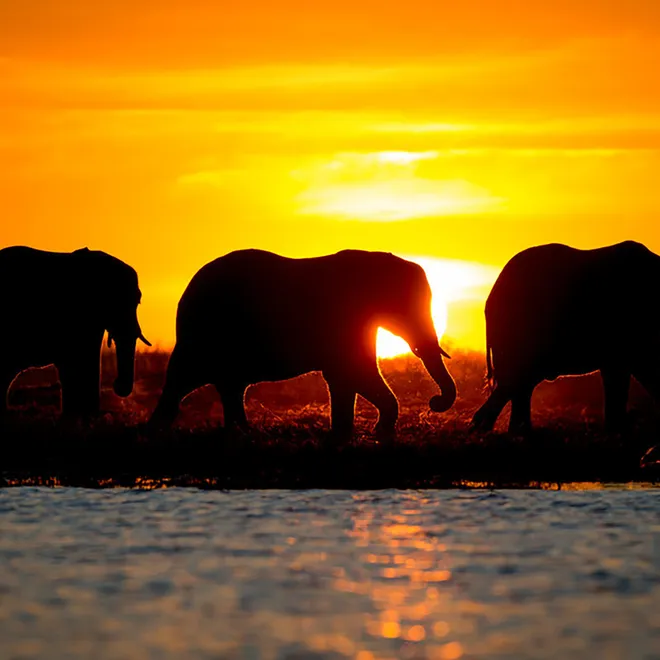
In central Africa, a “linear oasis” emerges in contrast to the dry, sandy woodlands that flank the river to the East and West. Animals such as elephants, zebras, Southern African cheetahs, and African Wild dogs call this oasis home, and close to 200,000 people rely on the water and land for subsistence farming, fish, and bushmeat. This oasis is created by the Cuando River (alternately spelled as ‘Kwando’), whose basin stretches over 37,000 square miles and is shared by four countries: Angola, Zambia, Namibia, and Botswana. The Cuando is an important water source for the Zambezi River, whose waters combine and flow together into Victoria Falls, one of the Seven Natural Wonders of the World and a World Heritage Site. Additionally, the Cuando and Zambezi are a vital part of the Kavango-Zambezi Transfrontier Conservation Area (KAZA), the largest transboundary conservation area on the planet.
As a critical area for conservation and ecotourism, the region needs to maintain its environmental health and quality. WWF, along with the Zambezi Watercourse Commission (ZAMCOM), the KAZA Secretariat, and the United States Agency for International Development (USAID) embarked on a Basin Report Card assessment to better understand and improve regional water management across the four nations.
The Cuando River Basin report card aims to strengthen transboundary water governance and inclusive decision-making mechanisms across the four countries that the basin traverses. This work will ultimately help ensure inclusive and sustainable water resource management and increased water security for the benefit of people and ecosystems in the Cuando River Basin, and downstream in the Zambezi Basin.
Without a shared transboundary vision that balances the needs of people and the environment, these pressures could result in negative impacts on the basin and the people who live within it.
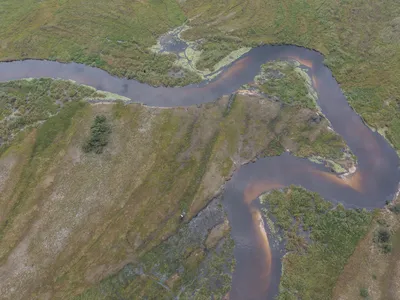
The Cuando River Basin has generally good environmental quality because it is largely undeveloped and has received protections to maintain the wildlife diversity of the area. Transboundary cooperation will be critical to maintain this high quality landscape over time.
© WWF Zambia
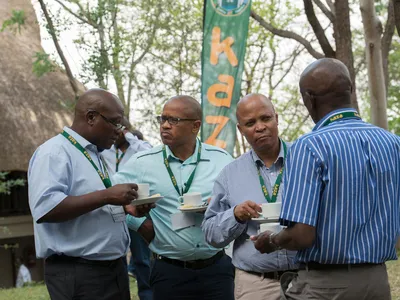
Gathering representatives of the varied water users in the basin is critical to getting a snapshot of not only the health of the basin, but what the basin means to each of the diverse communities that depend on it. In March 2020, a stakeholder workshop with over 35 participants from 19 institutions came together in Kasane, Botswana. The group conceptualized the river basin, created a shared vision, and discussed indicators for the Cuando River Basin Report Card.
© WWF in Namibia
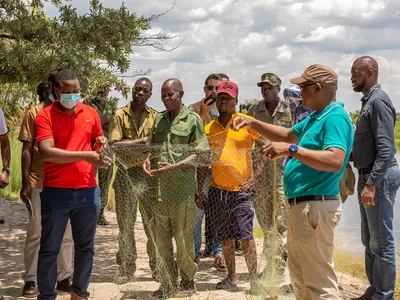
The Cuando Basin is a data scarce region making it challenging to make informed decisions on sustainable management and development of the natural resources. There is an urgent need to enhance monitoring and evaluation of climate and environmental variables through improved data collection.
© WWF Zambia
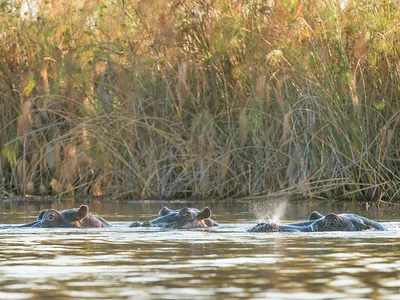
Wildlife and natural resources are economic drivers in the area and provide incentive for collaborative management amongst the countries. Collaboration includes agreements among conservancies to allow for wildlife corridors, movement away from floodplains to remain secure habitats for wildlife, implementation of conservation agriculture practices, and other holistic land management techniques.
© Patrick Bentley / WWF-US
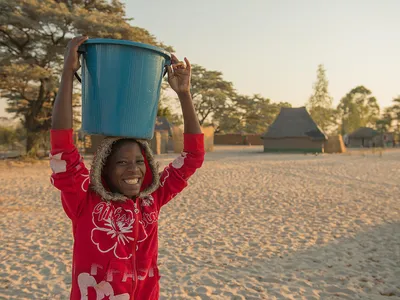
Across the Cuando River Basin, access to clean water and sanitation services varies significantly. Without consistent sanitation and water access, water-borne disease can spread, harming human health and well-being and potential for human development and economic growth.
© Gareth Bentley / WWF-US
Future planned development might threaten the health of the basin. It is critical to identify and protect all key freshwater and biodiversity areas in the Cuando Basin, especially in the headwater area, before further damage or degradation occurs. The efforts to coordinate this protection among the four countries can act as a living example for further implementation of transboundary water governance.