Erin Schmidt
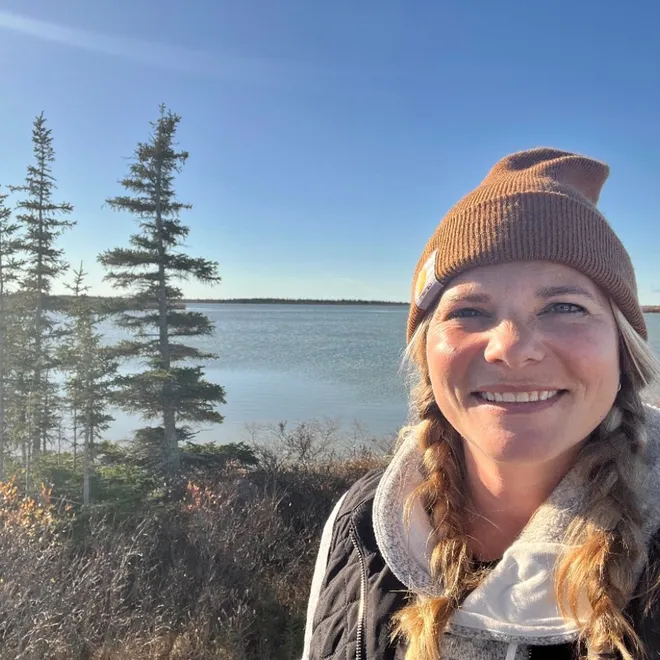
Erin Schmidt, a science teacher at Totino-Grace High School in Fridley, Minnesota, brought the Arctic to life in her classroom after earning a Natural Habitat Adventures Churchill Polar Bear Scholarship Grant, transforming her immersive wildlife and ecosystem experience into a powerful, student-driven exploration of climate change.
© Erin Schmidt
My name is Erin Schmidt, and I have spent the past 23 years teaching biology, ecology, and forensic science at Totino-Grace High School in Fridley, Minnesota. This past October, I had the incredible opportunity to travel to Churchill, Canada, as a recipient of the Polar Bear Scholarship Grant with Natural Habitat Adventures. I spent an unforgettable week searching for polar bears, beluga whales, and Arctic hares, witnessing the northern lights, and exploring the unique history and ecosystems of the region.
Seeking to involve my students in this adventure, I spent time before my departure introducing them to my destination, the unique ecosystem I would be exploring, and the wildlife I expected to encounter. After conducting their own research, students created a 'Post-It Note Challenge', in which each student tasked me to 'Do, Document, or Ask' something specific while I was on the tundra in Churchill.
I brought these Post-It notes with me and completed as many challenges as possible, sharing the results on my school Instagram account and giving each student a shout-out upon completion. This became a major highlight of my return; the students were thrilled to see their challenges accomplished and their questions answered. You can check them out on Instagram @Schmidt.303.

© Erin Schmidt

© Erin Schmidt

© Erin Schmidt
With my final ecology unit of the semester focusing on climate change, I knew I wanted to incorporate what I had learned, observed, and experienced in the Arctic into my students’ final project, titled 'The Story of Our Changing Planet: Creating Art with Climate Data.' I developed this lesson inspired by Ed Hawkins' 'Climate Stripes', a visual representation of global temperature changes from 1850 to 2024. Each stripe represents the average temperature for a single year relative to the 1961 to 2010 average. Shades of blue indicate cooler-than-average years, while red indicates years that were warmer-than-average. The darker the color, the further that year's temperature deviates from the baseline average.
Students chose from a variety of climate change datasets to create their own "climate stripe" artwork. One group creatively displayed the decrease in the estimated number of polar bears in Western Hudson Bay, and another group showed the stripes of the annual increase of ice-free days in the region. After completing their artwork, students participated in a gallery walk where they shared their work with their peers, explaining the causes and effects behind the data. The presentations ended with a call-to-action to encourage others to make smarter choices for our planet.
By using the WWF website, students explored the broader impacts of climate change and gained a deeper understanding of the specific threats facing the Arctic and its wildlife. WWF proved to be a valuable and credible resource, providing clear, accessible information that supported students in developing their call-to-action messages that encouraged lifestyle changes, reduced carbon footprints, and advocacy for sustainable environmental policies.
Making students part of my Arctic adventure sparked their curiosity and deepened their interest in the topic, helping them feel personally connected to the issue. This personal connection, combined with the trusted information and guidance provided by WWF, resulted in students becoming more invested and passionate about their learning. The dedication and sense of responsibility students demonstrated through their artwork and calls to action was both inspiring and hopeful, reinforcing the importance of engaging young people in real-world environmental and conservation learning experiences.