Tiger timeline

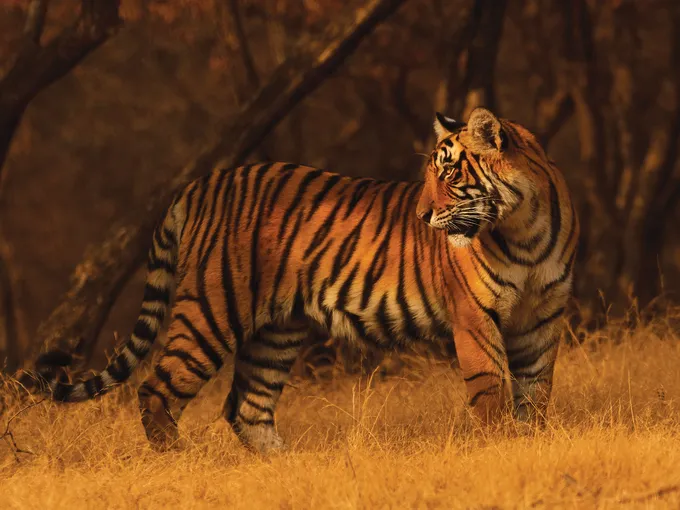
© ANDY ROUSE/NATUREPL.COM
2010
An estimated 3,200 wild tigers exist worldwide. At the Global Tiger Summit in St. Petersburg, Russia, governments of all 13 tiger range countries set a goal, known as TX2, of doubling the wild tiger population by 2022.

© Marina Khrapova / WWF-Russia
2011
Nepal’s Chitwan National Park marks a full year with no tigers lost to poaching.
2012
A survey confirms that tiger numbers have doubled in Nepal’s Bardia National Park since 2009, evidence that doubling wild tigers is possible with political support.
2013
The Conservation Assured|Tiger Standards—a framework for tiger site management—is set at the Asia Parks Congress in Japan.
Tigers likely go extinct in Lao PDR.
2014
WWF opens an office in tiger range country Myanmar. Preventing wildlife trafficking, including tackling the illegal tiger trade, is a top priority.
India’s tigers make a major comeback: Their population estimates rise to 2,226— an increase from 1,706 in 2010—largely due to better management of protected areas and increased protections for the species.
Nepal becomes the first tiger range country to achieve zero tiger poaching for a whole year.

© naturepl.com / Vivek Menon / WWF
2015
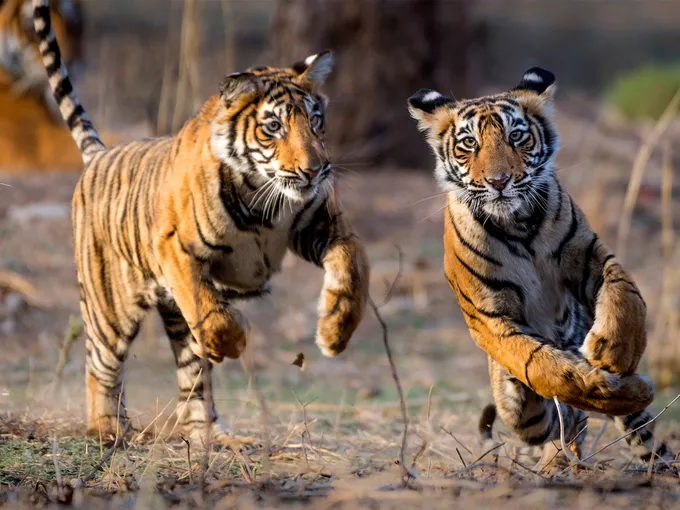
WWF captures footage of a tiger and her cubs in Wangqing, China, almost 20 miles from the Russian border—proof that wild tigers are once again breeding in China.
A nationwide survey estimates there are 103 tigers in Bhutan.
2016
After a century of declining numbers, new evidence shows that around 3,900 tigers exist in the wild.
Governments of tiger range countries commit to enacting legislation to stop poaching and the illegal trade of tigers and their parts.

© Ola Jennersten / WWF-Sweden
Tigers are declared functionally extinct in Cambodia. The country’s last known tiger was photographed by a camera trap in 2007.
2017
Bhutan is the first tiger range country to launch a national SAFE Systems strategy, an integrated approach to managing human-wildlife conflict in a landscape.
China announces the creation of Northeast Tiger and Leopard National Park—60% larger than Yellowstone—with a goal of protecting critical habitat for Amur tigers.
Six newborn tiger cubs are photographed in Thailand’s Mae Wong and Klong Lan National Parks, inspiring renewed hope for the country’s critically endangered tigers.
Seventy years after the extinction of tigers in Kazakhstan, the country embarks on a project with WWF-Russia to reintroduce the big cats to the country.
2018
WWF launches Bhutan for Life, an innovative sustainable financing model to finance the country’s conservation efforts—including tiger conservation—in perpetuity.
With 235 tigers, Nepal is on track to double its wild tiger population, up from 121 in 2009.
WWF-Malaysia launches Project Stampede, a collaboration that trains and employs Indigenous communities to conduct antipoaching patrols in the Belum-Temengor forest.

© WWF-Malaysia
2019
A study finds no trace of tigers in Lao PDR since 2013.
WWF engages farmers in a project in India’s Satpuda-Pench corridor to encourage more sustainable cotton production, thereby securing an important tiger corridor and more prosperous livelihoods for local communities.
It’s estimated that Malaysia’s wild tigers number fewer than 200 and could be at risk of extinction. Poaching is the largest threat to their survival.
In partnership with WWF and TRAFFIC, tech companies in the Coalition to End Wildlife Trafficking Online reported, removed, or blocked over 3 million listings of endangered and threatened species (including live tigers) and associated products from their online platforms between 2008 and 2020.
2020
India announces it will adopt Conservation Assured|Tiger Standards across all its tiger reserves.
2021
The first-ever tiger camera trap survey in Sumatra’s Thirty Hills ecosystem restoration concession is conducted.
IWWF-China estimates a potential recovery population of up to 300 Amur tigers in northeast Asia.

© Mihir Mahajan / WWF-International
A tiger is documented at a record-high elevation in Nepal, indicating that the country’s tiger range extends beyond the Terai Arc Landscape—farther than scientists once thought.
2022
The Chinese zodiac’s Lunar Year of the Tiger begins on February 1.
In September, the second Global Tiger Summit in Vladivostok, Russia, marks the official culmination of the TX2 initiative.

© naturepl.com / Andy Rouse / WWF
© Philippe Oberle / WWF
Explore more
Keep reading this issue of World Wildlife magazine