Champions of the Great Sea Reef
The Great Sea Reef that hugs Fiji’s northwestern shores is a biodiversity hotspot and deeply important to the country and its people. Sometimes called Bainivualiku, “protector of the North,” it serves as a massive natural seawall shielding the islands from wave breaks and storm surges. It also provides daily sustenance to coastal communities and drives the tourism sector that is Fiji’s leading economic activity.
“A healthy reef equals healthy people, a healthy economy, a healthy Fiji,” says Duncan Williams, program manager for sustainable fisheries and seafood at WWF-Pacific.
WWF-Pacific works across three island nations—Fiji, Papua New Guinea, and the Solomon Islands—to address global and regional issues affecting the ocean and the reef, including driving to end industrial overfishing and bycatch through long-standing relationships with the tuna industry, regulatory bodies, and governments.
Complementing these efforts are vital initiatives on the ground and in the sea. With WWF’s support, coastal communities are combining traditional knowledge and contemporary conservation science to sustainably manage natural resources and adapt to the impacts of climate change.
Meet a few of the conservation champions who are leading the way in localized efforts to protect their protector.
Nacula District, Ba Province
Lavenia Naivalu made waves at the United Nations Climate Change Conference in 2023 by speaking candidly about the impacts of climate change on her home district of Nacula, where she led with a focus on attaining food and water security. She and her constituents work with WWF to restore natural resources and reduce the risk of food insecurity through seed banking and other initiatives.
“My grandfather used to fish along our coastline in the village. Nowadays, my children walk for miles to get fish for a family meal. Sometimes what comes to my mind is: What did my children do wrong? We did not build any tall buildings. We did not dump any nuclear waste into the sea. That’s the kind of stuff that fuels me up to keep pushing and advocating for my people and my children.”

© _
Tavua District, Ba Province
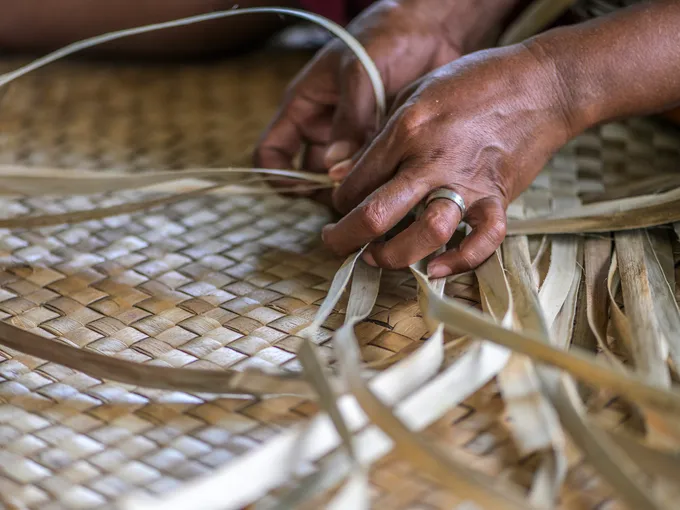
WWF is helping coastal communities in Ba Province adapt to climate change by developing alternative livelihood skills, like weaving, that relieve pressure on natural resources and can generate savings to draw on in the face of cyclones, droughts, and other natural disasters. WWF volunteer Meri Vauvau helps women in Korovou Village achieve financial literacy. In what is still largely a subsistence economy, concepts like savings, insurance, and investing are new.
“Today, our women know how to budget and use money wisely. They have been financially empowered, because they realize how important it is to save. Come a natural disaster, they will be prepared.”

© _
Macuata Province
WWF works with communities in Macuata Province to protect critical habitats like mangroves and turtle nesting beaches and with farmers to reduce chemical runoff and other pollutants that can damage marine environments. Nature-based tourism operators like dive master Leone Vokai depend on a healthy reef for their livelihoods. In addition to raising its profile with divers, Vokai organizes environmental education programs for local youth and assists WWF and other NGOs with their work.
“The ocean is our life. My hope [is that the] Great Sea Reef will remain the same, so my son can see what I see. But a lack of information about farming or rubbish—you know, you throw your rubbish out your car door and it ends up on the reef—can change everything. If we don’t look after what we are doing on the mainland, we will damage the reef and it will come to be just a story.”

© _
© MIKE HILL/GETTY IMAGES
Explore more
Keep reading this issue of World Wildlife magazine