Meet the aye-aye, the world's weirdest primate
Face of possum, tooth of mouse, ear of bat—it’s not a line from Macbeth, but it just might describe the world’s weirdest primate. Meet the aye-aye (Daubentonia madagascariensis), a lemur so singular that it has its own taxonomic family (read: no next of kin). Oh, and did we mention that middle finger? Let’s take a closer look.

© JOEL SARTORE/NATIONAL GEOGRAPHIC PHOTO ARK
They who must not be named
According to local lore, aye-ayes bring bad luck and death and must be killed on sight. This has led to the death of so many that they are now protected by law. Some researchers believe aye-aye comes from the phrase “I don’t know” in Malagasy, which may be because locals were afraid to speak the name.
Late-night munchies
The world’s largest nocturnal primate, this lemur spends the night eating and traveling the forest canopy, occasionally descending to the ground and exploring human areas. During the day, aye-ayes sleep in elaborate, spherical nests made of leaves and branches.
First impressions
RANGE Madagascar’s east coast and northwestern forests
SIZE Body: 14"–17"; tail: 22"–24"
WEIGHT 4 lb.
DIET Mostly insects and grubs; also nuts, nectar, fungi, and fruits
STATUS Endangered, though recent research suggests higher numbers than previously thought
THREATS Hunting, loss of habitat
© JOEL SARTORE/NATIONAL GEOGRAPHIC PHOTO ARK
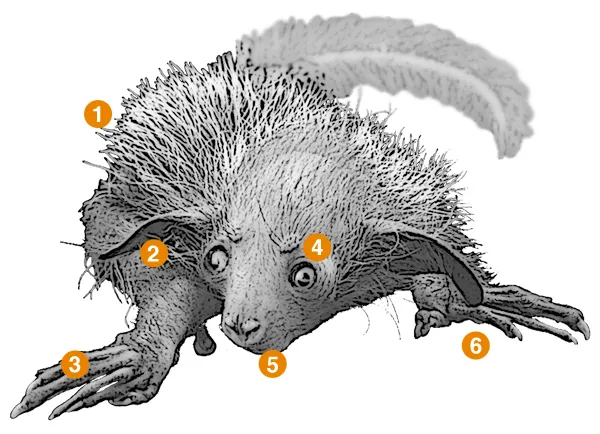
1 FUR When threatened or excited, the aye-aye raises its guard hairs and appears to double in size.
2 EARS Bat-like ears help the aye-aye find food. These sensitive organs can detect hollow areas in trees via echoes made when the animal taps on wood, a method called percussive foraging.
3 FINGER The aye-aye uses its skeletal middle finger to tap on branches as it searches for wood-boring grubs—and then to hook and pull them out. The finger has a ball-and-socket joint, giving it a wide range of motion for reaching prey or scooping out coconuts.
4 EYES Big, round eyes help the nocturnal animal see at night.
5 TEETH Researchers originally thought this lemur was a rodent because of its constantly growing incisors. Used for tearing into trees to get to grubs, these teeth are strong enough for aye-ayes to chew through cinder blocks.
6 TOES The aye-aye can hang from branches thanks to its opposable big toes.

© LUIS BARRETO/WWF-UK
Explore more
Keep reading this issue of World Wildlife magazine