What are nature-based solutions?

© JÜRGEN FREUND/WWF; © PAUL MCKENZIE/WWF-HK
Nature had its day in the sun last November at the global climate talks in Glasgow.
As WWF and others called for world leaders to put nature front and center in efforts to tackle the climate crisis, countries heeded the cry. A WWF report released at the conference found that 92% of new national climate action plans include measures to tackle nature loss—up 10% from just four months earlier.
Research indicates that wielding the immense power of oceans, forests, and other ecosystems to absorb carbon dioxide could deliver up to 30% of the climate mitigation needed by 2050 to achieve the Paris Agreement goal of limiting warming to below 2ºC (3.6ºF).
At WWF, we define NATURE-BASED SOLUTIONS as efforts that protect, restore, and sustainably manage land and ocean ecosystems (such as forest peatlands, wetlands, savannas, coral reefs, and mangroves) while simultaneously addressing societal challenges (such as climate change, Indigenous and community rights, economic inequality, and overconsumption of natural resources).
In fact, there is no path forward without protecting and restoring nature.
The climate crisis and the biodiversity crisis are inextricably linked, explains Josefina Braña Varela, WWF vice president and deputy lead for forests. “Any meaningful solution has to address both at once.”
Take tropical deforestation, for example. Not only does the loss of tree cover destroy essential habitat for innumerable species, remove natural pollinators from agricultural fields, and pull much-needed forest products and other services away from local communities, but it also releases massive amounts of planet-warming greenhouse gases. If there were a country whose yearly CO2 emissions were equal to those released annually by tropical deforestation, it would rank as the third-largest emitter in the world, trailing China and the United States. And as the climate changes, the incidence of forest fires increases, driving further losses. If tropical deforestation continues at recent rates, it will be nearly impossible to meet the 2°C goal set in Paris.
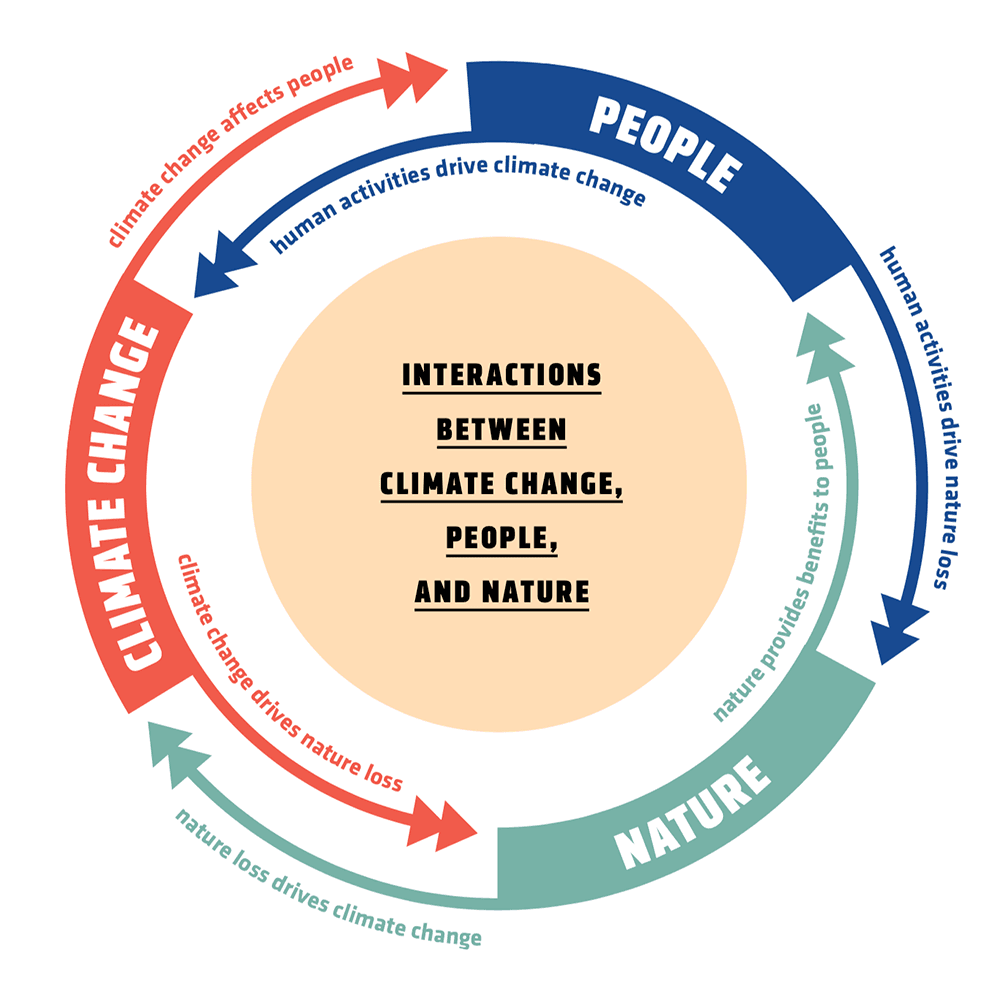
So in that problem—deforestation and forest degradation—lies the solution: If we keep forests standing, we sequester carbon and reduce emissions. At a broader scale, protecting, managing, and restoring natural and altered ecosystems—from the Amazon to the Arctic, from seabeds to grasslands—are nature-based solutions to the climate crisis that can provide added benefits— such as food security, public health, and clean drinking water.
“The climate crisis has given us an opportunity to step back and look at humanity’s relationship with nature and the ecosystems that support us,” says Marcene Mitchell, WWF’s senior vice president for climate change. “Nature-based solutions embody the need to shift from separate conversations about addressing biodiversity, climate, or water to a more holistic approach—one that moves us toward a sustainable living environment for all life on Earth.”
Greater Good
“Nature-based solutions are often seen as just being about climate mitigation or offsets,” says Lucas Black, WWF vice president for climate finance. “But for us, they’re about a long-lasting relationship with a landscape or a seascape that addresses financing needs in their entirety and creates multiple benefits for people. Climate mitigation is just one of many benefits.”
Braña Varela agrees. “Serving people and nature is a central part of our work, along with climate impacts,” she says. “For example, we need to ensure that the frenzy around carbon markets doesn’t lead to a disregard for Indigenous rights.”
“We need long-lasting partnerships on the ground,” says Braña Varela, “with an eye to balancing the needs of nature, people, and climate. It’s the difference between measuring carbon only versus ensuring benefits are shared with local people, monitoring whether biodiversity is increasing, assessing the trade-offs, etc.”
“We have to also look at water provisioning and quality, soil health—we look at the benefits and risks in the entirety,” says Black. “It’s not just tons of carbon sequestered or avoided emissions, it’s greater good, valuing and protecting natural capital on the ground based in rigorous science and metrics.”
WWF’s Approach
In practice, WWF’s approach to nature-based solutions is holistic, landscape-based, and community-centered. Ensuring that interventions deliver real, lasting gains for nature and people requires
- deep engagement with local governments and communities
- concepts and plans that use the best science and metrics available
- clear, measurable goals that quantify impact
- forward-looking plans that ensure project interventions are self-sustaining and provide the intended benefits well into the future
Carbon Accountability
Carbon credits (also referred to sometimes as “carbon offsets”) can be another way to promote nature-based efforts to reduce greenhouse gas emissions. A carbon credit is a virtual unit representing the ability to emit one ton of CO2. So carbon credit projects can either sequester carbon from the atmosphere in quantifiable amounts or prevent carbon from being emitted in quantifiable amounts. These units can be sold to buyers—corporations, governments, individuals—who may want to comply with government policies or use them toward voluntary sustainability goals.
For example, let’s say a farmer in North Carolina has 100 acres of peatland, and the farmer invests in both the science to measure how much carbon the peatland is storing and in protecting the peatland from being disturbed in a way that would cause the carbon to be released. If the project meets the right requirements, it can be enrolled in a carbon crediting program.
Other common types of projects that can be financed through carbon credit programs include improved cookstoves, landfill gas mitigation, and interventions that harness the natural carbon storage potential of landscapes and seascapes, like terrestrial reforestation or mangrove restoration.
To be effective, carbon credits need to be priced appropriately and must reflect the true social costs of carbon, says WWF’s Braña Varela. But ultimately, she says, “there is no longer any room for excuses and avoiding action. We have to stop emitting and move toward nature-based solutions across the board.”

© TOM VIERUS/WWF-UK
“We need long-lasting partnerships on the ground, with an eye to balancing the needs of nature, people, and climate.”
JOSEFINA BRAÑA VARELA
WWF Vice President and Deputy Lead for Forests
Steering the momentum
In addition to garnering the attention and backing of governments around the world, nature-based solutions have secured billions in investments from the private sector.
The momentum is promising. Yet while nature has a powerful role to play in mitigating climate change, it’s not a silver bullet, cautions Martha Stevenson, WWF’s senior director of strategy and research for forests. “It’s vitally important that nature-based solutions not take the place of ambitious reductions in emissions on the part of the public and private sectors,” she says.
For those governments and businesses that have already committed to reducing their carbon footprints and are looking to do more, WWF can play an important role. “We are uniquely positioned to provide science-based guidance and standards,” Braña Varela says, “and to demonstrate what integrity looks like through the development of a robust pipeline of high-quality on-the-ground interventions.”
“With science as our North Star, we hope to harness our powerful partnerships and relationships, our technical expertise, and the credibility of our brand to turn the tide for nature and climate through a landscape- and rights-based approach,” she says. “When implemented effectively, nature-based solutions for climate mitigation can enhance rural livelihoods and promote the value of forests and other critical ecosystems while also helping to reduce people’s vulnerability to, and build their resilience in the face of, climate change events.”
She emphasizes that conservation interventions must center on people. “This includes creating the conditions for the full participation of Indigenous peoples and local communities and demonstrating the diverse benefits of these interventions in a measurable way.”
Nature-based funding goals
Annual investments will have to triple by 2030 and increase four-fold by 2050
-
$133 billion current funding
Current annual (2020) funding level is $133 billion
-
$399 billion annual in 2030
$399 billion annual funding needed by 2030
-
$536 billion annual in 2050
$536 billion annual funding needed by 2050
All hands on deck
Currently, nature-based solutions receive roughly $133 billion in funding each year, mostly from public sources. But according to the United Nations Environment Programme (UNEP), if the world is to meet targets around climate, biodiversity, and avoiding land degradation, financing for nature-based solutions will need to reach a total of $8.1 trillion by 2050. In short, this means that at current funding levels, we’ll only get halfway there.
“Addressing the biodiversity and climate crises requires all hands on deck,” says Braña Varela. For WWF, this means collaborating with corporate, government, and private partners to bridge the financial gap and develop innovative and exemplary nature-based solutions.

© WWF-MALAYSIA/MAZIDI ABD GHANI
Cases in point
Restoring a forest
Since 2019, technology company HP Inc. has helped fund forest restoration in Brazil’s Atlantic Forest, with the goal of restoring more than 1,000 acres. To date, more than 66,000 tree seedlings have been planted and 37 freshwater springs have been protected on 313 acres in collaboration with rural landowners and dozens of local organizations. WWF planning and analysis ensures restored plots knit together to enhance the entire region, with the aim of helping the landscape supply more water to its human and animal inhabitants while trees sequester planet-warming carbon dioxide.
In October 2021, HP announced an $80 million expansion of its partnership with WWF, seeking to restore, protect, and improve the management of nearly 1 million forested acres around the world by 2030. The company has already addressed its own direct environmental impacts— committing to carbon neutral operations by 2025, for example, and ensuring that its own paper and paper-based packaging are deforestation-free and come from Forest Stewardship Council®-certified and recycled sources. Now HP has set out to defray the impacts of the 17 million metric tons of paper projected to pass through its printers over the next 10 years—regardless of whether that paper is produced by HP.

© WWF
Fast-tracking solutions
A transformative $100 million grant to WWF from the Bezos Earth Fund aims to accelerate some of the most promising nature-based solutions. The 2020 grant supports three types of work: protecting and restoring mangroves in Colombia, Fiji, Madagascar, and Mexico; developing new markets for seaweed, such as for animal feed and biodegradable plastics; and protecting forests and other ecosystems that can harness the power of nature to stabilize the climate.
Projected impacts include:
- PROTECTING, RESTORING, AND STRENGTHENING MANAGEMENT OF MORE THAN 2.4 MILLION ACRES OF MANGROVES, which store 1.8 billion metric tons of carbon and make coastal communities more climate resilient
- DRIVING DEMAND AND SUPPLY FOR SEAWEED as a source of protein and bioplastics, resulting in significant greenhouse gas reductions and providing income to coastal residents
- ENSURING LASTING PROTECTIONS FOR MORE THAN 130 MILLION ACRES OF CRITICAL ECOSYSTEMS, thereby reducing vulnerability to climate impacts such as flooding for 14.2 million people who live within those ecosystems

© WWF
Implementing sustainable land-use practices
A public-private partnership launched in Peru in 2017 with the support of the Norwegian Agency for Development Cooperation (Norad) aims to reduce deforestation in the Amazonian province of Tahuamanu, an agricultural frontier. A pilot program led by WWF and local and regional governments and organizations engaged 10 local ranchers in identifying and implementing best practices to increase productivity while decreasing forest clearing and other ecological impacts of livestock management.
The livestock producers not only transformed their own practices; they set the stage for large-scale change. Through the efforts of pilot participants and with the backing of the Ministry of Agricultural Development and Irrigation and other state actors, 200 additional ranchers have received support to implement the identified best practices.

© WWF
“We cannot address the climate crisis without also addressing the nature crisis. these twin challenges are inextricably linked, which is why we are doubling down on solutions that solve for both—ones that make peoples’ lives better now and in the future.”
ANDREW STEER
President and CEO, Bezos Earth Fund
© Nils Aukan / WWF-Canon
Explore more
Keep reading this issue of World Wildlife magazine