Tracking bonobos in the wild
In Salonga National Park, coexistence, opportunity, and conservation

© WWF-DRC
It’s 5am in the forests of Salonga National Park and a team of bonobo trackers mobilizes to head into the forest. Their goal? To find bonobos in their nests and, once found, follow these extraordinary primates and one throughout the day, without causing the animals stress or prompting them to flee.
For the past 18 months, the team of eight trackers has followed the same daily routine. Their gentle approach, based on patience and repetition, is beginning to pay off: They can now approach the bonobos at close range for extended periods, observe social interactions, and gather valuable data on individual behavior, including photos and video. Soon, the trackers hope to follow the bonobos from sunrise to sunset.
What habituation means
The tracking is a critical step for bonobo habituation, which is the process of ensuring an animal is at ease in the presence of humans. Why habituate bonobos or other primates in the wild? Because habituation helps researchers and opens the door to eco-tourism, allowing visitors to see these animals in a way that is safe for both humans and wildlife. The bonobos are at ease and humans keep their distance and follow procedures—such as masking—that keep bonobos safe from human disease.
Sustainable wildlife tourism brings employment opportunities to local communities, helps keep forest ecosystems intact, and raises funds for conservation—protecting bonobos and their habitats for the long term.
A three-step method
Salonga is Africa’s largest forest park and home to about 40% of the world’s bonobos. The Bonobo Habituation Project, established by WWF in 2023, aims to foster coexistence between the bonobos and humans and create opportunities for bonobo-based tourism in the region.
Before the project began, the bonobos were located solely by their vocalizations. Any encounter with humans ended in bonobo panic and flight. Today, the animals are observed for hours at a time and are visibly less stressed, more curious, and increasingly tolerant towards human presence.
The secret to success lies in three key steps: identifying and understanding the groups and subgroups of bonobos, strengthening the trackers' skills in habituation techniques, and establishing a lasting climate of trust.
Eight facts about bonobos
- Bonobos are the only great apes led by females.
- Bonobo society is egalitarian: They form sophisticated social structures and alliances to produce peace and cooperation.
- Chimps and bonobos are more closely related to humans than they are to gorillas.
- Bonobos are one of the four great apes: a separate species from chimpanzees, gorillas, and orangutans.
- Bonobos are usually, smaller, leaner, and darker than chimpanzees and weren’t identified as a separate species until 1929.
- They prioritize social relations and are known as the “make love not war ape,” as they choose sex over aggression. They’re also naturally bisexual and enjoy sexual behavior, not just for copulation.
- Bonobos only give birth to a single offspring every four to six years (sometimes longer), then nurse their young for up to five years. As a result, bonobo populations don’t bounce back quickly because they are not reproducing at a fast rate.
- Unlike chimps and gorillas, bonobos don’t have to compete for food with other primates. Living south of the Congo River, they are separated from other apes living north of the river.
Getting to know bonobos
Bonobos, like chimpanzees, are humankind’s closest living relatives, sharing 98.7% of human DNA. They live in complex communities that, unlike other primates, are female-led and often divide into subgroups for certain jobs, such as searching for fruit during the dry season.
For scientists, the number of subgroups and the primates’ remote location make determining the number of individuals and their social composition a major challenge. But thanks to meticulous observation, the trackers in Salonga have identified a group and subgroups of individuals in the park, allowing for daily monitoring.
"When an entire family gets used to the presence of humans, it becomes easier to integrate other individuals into the [habituated] group,” says Elisabeth Bru, a primatologist working with the Bonobo Habituation Program, “Because bonobos imitate the behavior of their already accustomed peers."

© naturepl.com / Theo Webb / WWF
Encouraging results
These advances in habituation pave the way for responsible tourism, focused on conservation and respect for the animals. Tourism infrastructure—lodges, restaurants, and offices—are currently under construction in the Salonga region. It’s another substantial step towards a future that helps the endangered bonobo population and the local communities.
How you can help
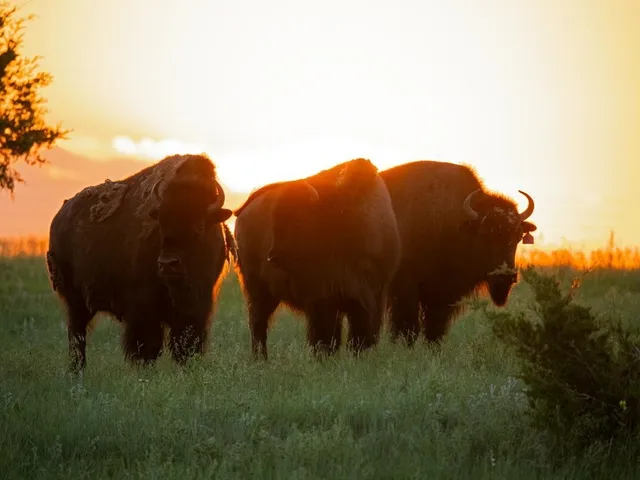
© WWF-US/Clay Bolt
Support Tribes restore buffalo to the Great Plains
The Indian Buffalo Management Act would strengthen support for Tribal Nations who are working to bring buffalo back from the brink of extinction.