Delaying deforestation policy won’t delay its impacts
Here’s the business case for staying the course
Deforestation’s impacts on businesses and ecosystem resilience are already here. And despite shifting timelines, the risks are too great for companies to delay their efforts toward achieving deforestation-free supply chains. Fortunately, the direction we need to travel is clear; the rest comes down to taking action.
By
-
Jamie Bindon,
-
and Martha Stevenson

© Brent Stirton / Getty Images / WWF-UK
The agriculture and forest sectors stand at a decisive moment that will shape the trajectory of efforts to end deforestation. The Science Based Targets initiative (SBTi) recently opened a public consultation on required deforestation commitments under its Forest, Land and Agriculture (FLAG) Guidance. At the same time, the European Union Deforestation Regulation (EUDR)—which was slated to go into effect at the end of this year—faces a pivotal legislative moment that could lead to an additional year of delay, contributing to various interruptions in implementation and enforcement.
It is critical that leading companies make their voices heard in both these arenas. While policy timelines around deforestation may be shifting, the physical consequences of deforestation are not waiting. For companies in food and agriculture, the impacts of deforestation—on crop yields, climate stability, and supply chain reliability—are already unfolding. The danger lies in assuming that policy delays will buy time. They won’t.
Nature operates on its own clock. When forests are cleared, soil degrades, water cycles are disrupted, climate risks intensify—especially heat exposure. These changes directly affect agricultural productivity and sourcing stability, posing real threats to business continuity. The longer companies wait to act, the more vulnerable their operations become, and the closer we inch toward tipping points.
Today, the pressure to eliminate deforestation from supply chains is mounting. Deforestation-free supply chains aren’t solely a climate or nature issue—they’re a business resilience imperative. Companies that move now will be better positioned to navigate future disruptions, protect long-term land viability, and meet rising expectations for sustainability and transparency. That said, deforestation is a systemic issue, and we need many different actors to come together to implement these changes. We need leaders to keep leading, AND we need to reach deeper into value chains, bringing new actors into the fold.
Taking Action
The SBTi launched a public consultation on updates to its FLAG Guidance that will enable companies to continue setting FLAG targets with no-deforestation commitments. There are already 350 companies with FLAG targets. That number has been rapidly increasing since the guidance brought land-sector emissions (including deforestation) into company targets for the first time in 2022.
Key proposed FLAG no-deforestation commitment updates include:
- Allowing new companies to set no-deforestation commitments after the current December 2025 deadline, giving them an additional two years to keep building momentum on deforestation action
- A requirement for companies to use a deforestation cutoff date preceding FLAG target submission
- An updated commodity list including cattle, cocoa, coffee, palm oil, rubber, soy, and timber
- Clarified requirements for public documentation that demonstrate implementation of no-deforestation commitments
© anderm / iStock
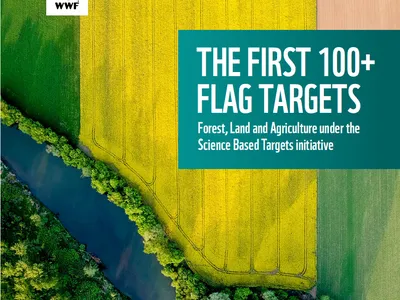
Read WWF’s report on emerging land-sector mitigation lever trends across targets set under the initial FLAG Guidance.
Stakeholders can review the proposed revisions and provide input via a public consultation survey, which is open until November 6, 2025. The reality of these issues is complex across sectors and markets—which is why it’s critical everyone weighs in with their perspectives. Those who engage now will help shape standards and demonstrate their leadership.
In parallel with updates to FLAG, the European Commission has proposed potential delays in the EUDR’s implementation requirements for certain company categories and in its enforcement. Despite these possible delays, many companies have prepared themselves to meet EUDR requirements on deforestation—and they’re right to stay the course. EUDR alignment is more than legal compliance—it’s a strategic advantage. The EUDR has already been a catalyst for investments in supply chain traceability. On top of that, the requirements help companies secure EU market access, meet science-based targets, and build trust with investors and customers.
While the EUDR legislative process is still in flux, acting now to ensure readiness for compliance and shaping voluntary approaches—like the SBTi and Science Based Targets Network (SBTN)—positions companies for success ahead of uncertainty.
So, what practical steps can companies take to engage today?
- Contribute to the SBTi FLAG public consultation by reviewing and commenting on proposed revisions.
- Continue to prepare for EUDR implementation and reinforce public no-deforestation commitments.
Deforestation-free supply chains are central to delivering on climate and nature commitments for the land sector and for maintaining market access. FLAG Guidance revisions and EUDR compliance are opportunities to future-proof supply chains and lead on land-sector climate action.
With thanks to additional contributors: Stephanie Cappa, Amy Smith, Claire Jones, Victoria Markovitz, and Megan Moreno
Stay up to date
© WWF-US / Darren Higgins
Connect with Sustainability Works on LinkedIn
Stay current with insights from sustainability leaders and rising stars—fresh ideas, technical depth, and bold thinking across industries.