From risk to resilience: how we can reach a nature-positive ocean



By
-
Alanna Waldman Carrow,
-
and Lauren Lynch
As we cross into the second half of the United Nations Ocean Decade—a critical moment to act for the ocean—it’s a timely moment to pause and reflect on global progress toward key goals. The science is clear: healthy marine and coastal ecosystems and a stable climate are essential to community livelihoods, food security, and a healthy global economy. And yet, we are sorely missing the mark—only 18% of the global Sustainable Development Goals are on track. And today, the Sustainable Development Goal for the ocean—Life Below Water—remains the least funded of all goals, climate change is accelerating (IPCC 2023), and ocean biodiversity continues to decline.
Despite these trends, there are still reasons for optimism in our ability to reach collective goals, including for nature. Some private sector leaders—including those who operate in the ocean or on coastlines ( the “blue economy”)—are paying attention to the risks that nature loss poses to their business, and working on nature assessments and disclosures, target setting, and initial steps towards nature transition planning.
These risks include:
Physical risks
Physical damage to business assets (buildings, materials, production sources, means of transportation, etc.), often related to the impacts of climate change.
Operational risks
Interruptions to ongoing business activities, including supply chain operations, logistics and transportation, labor, etc.
Regulatory risks
Changes in the regulatory environment affecting the sector that affect compliance costs, and/or whether and how it may be taxed or subsidized.
Reputational risks
Changes in public perception of a sector or company that manifest as negative public campaigns, boycotts, or other changes to purchasing decisions.
Market risks
Changes to demand for a good or service as a result of changes in the broader market (e.g. supply increases, technological innovations, changes in consumer sentiment, etc.) (UNEP FI TTT)
By identifying and managing these risks, companies can begin to better set themselves up for long-term business success. What’s more, companies with a strong risk management foundation have a significant opportunity to go further and identify and invest in ways to contribute to positive outcomes for nature, for both their own benefit and the benefit of society writ large. For example, restoration and regeneration of ecosystems like corals and sea grasses can support sustainable supply chains like healthy fish stocks as well as ensure coastal resilience to extreme weather events.
So what can the private sector do for nature and the ocean to help create the future we know we need? The galvanizing term “nature positive”—which refers to the global goal for nature—begins to point the way. Nature positive means halting and reversing biodiversity loss by 2030, with the aim of full recovery by 2050, aligned with the mission of the Kunming-Montreal Global Biodiversity Framework. Achieving the nature-positive goal for the ocean—the largest habitat on Earth, a collective source of inspiration, and an economic engine—is fundamental to achieving our global goals for people and planet. Despite this, available guidance for nature-positive approaches in marine and coastal environments has lagged behind those for land and freshwater.
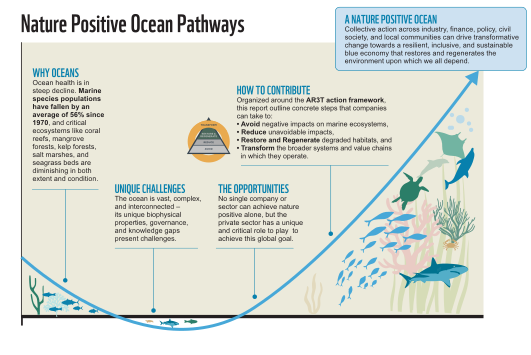
Contributing to a nature-positive future for the ocean is possible—and WWF’s recent report, Towards Nature Positive for the Ocean: Pathways for Corporate Contributions, shows companies in the ocean economy how. The report offers a clear entry point for companies to credibly contribute to this global goal, providing targeted recommendations for key sectors—offshore wind, coastal and marine tourism, shipping, and seafood— recognizing the interconnections among them. The report also grapples with the complexity of the ocean—including its size, constant movement, and how decisions are made about it—pointing the way toward clear, science-based, and practical actions that can be tailored to unique contexts.
The use of a credible science-based tool—known as the “AR3T”—is critical to this journey. Companies can play a key role by implementing actions to Avoid and Reduce impacts on biodiversity – thereby reducing risks, as well as Restore and Regenerate ecosystems – shoring up long-term business resilience, in line with increasing expectations from investors and governments for nature disclosures and action. At the same time, they can Transform systems, including by mobilizing finance, advocating for policy, and collaborating with scientists, communities, and civil society to shift incentives toward a more sustainable, resilient, and prosperous future.
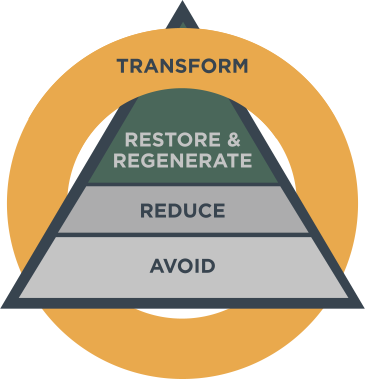
© Science Based Targets Network. The AR3T Action Framework
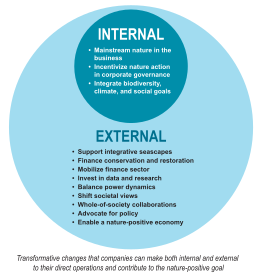
Transformative change is essential to putting us on a positive trajectory for nature, and businesses have a key role to play.
Transformative change may seem daunting, but it is possible and urgent. There are transformative actions that companies can take both within and outside of their direct operations, which not only reduce risks but can unlock more than US$10 trillion in business opportunity value.
Tools, resources, and incentives are now increasingly available for companies to take action for a nature-positive ocean. There is no time to waste.