
What the UN Decade of Sustainable Transport means, and why it matters
Around the world, transportation infrastructure connects people and drives economies. But when poorly planned, it fragments habitats, increases emissions, and weakens resilience. And right now, we’re living in the most explosive era of infrastructure expansion in human history.

By

© Getty Images / Thianchai Sitthikongsak / WWF-US
The United Nations (UN) has launched the first-ever Decade of Sustainable Transport (2026–2035), a global effort to accelerate progress toward more sustainable, resilient transportation systems.
Why focus on sustainable transport?
The UN Decade of Sustainable Transport is an opportunity to elevate transport’s role in meeting the Sustainable Development Goals—17 interconnected global goals set by the UN—and to encourage concrete, coordinated action across countries and sectors. As part of the launch, the UN invited organizations to submit voluntary Sustainable Transport Action Commitments—tangible actions that can help shift global practices.
WWF and partners have joined this effort by submitting a voluntary commitment focused on considering biodiversity as part of transportation infrastructure. Our aim is to mainstream biodiversity into early-stage planning and development to shift how decisions are made long before projects break ground.
WWF submitted this commitment in partnership with the Asian Development Bank and the United Nations Development Programme. The commitment was endorsed by the International Road Federation, the International Federation of Consulting Engineers, the International Coalition for Sustainable Infrastructure, and the Center for Large Landscape Conservation.
What WWF is committing to
Through the Greening Transportation Infrastructure Development (GRID) integrated program, WWF, together with the Asian Development Bank and the United Nations Environment Programme, will help advance nature-positive approaches to transportation infrastructure planning and development worldwide.
Supported by the Global Environment Facility and led by WWF, GRID will strengthen early planning, support policy reform, build institutional capacity, and deliver a global knowledge hub to help countries design transportation infrastructure that safeguards ecosystems, reduces climate and biodiversity impacts, and improves long-term resilience.
“Transportation infrastructure is expanding at an unprecedented pace. The decisions we make in the earliest stages of planning determine whether we further fragment vital ecosystems or create networks that support thriving communities and wildlife for generations to come. When we integrate biodiversity considerations from the outset, we don't have to choose between development and conservation—we can deliver transport systems that strengthen both economic connectivity and ecological resilience.”
-Nik Sekhran, Chief Conservation Officer at WWF
Connecting global knowledge with on-the-ground action
GRID’s global platform will leverage partnerships worldwide to provide knowledge sharing and capacity building to enhance nature-positive infrastructure approaches and innovation.
From 2025 to 2031, projects in Malaysia, Nepal, the Philippines, Suriname, and Ukraine will demonstrate how sustainable transportation infrastructure can be planned and delivered through enhanced policies, innovative partnerships, and deeper engagement across the sector.
Together, these efforts aim to advance a global transition toward transportation infrastructure that safeguards, conserves, and restores key coastal, marine, and terrestrial ecosystems.
Why this matters
The development of roads and ports is expanding rapidly around the world. By 2050, the world’s paved roads are expected to grow by 60%, according to research in Current Biology. That’s enough to wrap around the planet more than 600 times. Whether that expansion fragments ecosystems or supports resilience depends on the choices made across sectors.
Infrastructure decisions made upstream set the trajectory for ecosystems, economies, and communities for decades. The UN Decade of Sustainable Transport is a chance to align decisions across sectors with climate and biodiversity goals and create transportation infrastructure that works for people and wildlife.
“Integrating biodiversity and ecosystem-based considerations into transportation infrastructure planning is critical to ensuring that infrastructure development meets the needs of humans while protecting nature. With financing from the GEF, GRID will support countries to address the complex challenges associated with infrastructure development and biodiversity conservation.”
-Mohamed Bakarr, Manager for Integration and Knowledge Management Division at the GEF
What happens next
The UN will showcase selected commitments at the launch event for the initiative on December 10, 2025. (You can view the streaming event, beginning at 10:00 a.m. ET, at https://webtv.un.org/en.) As the initiative unfolds, organizations will share annual updates, exchange best practices, and help shape the next generation of sustainable transport systems.
Read WWF’s official commitment statement here.
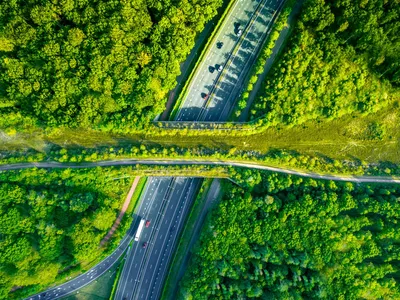
© Getty Images / Artur Debat / WWF-US