© Gustavo Ybarra / WWF
Pantanal
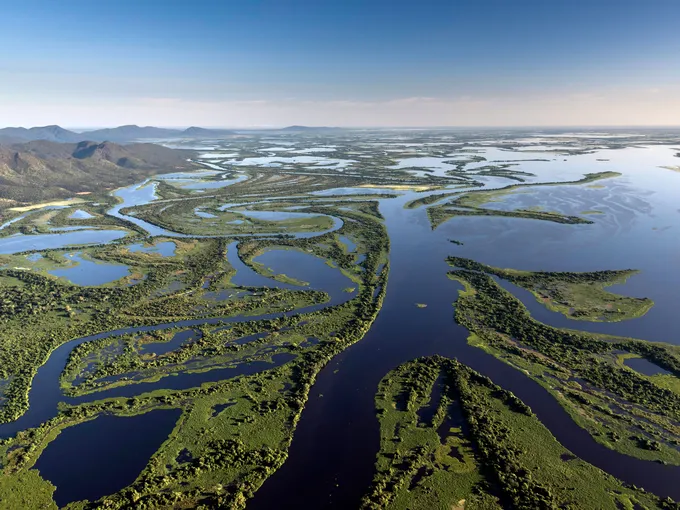
Situated in the heart of South America, the Pantanal is the world’s largest tropical wetland.
At 42 million acres, the Pantanal covers an area slightly larger than nine U.S. states and sprawls across three countries—Bolivia, Brazil, and Paraguay. While not as globally familiar as the Amazon to the north, the Pantanal is one of the most biologically rich environments on the planet with more than 4,700 plant and animal species. In fact, the Pantanal contains South America’s highest concentration of some iconic wildlife species, including the jaguar and caiman.
From October to March, floodwaters fill the Pantanal like a giant reservoir and drain out slowly between April and September, providing ideal aquatic habitat, nutrient renewal, and flood control for millions of people downstream. This flood pulse provides an array of irreplaceable benefits that help the region's economic development and environment, including river flow for boats to navigate, groundwater recharge, and regulation of floodwaters for millions of people. The Pantanal’s economic activity ranges from cattle ranching to soy production to tourism, boosting the local economies of each state within it by billions.
Wildlife of the Pantanal

© Richard Barrett / WWF-UK
This massive wetland has the largest concentration of crocodiles in the world, with approximately 10 million caimans. Jaguars, the largest feline in the Americas, hunt caiman in the Pantanal, which has one of the highest density of jaguars anywhere the world. The Pantanal is also home to the biggest parrot on the planet, the hyacinth macaw. Sighting these animals and others help attract the 1 million tourists who visit the Pantanal every year.

© André Dib / WWF-Brazil
About 3,000 hyacinth macaws—the world’s largest parrot—reside in the Pantanal, where they eat fruits and nuts and nest in naturally hollow manduvi trees. Birdwatchers identify this rare bird by its apparent smile, cobalt blue plumage, and yellow trim around its eyes. Yet it’s these unique features that make it desirable on the black market—a trade that almost drove the bird to extinction in the 1990s. Rehabilitation efforts have since recuperated population size, but the hyacinth macaw remains a vulnerable species. In Brazil and beyond, WWF works to end illegal wildlife trafficking that threatens many rare species.
People and communities of the Pantanal

© André Dib / WWF-Brazil
The Pantanal is a dynamic and growing place, for both the people and nature who thrive there. In a single year the Pantanal fluctuates between drought and deluge, providing livelihoods to over 270 communities. A wide range of people, from small indigenous groups in Paraguay to cattle ranchers in Bolivia and soy farmers in Brazil, call the region home. More than 1.5 million people need the Pantanal for income, food security, and drinking water, while millions more downstream depend on the expansive wetland for flood control.
The Pantanal under threat

© Staffan Widstrand / WWF
The Pantanal’s complex and interconnected nature is what makes it so rich with biodiversity and natural resources, but it’s also what makes it so challenging to conserve and develop sustainably. More than 1,200 rivers and streams converge to form the Pantanal, including the free-flowing Paraguay River. These rivers are the arteries of the Pantanal but carry with them upstream pollutants from agriculture and other industries. Unsustainable infrastructure is also a threat here, with over 100 hydroelectric dams currently planned in the headwaters of the Pantanal. If completed, these dams will reduce river connectivity and interfere with the natural seasonal cycle. These threats impact the whole ecosystem, so require holistic solutions that tackle the challenges in their entirety.
WWF is taking action to protect the Pantanal

© André Dib / WWF-Brazil
On the current trajectory, the pace of degradation of this unique ecosystem will increase and we will lose the Pantanal as we know it. But there is still an opportunity to save it.
Development must be strategically and sustainably planned in a coordinated effort across all three countries and seven ecoregions. For over 20 years, WWF has collaborated farmers and ranchers, the private sector, local and national governments and communities to balance conservation priorities with the region’s economic development. In March 2018, Brazil, Paraguay and Bolivia signed a declaration agreeing to coordinate actions to reduce pollution, strengthen water governance, mitigate climate change, and expand scientific knowledge, while protecting the rights of indigenous peoples. Through a holistic approach and developing solutions to tackle the growing threats, this magnificent wetland of international importance can continue to support people and nature for generations to come.