Publications
-
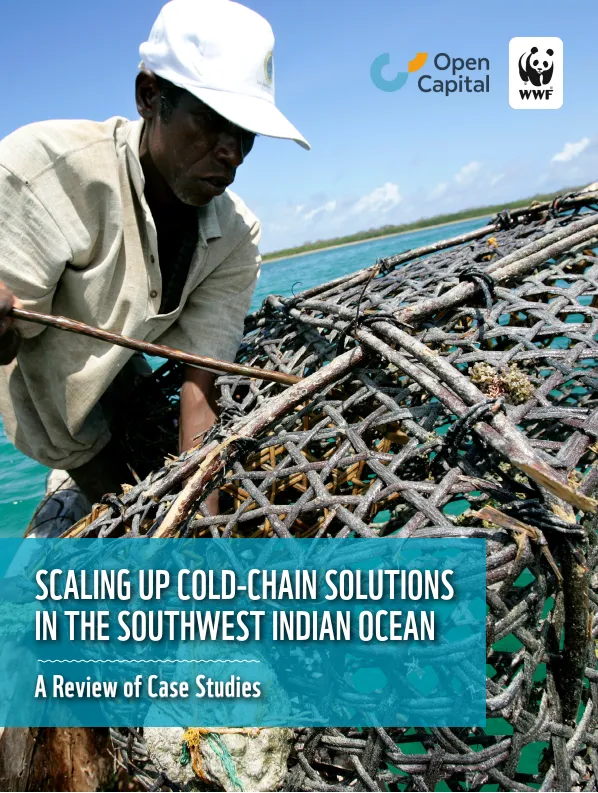
The lack of effective refrigeration is the leading cause of food loss and waste, which resulted in the loss of 12% of global food production in 2017. Moreover, cold-chain technologies and food loss and waste are responsible for 4% of global greenhouse gas emissions. As part of a systems-based approach to transforming entire fishery supply chains to make them more resilient and sustainable, cold-chains solutions must be delivered alongside strong governance mechanisms to ensure sustainable fisheries practices. The current report presents the findings of research conducted by WWF and Open Capital Advisors for scaling cold-chain solutions across the Southwest Indian Ocean region.
-
Sustainable Financing Mechanisms Feasibility Assessment: Expression of Interest
-
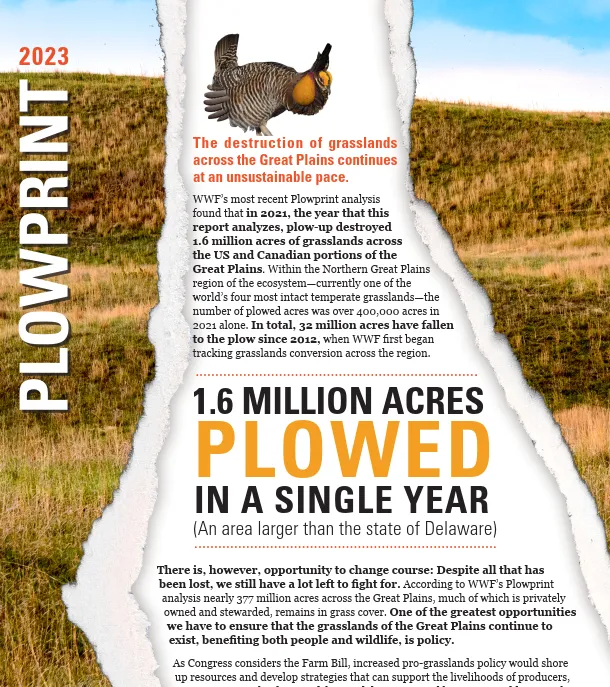
WWF‚'s 2023 Plowprint Report analyzes the rate of grasslands plow-up across the US, and Canadian portions of the Great Plains.
-
The world is off track to protect and restore forests by 2030. Fortunately, there‚'s still time to get back on course and meet global goals. WWF‚'s Forest Pathways report shows how the scale of failed action on the world‚'s forests is leading to an alarming increase in deforestation. It also shows it‚'s possible to halt deforestation, sustainably manage forests, and restore them in ways that benefit humanity and nature.
-
The KAZA Elephant Survey 2022 Fact Sheet provides an outline of high-level findings from the survey along with the rationale for the work, including the need for a synchronized and coordinated approach and an outline of the survey techniques employed.
The KAZA Elephant Survey was conducted from August to October 2022 to estimate the number and distribution of Africa‚'s largest savanna elephant population. It was the first time that all five KAZA partner states‚ – Angola, Botswana, Namibia, Zambia, and Zimbabwe‚ – collaboratively undertook a standardized survey of the region‚'s entire elephant population in a single coordinated exercise. The primary objective was to obtain a relatively precise and accurate estimate of the number of live elephants, elephant carcasses, and other large herbivores in the region in order to inform future conservation plans and opportunities to enhance human-wildlife coexistence. The survey was coordinated by the KAZA Secretariat, with support from WWF, Paul G. Allen Family Foundation, and others, as well as international and US governmental agencies like US Fish and Wildlife Service and USAID.
-
The KAZA Elephant Survey was conducted from August to October 2022 to estimate the number and distribution of Africa‚'s largest savanna elephant population. It was the first time that all five KAZA partner states‚ – Angola, Botswana, Namibia, Zambia, and Zimbabwe‚ – collaboratively undertook a standardized survey of the region‚'s entire elephant population in a single coordinated exercise. The primary objective was to obtain a relatively precise and accurate estimate of the number of live elephants, elephant carcasses, and other large herbivores in the region in order to inform future conservation plans and opportunities to enhance human-wildlife coexistence. The survey was coordinated by the KAZA Secretariat, with support from WWF, Paul G. Allen Family Foundation, and others, as well as international and US governmental agencies like US Fish and Wildlife Service and USAID.
-
The Kavango Zambezi Transfrontier Conservation Area (KAZA TFCA) is home to the largest population of elephants in the world. The long-term viability of KAZA‚'s elephants as a transboundary population depends upon securing landscape connectivity between protected areas. Identifying and addressing the threats to habitat connectivity must be prioritized in order for elephants and other wildlife to move freely throughout this landscape.
The KAZA Policy Brief on Elephant Movements and Connectivity in the KAZA TFCA provides an overview of the current data and knowledge regarding elephant movements and connectivity in KAZA. It provides recommendations for securing and maintaining corridors at different scales to ensure the persistence of landscape connectivity for elephants and other migratory wildlife. It will also work towards the objectives and vision of KAZA‚'s Strategic Planning Framework for the Conservation and Management of Elephants in the KAZA TFCA, to secure KAZA as a focal landscape for elephants and other wildlife for the benefit of rural communities and society at large.
-
The benefits of receiving funding support from WWF‚'s Russell E. Train Education for Nature (EFN) extends beyond completing the academic program and conservation activities. For close to three decades, EFN has invested in over 3,000 individuals, empowering leaders to pursue Ph.D., master‚'s and undergraduate, and short-term courses and worked with over 600 institutions across 60 countries in Africa, Asia, and Latin America and the Caribbean. The work led by alumni has increased national, regional, and global-level collaborations and benefited communities and nature. WWF is committed to strengthening its global community of EFN alumni to connect, develop, and sustain their science capacity and leadership for long-term benefits to people and nature.
-
Sustained actions to support effective and timely conservation and sustainable development efforts must not only be underpinned by interventions that incorporate a wide range of local and traditional knowledge, skills, tools and abilities, but must also provide long-lasting impact to keep pace with increasing biodiversity challenges. Building robust, functional, and adaptive interventions requires long-term investment in research, education, and training that bolsters capacities to accelerate conservation outcomes.
Despite demands placed on biodiversity to meet current and future societal needs, capacity deficits in many places around the globe continue to be evident and include insufficient resources to sustain individual and organizational capacities, limiting the ability to build local conservation leadership. Efforts to foster and maintain conservation capacity have included the development of core competencies, provision of resources, support for education, research, and training and establishment of institutions. However, the complexity of balancing loss of biodiversity with development combined with widening inequalities in capacity continues to demonstrate that achieving inclusive conservation and sustainable development requires scaling up and across to deliver individual, institutional, and community capacities. At this critical moment in time, when biodiversity is faced with growing threats, we require support for individuals and systems to continuously meet the surge in capacity and close the gap between capacity needs and delivery.
Reflecting on nearly three decades of EFN work, the Cassagnol Fellowship creates an opportunity to deliver on the lesson that supporting conservation leaders at their home country universities, research centers, and conservation projects creates lasting opportunities for co-development and collaboration, and therefore ensures longevity of solutions while also sustaining the pipeline of conservation leaders.
-
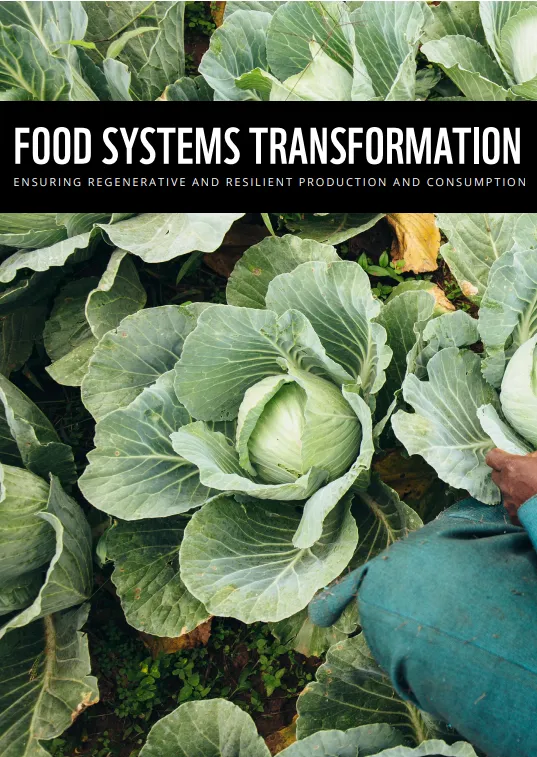
Discover WWF's strategy for reshaping global food systems. This factsheet emphasizes the urgency to cease ecosystem degradation for food production. WWF envisions more resilient, nature-positive systems aligned with Sustainable Development Goals. Through targeted initiatives, WWF collaborates with stakeholders to drive the adoption of regenerative agriculture, share best practices, align supply-chain actions, scale innovations, and strengthen enabling environments. This factsheet is a guide to WWF's initiatives to create a more sustainable and nourishing food landscape