Publications
-
Sustainable livelihood projects can be vulnerable to corruption risks that may contribute to further social and environmental damage. This guide has been developed for programming designers and implementers aiming to reduce corruption's impact on community-based conservation initiatives. It contains three modules exploring the corruption opportunities, power, and justifications that might manifest in three typical sustainable livelihood interventions. Each module identifies corruption risks in that activity type and anti-corruption responses that have been tried or can be considered to address those risks.
Visit the TNRC Knowledge Hub for more resources.
---
This content is made possible by the generous support of the American people through the United States Agency for International Development (USAID). The contents are the responsibility of World Wildlife Fund (WWF) and do not necessarily reflect the views of USAID, the United States Government, or individual TNRC consortium members.
-
WWF is fighting for a world with No Plastic In Nature by 2030. We need all stakeholders to think differently, to innovate, and to provide solutions that not only make us better stewards of the resources we are taking from the planet but also make sure we keep them in the system so they can be used again and again.
Industry has an important role in addressing plastic waste pollution as it both impacts, and is impacted by, this environmental crisis in dynamic ways. This paper outlines the opportunities for finance sector engagement on this issue.
-
WWF is fighting for a world with No Plastic In Nature by 2030. We need all stakeholders to think differently, to innovate, and to provide solutions that not only make us better stewards of the resources we are taking from the planet but also make sure we keep them in the system so they can be used again and again.
Industry has an important role in addressing plastic waste pollution as it both impacts, and is impacted by, this environmental crisis in dynamic ways. This paper outlines the opportunities for retail sector engagement on this issue.
-
WWF is fighting for a world with No Plastic In Nature by 2030. We need all stakeholders to think differently, to innovate, and to provide solutions that not only make us better stewards of the resources we are taking from the planet but also make sure we keep them in the system so they can be used again and again.
Industry has an important role in addressing plastic waste pollution as it both impacts, and is impacted by, this environmental crisis in dynamic ways. This paper outlines the opportunities for seafood sector engagement on this issue.
-
WWF is fighting for a world with No Plastic In Nature by 2030. We need all stakeholders to think differently, to innovate, and to provide solutions that not only make us better stewards of the resources we are taking from the planet but also make sure we keep them in the system so they can be used again and again.
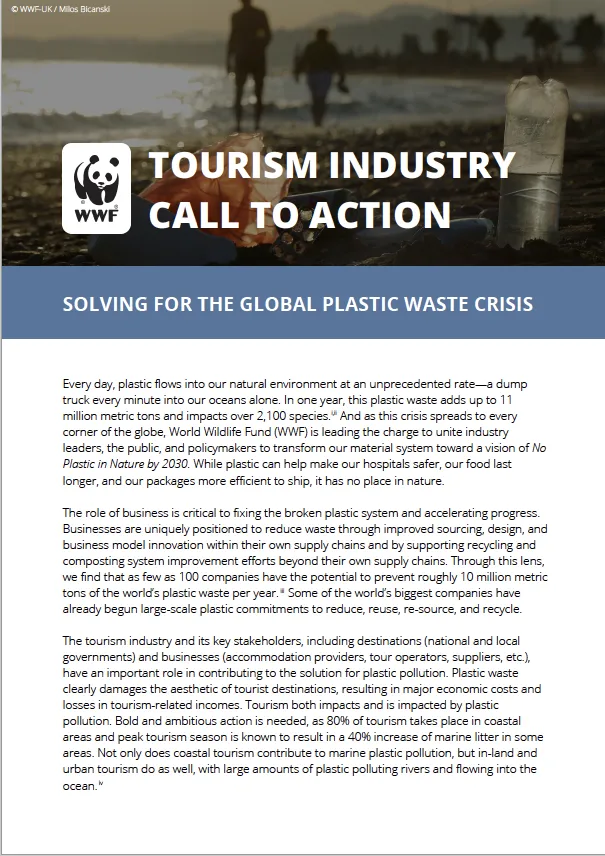
Industry has an important role in addressing plastic waste pollution as it both impacts, and is impacted by, this environmental crisis in dynamic ways. This paper outlines the opportunities for tourism sector engagement on this issue.
-
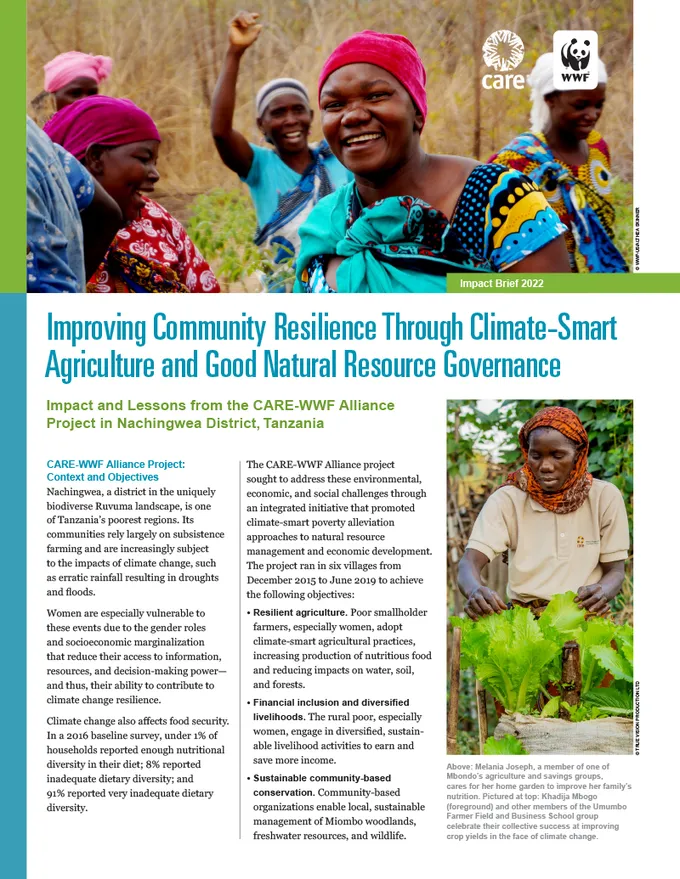
Impact and Lessons from the CARE-WWF Alliance Project in Nachingwea District, Tanzania
Nachingwea, a district in the uniquely biodiverse Ruvuma landscape, is one of Tanzania‚'s poorest regions. Its communities rely largely on subsistence farming and are increasingly subject to the impacts of climate change, such as erratic rainfall resulting in droughts and floods.
Women are especially vulnerable to these events due to the gender roles and socioeconomic marginalization that reduce their access to information, resources, and decision-making power‚ – and thus, their ability to contribute to climate change resilience.
This brief presents key impacts and lessons drawn from various monitoring, evaluation, and learning methods implemented through the project. After a mixed-methods baseline quantitative household survey of 30 clusters randomly selected from 126 villages, including all six project villages, an independent endline survey evaluated households from three project villages regarding changes in natural resource management agricultural practices, and their well-being, among other things.
-
WWF and Guggenheim Investments, the global asset management and investment advisory business of Guggenheim Partners, released a global survey on the collecting, reporting, and application of environmental, social, and governance (ESG) data in infrastructure projects: Testing Industry Attitudes Toward a Common Reporting Approach for ESG Data Use in Infrastructure Investment. The report was conducted by KPMG Advisory N.V. and Mott MacDonald and uniquely surveys both ESG data users and data preparers to explore whether an industrywide standard approach to measuring ESG in infrastructure investment is desired and how this might be achieved.
The survey results demonstrate that both data users and data preparers are looking for well-defined and consistent metrics, standards, and reporting frameworks for ESG. The output suggests that the market sees value in convergence on an industry-tailored set of metrics for ESG data, but with almost 40 different frameworks currently in use by respondents, there is significant divergence in current ESG standards.
According to the survey results, both data users and data providers believe that, apart from standardization and simplification, there are two mechanisms that may improve measurable integration of ESG into infrastructure investment: government regulation regarding ESG disclosures and pressure from investors and lenders.
In a joint letter accompanying the report, Scott Minerd, chairman of Guggenheim Investments and Guggenheim Partners global chief investment officer, and Carter Roberts, president & CEO of WWF, wrote:
"We agree with the authors of this report, who conclude that ‚Äòthe time for action is now.‚' Trends in climate change and the COVID-19 crisis have led to an awakening in the finance sector of its roles and responsibilities in securing a healthy and stable planet and global economy."
-
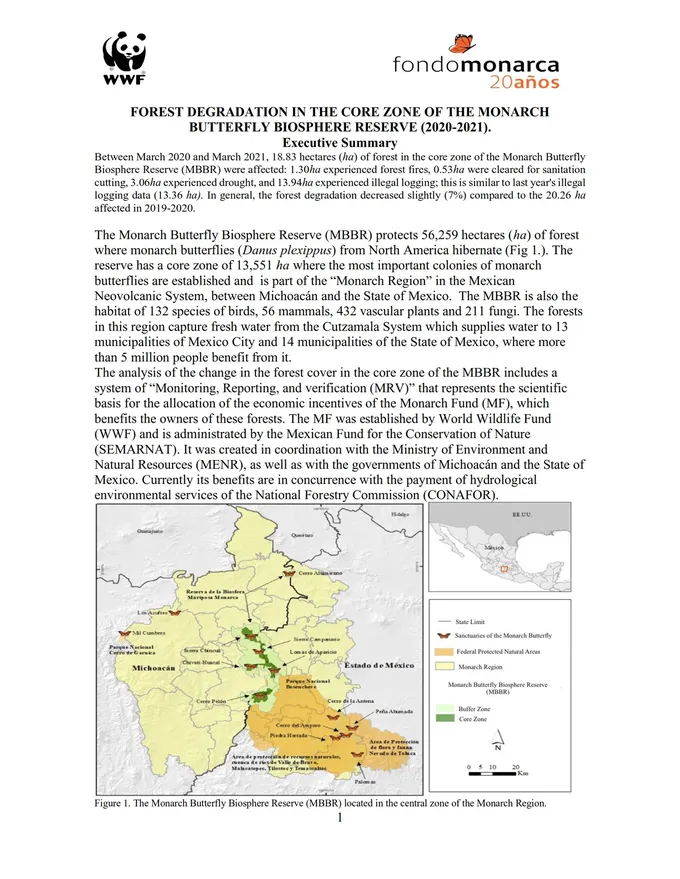
Forest Degradation in the Core Zone of the Monarch Butterfly Biosphere Reserve (2020-2021)
-
-