Publications
-
WWF works with partners and local communities in Iowa’s Cedar River Valley to pilot and develop new scientific approaches to inform decisions for sourcing corn more sustainably. Learn how these tools will enable public and private supply chain actors to evaluate the potential range of environmental benefits and costs of achieving sustainability goals.
-
Often referred to as a ‚Äòliving fossil‚', the ancestors of the modern nautilus first appeared roughly 500 million years ago. This mobile cephalopod‚ – typically associated with coral reefs‚ – has a large, chambered shell and adjusts its buoyancy by changing the amounts of gas inside its chambers. Slow to grow and reproduce, with a lifespan exceeding 20 years, nautilus are vulnerable to even low levels of exploitation. This study by TRAFFIC and WWF, with support from the US Fish and Wildlife Service and US NOAA Fisheries, finds that trade may be a threat to the conservation of the chambered nautilus. The report calls on source and destination countries to take actions to reform harvest and trade controls to prevent the overexploitation and illegal harvest and sale of nautilus.
-
This World Wildlife Day, 3 March, WWF is shining the spotlight on our wildlife heroes‚ – the rangers on the frontline. Little has been done to systematically study and report on ranger working conditions, nor better understand how rangers feel about their work‚ – their concerns, challenges, rewards and motivations. We are therefore excited to be releasing the Ranger Perceptions: Asia survey, which will be the first in a series of reports that shed light on the lives of rangers. The aim is to collect a large data set that will influence and improve government policy towards rangers and their working conditions‚ – giving our wildlife heroes the support and recognition they deserve.
-
Brazil is home to the Amazon and other vital ecosystems that support diverse wildlife. This report provides guidance to agribusinesses, banks, policymakers, and other stakeholders that want to better understand Brazil‚'s new Forest Code so that they can promote, regulate, produce, consume, export, or import Brazilian agricultural products that comply with this law designed to protect its natural resources.
-
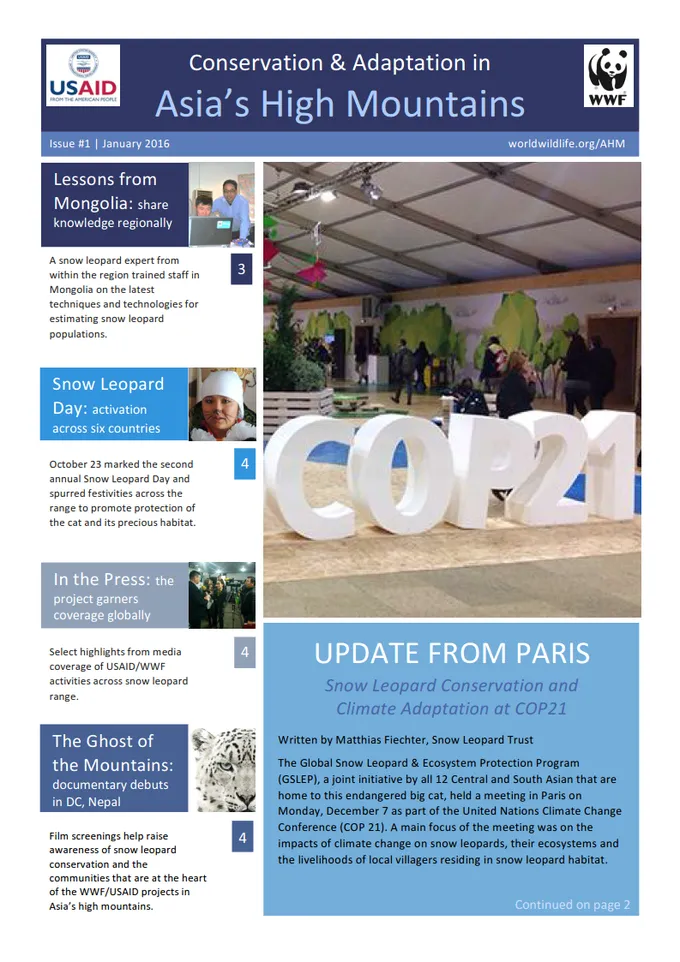
The January 2016 Asia High Mountains Project Newsletter with stories on the Global Snow Leopard and Ecosystem Protection (GSLEP) Program side event at the UNFCCC CoP21 Paris climate talks and other activities in AHM Project countries. (4 page Newsletter)
-

-
WWF‚'S Rapid Assessment of Circus-Arctic Ecosystem Resilience (RACER) presents a new tool for identifying and mapping places of conservation importance throughout the Arctic. This introductory handbook is intended as a general roadmap to the RACER method. It describes the approach and its use of the best available data to create maps of arctic key features as targets for future conservation efforts.
-
Codex Planetarius is a proposal for global system of minimum environmental performance levels to produce food traded internationally. This would help to monitor the health of renewable environmental resources impacted by food production and provide incentives to farmers and countries to enter global markets. The idea is loosely based on the existing Codex Alimentarius, the only internationally recognized set of standards to ensure food is safe and can be traded.
This concept was developed through The Markets Institute @ WWF.
-
Monarch butterflies are highly sensitive to weather and climate, however, they also have a high capacity to adapt to longer term changes in climate. Explore this and other traits which make monarch butterflies vulnerable to climate change, as well as recommended climate-adaptive management strategies.
-