Publications
-
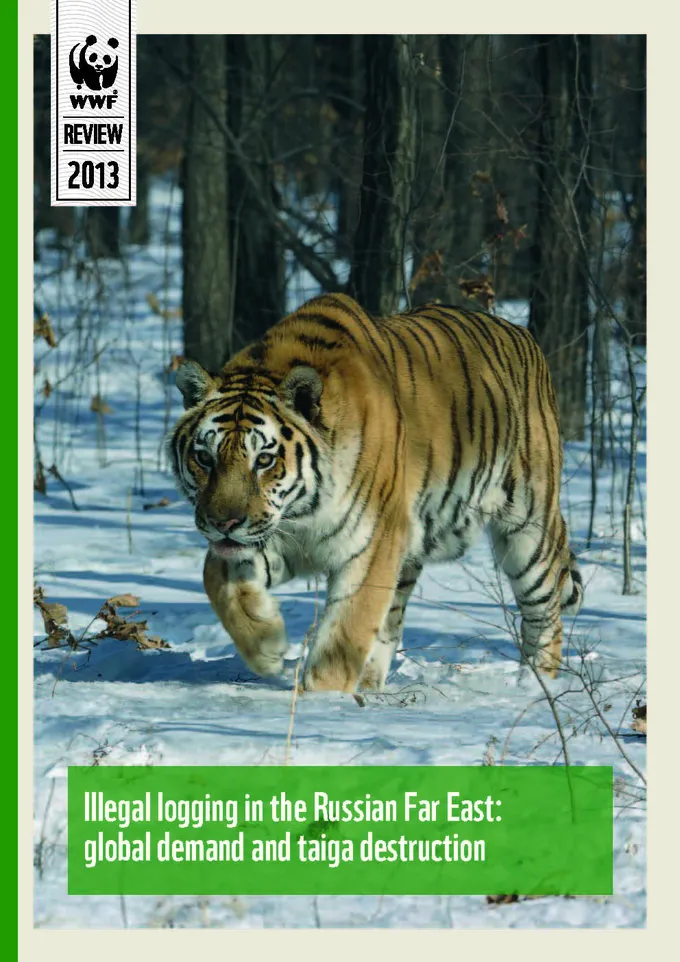
The forests of the Russian Far East‚ – known as the "Ussuri Taiga"‚ – are being pushed to the brink of destruction due to pervasive, large-scale illegal logging, largely to supply Chinese furniture and flooring manufacturers, many of whom in turn export to the U.S. and Europe. This widespread timber theft is driving the endangered Amur tiger‚ – which calls these forests home‚ – closer to extinction.
To demonstrate the scale of this rampant criminal activity, WWF Russia has synthesized over 10 years of on-the-ground field observations into an eye-opening report, Illegal Logging in the Russian Far East: Global Demand and Taiga Destruction . The report highlights a sobering reality: Russia‚'s forest sector has become deeply criminalized, with poor law enforcement, allowing illegal loggers to plunder valuable timber stocks of oak, ash, elm, and linden with impunity.
For instance, WWF analysis of Russian customs data revealed that in 2010, the volume of Mongolian oak logged for export exceeded the volume authorized for logging by 200 percent‚ – meaning that at least half of the oak being exported across the border to China was stolen. Further analysis of export data showed that 2010 was a mild year‚ – in 2007 and 2008 the oak harvest was four times as large. And the unavoidable truth is
that some of this wood reaches U.S. and European markets.As one of the largest importers of flooring and furniture from China, the U.S. can play an important role in helping address this crisis. In 2008, Congress amended the Lacey Act, incentivizing U.S. companies to conduct rigorous due diligence and exclude criminal suppliers by imposing legal liability for the importation of illegally sourced wood products.
The Lacey Act is having an impact, but resolving the pervasive illegal logging crisis in Russia‚'s last tiger forests requires action at all levels. Governments, companies and consumers can all play a role in helping combat illegal logging and saving this crucial tiger habitat.
-
An updated analysis of tiger seizures from 12 tiger range countries (2000-2012)
In 2010, TRAFFIC produced Reduced to Skin and Bones: An Analysis of Tiger Seizures from 11 Tiger Range Countries (2000-2010) (Verheij, 2010). The purpose of the present report is to provide an updated situational analysis of the current illegal Tiger Pantherea tigris trade picture and to gain an improved understanding of one of the greatest threats to the Tiger's survival. This report also aims ot illustrate the need, use, practicability and direction that can be gained from the central collation and analysis of seizure data. Its conclusions outline the need for Tiger range and consumer countries to agree on and adhere to a standardized format for sharing and reporting data on poaching and illegal trade.

-
WWF‚'s Living Forests Report is part of an ongoing conversation with partners, policymakers, and business about how to protect, conserve, sustainably use, and govern the world‚'s forests in the 21st century.
Chapter Four of WWF's Living Planet Report examines current and future demand for wood products and how this can best be met. We explore:
-
Many values and uses of wood and its footprint relative to alternative materials
(pages 2-7) - Current and future demand for wood products (pages 8-17)
- Relationship between wood production and the conservation of other forest values (pages 19-21)
- Various options for producing wood (pages 22-31)
- Broad solutions that will enable humanity to optimize the use and benefits of wood without diminishing the natural capital in the world‚'s forests
While this chapter focuses on wood as the major commodity extracted from forests, it is important to note that forests also produce non-timber forest products (NTFPs). The global value NTFPs is hard to assess but was estimated at US$18.5 billion in 2005. The economic, cultural and ecological value of NTFPs makes them an important component of sustainable forest management and the conservation of biological and cultural diversity.

-
Many values and uses of wood and its footprint relative to alternative materials
-
Through two dozen interviews with Fortune and Global 100 executives and analysis of public disclosures, the report finds that clean energy practices are becoming standard procedure for some of the largest and most profitable companies in the world. Among key findings, the report shows that:
- 102 companies from the combined 171 companies in the Fortune 100 and Global 100 have set GHG reduction goals (60 percent)
- Of those, 24 companies have set specific goals for renewable energy use (14 percent), with others using renewable energy to meet their GHG goals.
- Many companies are shifting from purchasing short-term, temporary Renewable Energy Credits (RECs) to longer-term investment strategies like Power Purchase Agreements (PPAs) and on-site projects, indicating a long-term commitment to renewable energy and reaping the benefits of reduced price volatility.
The report documents key barriers companies face in deploying more renewable energy as well as best practices, drawing from over 20 company interviews. The report also includes recommendations for governments and business.

-
Rethinking Conventional Responses: Integrated Approaches in the Fight Against Wildlife Crime

-
Healthy and plentiful fisheries are not only good for marine ecosystems, but they are critical to the health, employment and prosperity of over a billion people around the world that rely on fisheries for food and jobs. Yet, half the globe’s fisheries have been pushed to their limits and another third have been pushed beyond their limits. The percentage of these “overfished” species has nearly quadrupled since the 1970s. A rights-based management program is one tool to address this issue. They convey and manage exclusive entitlements that allow a person, company, fishing vessel, community or village to fish in a particular place at a particular time.
-

-
As a non-profit organization dependent on the support of others to carry out our work and advance our mission, WWF takes our obligation to donors very seriously to ensure that funds and other resources are used appropriately and as efficiently and effectively as possible. The whistle blower policy provides a mechanism for the reporting of suspected illegal activity or the misuse of WWF assets. This may include conflicts of interests with vendors, inappropriate purchases or reimbursements, falsified expense reports, and the like.
-
The “whistle blower” procedure is intended to provide a mechanism for WWF executives to respond to reports made pursuant to the WWF Whistle Blower Policy.
-
This brochure shows how the addition of offshore oil and gas activities greatly compromise the potential for right whale populations to recover from endangerment of extinction.