Publications
-
-
Addressing Invasive Carp and Boosting Economic Development through Market-based Solutions explores how market-driven strategies‚ – particularly through the pet food industry‚ – can help mitigate the environmental and economic damage caused by invasive carp in American rivers. These carp species, introduced in the 1970s, now dominate river ecosystems, outcompeting native species and degrading water quality. Despite their nutritional value, carp are underutilized in the U.S. due to their bony structure and negative public perception. However, the growing demand for sustainable, protein-rich ingredients in pet food presents a promising opportunity to create a viable supply chain that both reduces carp populations and supports local economies.
The report outlines how moderate harvesting of carp could help suppress their density, restore ecosystem services, and improve biodiversity, even if full eradication is unlikely. It also emphasizes the importance of supporting fishers through innovative business models like co-ops and vertical integration to ensure equitable and sustainable supply chains.
-
From African savannas to Himalayan peaks, oceanic waters to America‚'s Great Plains, your support fuels tremendous progress for wildlife around the world. This report details how your support helped pilot cutting edge conservation approaches, advance scientific research and technology, strengthen political will and community engagement for conservation, and celebrate new milestones for species recovery.
-
During the second half of 2024, WWF conducted a third annual assessment of 40 banks‚' seafood-related policies and disclosures to understand how they are, or are not, effectively implementing the tools at their disposal‚ – such as sector policies, due diligence processes, and sustainable finance products‚ – to manage, minimize and eliminate risks as well as maximize opportunities related to the sustainability and resilience of their seafood portfolios. This report highlights key findings from our 2024 assessment, compares the results against last year‚'s findings to monitor progress, provides actionable recommendations for banks, and directs readers to practical resources to guide next steps.
Overall, this year's results show that during 2024, 19 banks‚ – (48% of those assessed)‚ – demonstrated some improvements against last year‚'s baseline. Of these, five banks (13%) improved specifically on seafood-related "client expectations" indicators and six banks (15%) disclosed new information about seafood-related eligibility criteria for sustainable finance frameworks and/or issued new blue-labeled products supporting sustainable seafood. While encouraging, more progress is still needed to ensure that banks‚' policies sufficiently prevent and/or manage their exposure to these risks.
This year's report also sought to quantify the potential impact of observed policy improvements. In early 2025, WWF commissioned Profundo to analyze the seafood-related financing of eight banks documented to have updated or published new seafood-related sector and environmental and social risk management (ESRM) policies since the start of this benchmarking assessment in 2023. This research indicates that these eight banks have committed at least US $27 B in finance to 29 major seafood companies during just the past five years, comprising approximately 20% of all identified finance to these companies. As these new and enhanced policies come into effect, their potential to drive real improvements to the way companies manage impacts and risks in the water is significant. More progress by banks to improve their seafood policies can have a major impact on redirecting mainstream finance‚ – at scale‚ – towards more sustainable outcomes.
See the 2023 baseline assessment here .
See the 2022 baseline assessment here .
-
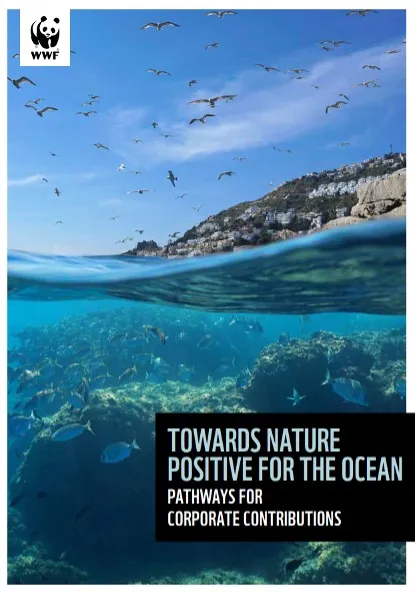
Towards Nature Positive for the Ocean is a first-of-its-kind guide created to help companies operating in marine and coastal environments take credible, science-based action to support the global nature-positive goal‚ – halting and reversing biodiversity loss by 2030 and achieving full recovery by 2050.
What sets this report apart is its dedicated focus on the ocean‚'s unique ecological, legal, and governance challenges. Building on leading global frameworks like the Science Based Targets Network (SBTN) and Taskforce on Nature-related Financial Disclosures (TNFD), it provides tailored guidance for key ocean-based sectors: offshore wind, shipping, coastal and marine tourism, and seafood.
Using the AR3T action framework‚ – Avoid, Reduce, Restore & Regenerate, and Transform‚ – the report outlines actionable pathways for companies to:
- Avoid future negative impacts on ocean ecosystems
- Reduce existing pressures where impacts are unavoidable
- Restore and regenerate degraded marine habitats
- Transform business models, practices, and value chains for long-term resilience
This report offers businesses a practical entry point to align with biodiversity goals and lead the way toward a sustainable, nature-positive ocean economy.
-
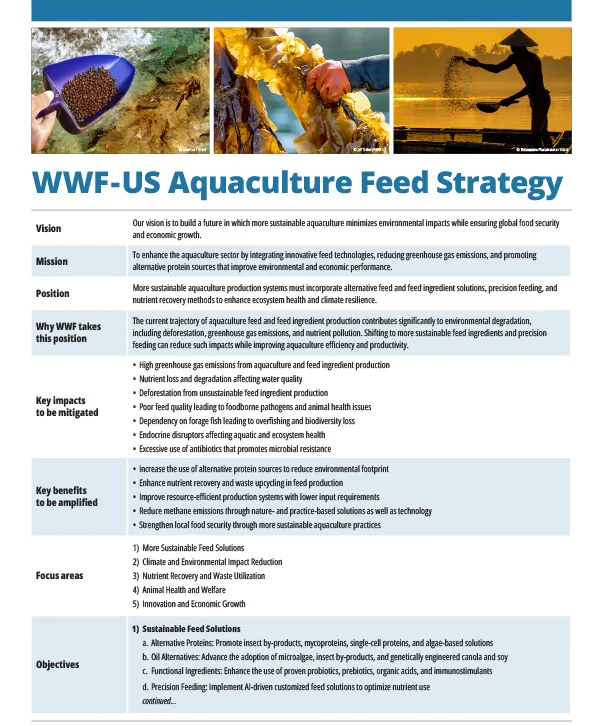
The current trajectory of aquaculture feed and feed ingredient production contributes significantly to environmental degradation, including deforestation, greenhouse gas emissions, and nutrient pollution. Shifting to more sustainable feed ingredients and precision feeding can reduce such impacts while improving aquaculture efficiency and productivity. WWF is working to enhance the aquaculture sector by integrating innovative feed technologies, reducing greenhouse gas emissions, and promoting alternative protein sources that improve environmental and economic performance.
-
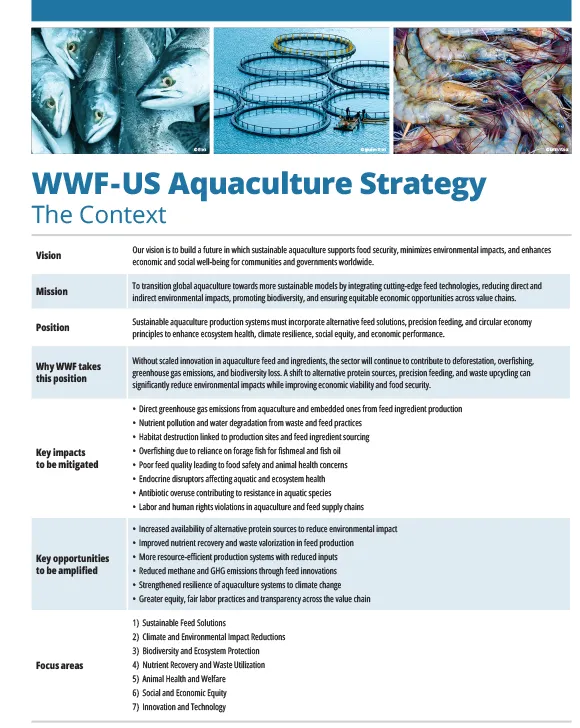
Without scaled innovation in feed and ingredients, the aquaculture sector will continue to contribute to deforestation, overfishing, greenhouse gas emissions, and biodiversity loss. WWF‚'s goal is to transition global aquaculture towards more sustainable models by integrating cutting-edge feed technologies, reducing direct and indirect environmental impacts, promoting biodiversity, and ensuring equitable economic opportunities across value chains.
-
This publication introduces a major update to one of the most widely used global wetland datasets. GLWD v2 integrates decades of satellite and ground data into a single, harmonized, high-resolution map of 33 different inland water and wetland classes. Designed to support hydrological, ecological, and conservation applications, the database addresses inconsistencies in previous mapping efforts by distinguishing between permanent and seasonal wetlands, natural and artificial waterbodies, and a range of ecological features like salinity, vegetation, and soil type. With an intuitive classification system and fractional grid cell coverage, this powerful new tool provides researchers, conservationists, and policymakers with a detailed baseline for monitoring and managing wetland ecosystems. Explore the new interactive online map.
-
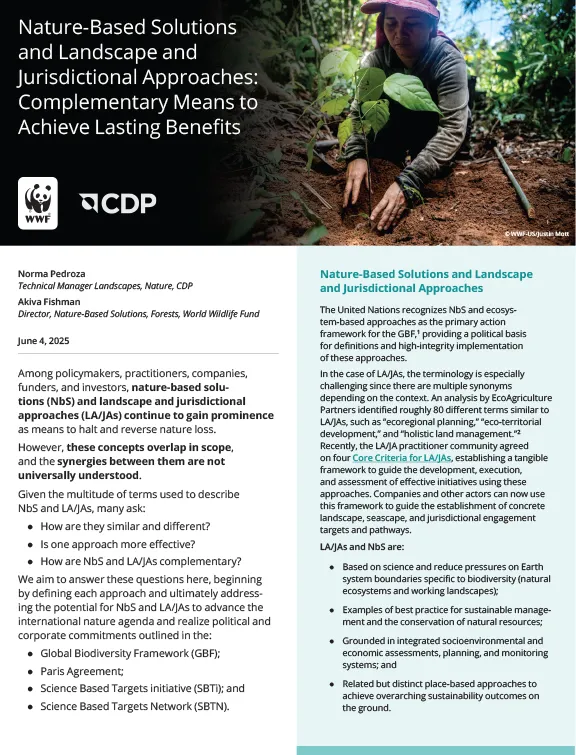
Among policymakers, practitioners, companies, funders, and investors, nature-based solutions (NbS) and landscape and jurisdictional approaches (LA/JAs) continue to gain prominence as means to halt and reverse nature loss.
However, these concepts overlap in scope, and the synergies between them are not universally understood.
Given the multitude of terms used to describe NbS and LA/JAs, many ask:
- How are they similar and different?
- Is one approach more effective?
- How are NbS and LA/JAs complementary?
In this piece, WWF and CDP aim to answer these questions, beginning by defining each approach and ultimately addressing the potential for NbS and LA/JAs to advance the international nature agenda and realize political and corporate commitments outlined in the:
- Global Biodiversity Framework;
- Paris Agreement;
- Science Based Targets initiative; and
-
Science Based Targets Network.
-
As part of the Ellen MacArthur Foundation’s and WWF’s engagement to support the development of an ambitious and effective international legally binding instrument, this document outlines examples of reuse initiatives across the Global South. This document contains a selection of case studies illustrating reuse initiatives across the Global South. Each case study is presented with essential details, including application, organization, geographic reach, and key statistics.