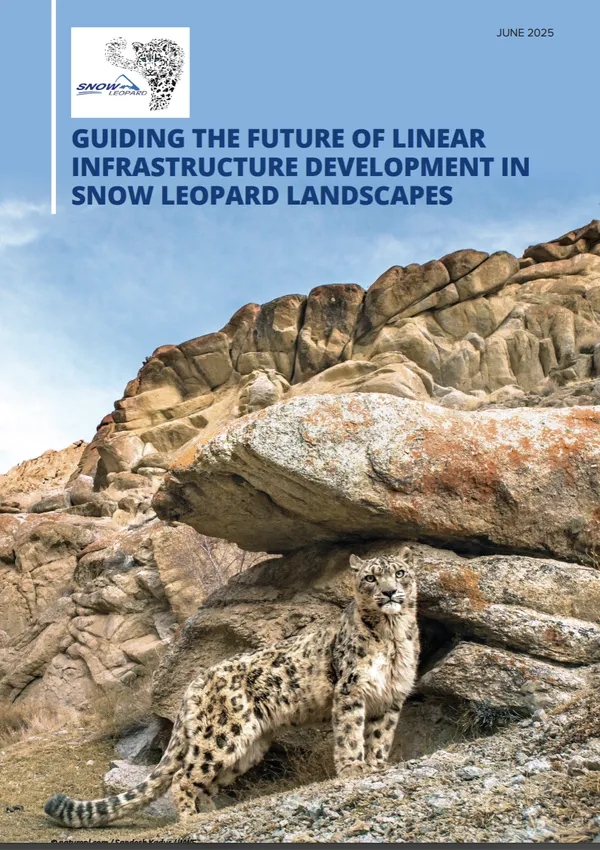
Guiding the Future of Linear Infrastructure Development in Snow Leopard Landscapes
Linear infrastructure (LI)‚ – such as roads, railways, power transmission lines, canals, pipelines, and border security and other forms of fencing‚ – is necessary to connect people and services and support communities. However, it also threatens snow leopards and the high-mountain ecosystems they inhabit. Concerns include habitat fragmentation, illegal hunting and trade, wildlife-vehicle collisions, and other forms of human-wildlife conflict. In addition, feral dogs, invasive species, pathogens, and pollutants introduced by LI further disrupt the environment and drive biodiversity loss. Climate change worsens these threats, while LI itself exacerbates climate change.
The Global Snow Leopard and Ecosystem Protection Program (GSLEP), an alliance of the 12 countries comprising the snow leopard‚'s range, formed a working group of scientists and conservationists to create guidance for how infrastructure development can integrate protections for these big cats. Led by the International Snow Leopard Trust, WWF, and the Center for Large Landscape Conservation, the working group presented a guidance document, Guiding the Future of Linear Infrastructure Development in Snow Leopard Landscapes, at the 9th GSLEP Steering Committee Meeting in Cholpon Ata, Kyrgyz Republic, in June 2025, attended by environment ministers or their representatives.
This initial guidance recommends how governments, civil society, and local communities in snow leopard range countries can use avoidance and mitigation techniques to address these threats. It covers the infrastructure life cycle and follows the mitigation hierarchy‚ – a framework to avoid, minimize, and mitigate negative environmental impacts. The guidance offers solutions to protect biodiversity and ecosystem health throughout the infrastructure project‚'s life cycle, but it also revealed gaps in our knowledge that we propose addressing in future work. Implementing the measures defined here and working to address knowledge gaps will reduce risks to snow leopards and their prey, support human communities living in these ranges, preserve the ecosystem services snow leopards depend on, and lower the risk of infrastructure failure.
-
Guiding the Future of Linear Infrastructure Development in Snow Leopard Landscapes
82.9 MB PDF Download