The Conservation Mosaic Approach to Reduce Corruption and the Illicit Sea Turtle Take and Trade
A. Alonso Aguirre, D.V.M., Ph.D., Department of Environmental Science and Policy, George Mason UniversityWallace J Nichols, Ph.D., California Academy of Sciences
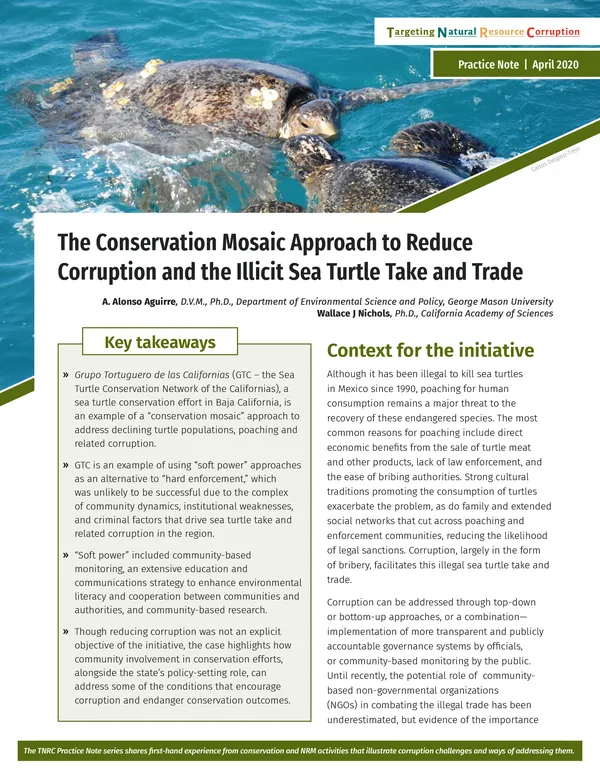
Although it has been illegal to kill sea turtles in Mexico since 1990, poaching for human consumption remains a major threat to the recovery of these endangered species. The most common reasons for poaching include direct economic benefits from the sale of turtle meat and other products, lack of law enforcement, and the ease of bribing authorities. Strong cultural traditions promoting the consumption of turtles exacerbate the problem, as do family and extended social networks that cut across poaching and enforcement communities, reducing the likelihood of legal sanctions. Corruption, largely in the form of bribery, facilitates this illegal sea turtle take and trade.
---
This content is made possible by the generous support of the American people through the United States Agency for International Development (USAID). The contents are the responsibility of World Wildlife Fund (WWF) and do not necessarily reflect the views of USAID, the United States Government, or individual TNRC consortium members.
-
The Conservation Mosaic Approach to Reduce Corruption and the Illicit Sea Turtle Take and Trade
1.4 MB PDF Download