How do animals get their names?
Names reflect an animal’s physical characteristics and history
© Thomas Busby
Key takeaways
- The origin of animals’ names is reflected in their physical characteristics, cultural significance, and history.
- Some animal names are reflective of the deep connection that humans have with nature. Other names are reflective of harmful and incorrect assumptions that humans have held about the species.
Hummingbird. Narwhal. Praying mantis. We tend not to think about the meaning behind these names. But dig a little deeper, and the names give way to a breadth of history. How do animals get their names? And what meanings do these names hold?
While this is a story about astonishing creatures, it’s also about the importance of protecting them and their habitats. By knowing their names, we breathe new life into them. For naming inspires connection, and connection inspires the will to protect.
Here are the stories behind the naming of eight different animals, adapted from Naming Nature, a new book by WWF’s board member T.A. Barron.
1. Hummingbird
Hummingbirds are as capable as they are beautiful. They can beat their wings up to eighty times per second, fly backward, and even fly upside down! Their yearly migration is almost 4,000 miles long, from Alaska to Mexico. The names of hummingbird species range from glittering-bellied emerald to red-tailed comet to fiery-throated metaltail, describing the variety and amazing abilities of these birds. The word for hummingbird in many languages comes from Taino, an Indigenous language of the Caribbean. One incredible hummingbird name is the Spanish zunzuncito, which sounds exactly like the bird’s whirring, buzzing wings.

© John Gould
2. Moonflower
Moonflowers’ name is self-explanatory—they are a white flower that blooms only at night, opening into a complete flower in the darkness and closing as the sun starts to rise. While blooming, these flowers release a fragrance that attracts the sphinx moth, which pollinates the moonflower while consuming its nectar. Moonflowers are found in tropical and subtropical parts of the Americas. Most of its common names are deeply reverential, evoking the devotion to God or the beauty of starlight—except for one, a local name that translates as “a child’s diaper."
3. Goblin shark
Deep under the surface of the ocean off the coast of Japan live these elusive sharks. They have been cruising these waters looking for prey for the last 125 million years. Goblin sharks’ noses are actually extremely sensitive electroreceptors, and they use them to detect the slightest changes in electrical fields from nearby organisms. They then pounce, sinking their fanglike teeth into the prey. Their name comes from the Japanese word tenguzame, which was inspired by the tengu, a mythical being that is part human and part bird. Goblin sharks live at depths far deeper than humans frequent. They are most often seen by humans when they become entangled in fishing nets.
4. Praying mantis
The praying mantis’s name reflects its appearance as someone in a prayerful stance. The word “mantis” comes from the Greek term mantikos, which means “like an oracle.” The insect’s posture has made it admired in cultures around the world. In China, its deliberate and focused movements helped to inspire the founding 1,500 years ago of Shaolin kung fu. Across the world in Egypt, the mantis represented a guide for people in their greatest quests. In the US, Indigenous communities have revered the insect as a symbol of the continuity of life.

© Edward Julius Detmold
5. Unicorn of the sea
Narwhals live in the icy waters of the Arctic, so rare they’re almost never seen. Because of their elegant tusks, which can grow up to 10 feet long, they’ve been called unicorns of the sea. The tusk of a narwhal is actually a supersensitive tooth! They live for fifty to sixty years, staying in the frigid Arctic waters for their whole lives. This magnificent cetacean actually inspired the modern legends of the unicorn, a mythical steed whose gleaming horn signifies purity and truth.

© Georges Cuvier
6. Hellbender
This salamander has different numbers of toes on its front and back legs and can breathe through its skin. Some consider it so ugly that it’s been called a monster. Hellbenders can grow up to two feet and weigh up to five and a half pounds! Their heads are so flat they seem to have been crushed, and their bodies contain deep layers of rippled skin. These salamanders were initially called tsu-wa, or water dogs, by the Indigenous Cherokee people in what is now the eastern US. But after colonization by European settlers, rumors started to spread that these harmless creatures were dangerous to fish in the rivers. This led to killing sprees, causing a steep decline in the population of hellbenders. Hellbenders remain quite vulnerable to human impacts such as pollution and deforestation.
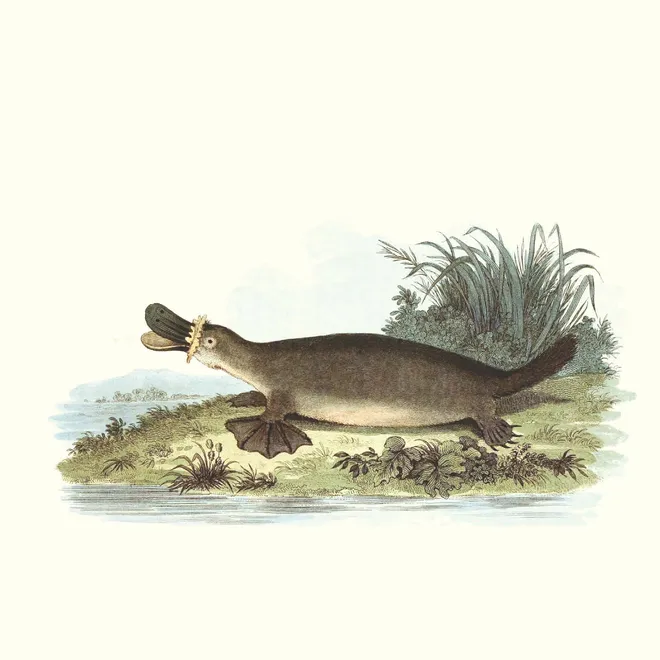
7. Platypus
The platypus has the beak of a duck, the feet of an otter, the tail of a beaver, and the venom of a scorpion. In addition, unlike almost any other mammal, it lays eggs like a bird. It’s a uniquely odd animal. The name platypus comes from two Greek words, platys—meaning broad or flat—and pous, meaning foot. But the name that most accurately reflects this animal’s bizarre qualities came from an 18th century biologist who called it simply “paradoxus,” Latin for “truly puzzling.”
8. By-the-wind sailor
This creature looks like a scallop or mussel, but it rides the ocean waves, using its shell as a sail. It moves entirely by the wind! Also known as a sea raft, some have sails that are angled to the left of the winds while others are angled to the right. This allows them to move across vast stretches of ocean. By-the-wind sailors are related to jellyfish, and work together in a group to catch plankton, digest food, and reproduce. They function as a team, kind of like a sailing ship! That’s how they’ve survived so well for more than 300 million years.