Nature’s most mysterious fish: Facts about fascinating freshwater eels
© Neil Aldridge / naturepl.com / WWF
By Callie Cho
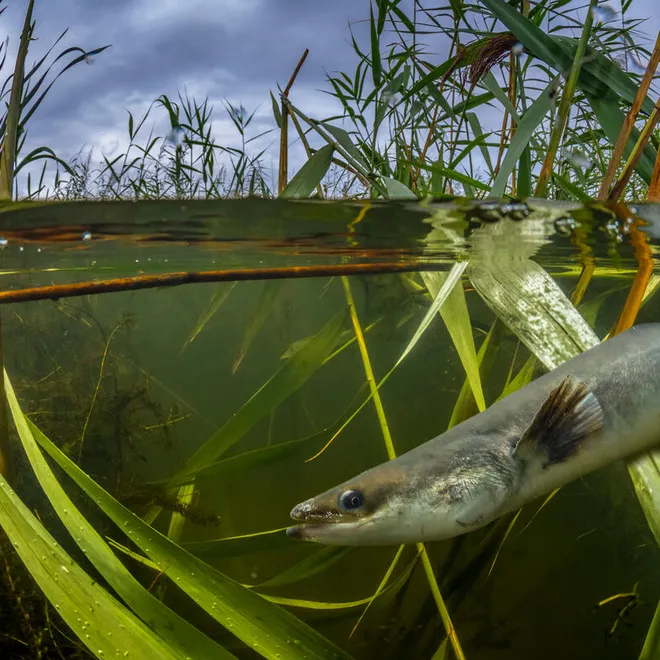
For centuries, freshwater eels have been one of nature's most puzzling creatures. These unassuming fish undertake one of the animal kingdom's most extraordinary journeys; a metamorphosis and migration so dramatic it rivals any transformation in nature.
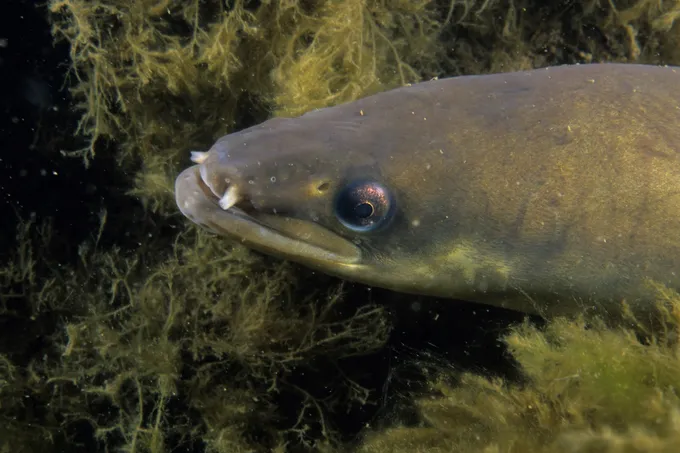
Freshwater eels belong to the genus Anguilla, a group of ray-finned fishes that includes well-known species like the European eel (Anguilla anguilla), American eel (Anguilla rostrata), and Japanese eel (Anguilla japonica), but there are more than nineteen species worldwide. Their earth-toned, serpentine bodies are built for life in both rivers and oceans, and Anguilla eels can be found across an extraordinary range of habitats, from tropical to temperate waters, to even freshwater streams, lakes, and estuaries.
Fact 1: Freshwater eels start their life in saltwater
While these eels are equally at home in brackish estuaries as they are in freshwater lakes, what makes them truly remarkable is their catadromous lifestyle. This means they’re born in saltwater but migrate to freshwater, where they live their adult lives, sometimes for decades, before returning to the ocean to spawn. For millennia, this reproductive strategy remained one of biology's greatest mysteries.

© Philipp Kanstinger / WWF
© Shutterstock
Fact 2: Both European and American eels spawn in the same remote ocean region—the Sargasso Sea
A breakthrough came in 1923, when Danish biologist Dr. Johannes Schmidt discovered tiny European eel larvae in the Sargasso Sea, a unique region of the Atlantic Ocean bound not by land but by swirling currents and a thick layer of floating Sargassum seaweed. This discovery suggested that eels travel thousands of miles from European rivers to spawn in this remote oceanic nursery.
For decades, this remained circumstantial evidence—no one had ever tracked an adult eel making the journey. Then, in 2022, researchers finally succeeded in tracking adult European eels using satellite tags. The tracking data confirmed what Schmidt suspected a century earlier: eels navigate over 3,000 miles across the Atlantic Ocean to reach their spawning grounds in the Sargasso Sea, completing one of nature's most epic (and enigmatic) migrations.
Fact 3: Freshwater eels have six distinct life stages
Like butterflies, eels transform completely as they mature. After hatching in the ocean depths, they drift for nearly a year as transparent, leaf-shaped larvae called leptocephali, riding ocean currents. Upon reaching coastal waters, these tiny planktonic forms metamorphosize into transparent, eel-shaped juveniles just a few inches long known as "glass eels".
Their transformation continues as they enter rivers: at four inches, they darken into "elvers," then gradually become "yellow eels", sexually immature juveniles. Finally, after 5 to 20 years in freshwater (depending on the species), they undergo a final transformation into "silver eels", maybe the most dramatic change in their life cycle. The eels turn into sleek adults with darkened backs and enlarged eyes, nostrils, and fins. These physical changes are also accompanied by dramatic internal changes. Their digestive tract shrinks as the eels stop feeding, while their swim bladder, heart, and respiratory muscles enlarge. This silvering process ensures that the eels are ocean-ready as they begin their long and arduous migration back to their spawning grounds.
Yet, mysteries persist: How do eels determine their sex? What triggers their return migration? Scientists cannot yet artificially breed freshwater eels and are still working to answer these fundamental questions.
Fact 4: Eels navigate using the Earth’s magnetic field
The question of how eels navigate to and from the Sargasso Sea has baffled scientists for decades, but recent research has revealed that eels use magnetoreception, along with other environmental cues, to navigate their long migrations. As larvae, eels learn to recognize the magnetic signature (field intensity and magnetic inclination) of their birthplace, a process known as “imprinting”. As the eel larvae drift along the ocean currents towards freshwater, they recognize the magnetic gradient of their migration path, creating a mental “magnetic map”. As adults, eels follow the reverse magnetic path of their initial journey as larvae back to their spawning grounds.
Fact 5: Eels are umbrella, indicator, and flagship species; Protecting them protects entire ecosystems
Though often overlooked, freshwater eels benefit their surroundings. They occupy a critical middle tier in the food web, consuming invertebrates, small fish, and crustaceans while serving as prey for larger predators like herons, otters, and large fish. This dual role makes eels essential for maintaining ecosystem balance.
Their long migrations also make eels uniquely important for nutrient cycling. As they travel between ocean and freshwater, eels transport marine-derived nutrients upstream into rivers and lakes, essentially acting as biological conveyor belts that fertilize inland ecosystems. Conversely, when silver eels return to the sea, they carry nutrients accumulated from years of freshwater feeding back to the ocean.
Perhaps most importantly, eels serve as sensitive environmental barometers. Because they travel between connected habitats from deep ocean spawning grounds to upstream freshwater refuges, eels are acutely vulnerable to habitat fragmentation, water pollution, dams, and climate change. Healthy eel populations signal healthy, connected waterways, and declining eel numbers often herald broader ecosystem problems.

© Erling Svensen / WWF
Fact 6: Freshwater eels are vanishing, with some species having declined by over 95%
Despite their ecological importance, freshwater eels face an existential crisis: they’ve quietly become one of the world’s most imperiled fish. The European eel is listed as Critically Endangered, while the American and Japanese eels are considered Endangered by the IUCN Red List. In some regions, eel populations have plummeted by more than 95% since the 1980s.
Eels confront threats at every stage of their remarkable life cycle:
Habitat fragmentation and barriers: Dams, weirs, and other barriers block eel migration routes, preventing juveniles from reaching upstream feeding grounds and trapping adults that need to return to the ocean to spawn. On top of that, urbanization, industrialization, and agricultural expansion have destroyed or degraded the rivers, estuaries, and wetlands eels depend on.
Climate change: Shifting ocean currents alter the transport of eel larvae from spawning grounds to coastal waters. Rising temperatures, changing rainfall patterns, and ocean warming affect food availability and disrupt the environmental cues that trigger eel migration and reproduction. Lastly, the Sargasso Sea itself is warming, potentially threatening the conditions eels have relied on for millennia.
Pollution: Chemical contaminants like pesticides, heavy metals, pharmaceuticals, and endocrine disruptors accumulate in eel tissues over their long lifespans. These pollutants can compromise health, disrupt hormones critical for reproduction, and reduce the eels' ability to complete their demanding oceanic migration.
Overfishing and illegal trade: From sushi to Spanish angulas, eels are consumed by people around the world in a variety of dishes. This global demand has led to the development of a lucrative illegal trafficking industry, fueled by the poaching of juvenile eels from the wild to supply eel farms, primarily in Asia. Because eels cannot be sustainably bred in captivity, the young eels command hefty prices, ranging from hundreds to thousands of dollars per pound. This exploitation targets eels before they've had a chance to grow or reproduce, accelerating population collapse.
What WWF is doing
Though much about the lives of eels remain undiscovered, we do know their survival is critical to the health of our oceans and freshwater systems. WWF scientists focus on the world’s most important rivers and seascapes to protect critical biodiversity and help communities who rely on these ecosystems for livelihoods and survival. By addressing cultural and economic needs as part of conservation, we work to ensure the health of these waters for eels and all life, including our own.
Take action: Nature needs us now
The natural world is under threat like never before. Do something today and sign the pledge to protect nature