Tiny but mighty climate ocean heroes
© Jürgen Freund / WWF
Key takeaways
- Krill, sea squirts, sea stars, and sea urchins are just some of the small creatures that play an outsized role in the health of our oceans
- These species are an essential part of the ocean food web and store major amounts of greenhouse gases.
- By mitigating the impacts of climate change, they help entire ocean ecosystems thrive.
Sharks, whales, sea turtles...these charismatic megafauna often steal the spotlight when we talk about ocean biodiversity and marine climate heroes. And while these animals are indubitably wonderful, the small, slimy, and spiky ocean-dwellers also deserve to be celebrated. They are the overlooked backbone of our ocean—essential for ecosystem function, maintaining food webs, and keeping a safe climate future in view.
So, let’s shine a light on some of these tiny but mighty ocean climate heroes!

© naturepl.com / Ingo Arndt / WWF
1. Cool krill
Antarctic krill (Euphausia superba) are tiny crustaceans (only about two inches long) but play an outsized role in the Southern Ocean ecosystem. They are best known as a key food source for baleen (filter-feeding) whales like humpbacks and blue whales, yet their importance extends far beyond the food web.
Krill are also crucial to the ocean’s “carbon sink,” the process by which the ocean absorbs and stores more greenhouse gases from the atmosphere than it releases. This system relies on both biological and physical processes, and krill are an important link in this system.
Their role begins with phytoplankton—microscopic, plant-like organisms that absorb carbon dioxide and release oxygen. Phytoplankton are incredibly efficient at capturing carbon and turning it into energy (a process known as “fixation”). In fact, scientists estimating they fix between 30 billion and 50 billion metric tons of carbon each year1—the equivalent of the greenhouse gases emitted by almost 43 billion gas-powered cars driven for a year! Krill feed on these organisms, effectively transferring that captured carbon into the next level of the food chain.
And krill do more than just consume carbon—they help move it. After feeding, krill produce waste that is rich in carbon and nutrients. This waste sinks into the deep ocean, ferrying carbon away from the surface to where it can be stored long-term. Because krill are so abundant and form massive swarms, this vertical transfer of carbon happens on a huge scale2.
At the same time, the nutrients in their waste help fertilize surface waters, supporting new phytoplankton growth. In this way, krill both strengthen the base of the marine food web and enhance the ocean’s capacity as a nature-based climate solution.

© shutterstock
2. Sea squirts
Sea squirts may be among the ocean’s strangest-looking creatures, but they play a vital role in marine ecosystems and even in regulating Earth’s climate. This is especially true for free-swimming varieties known as salps (or more broadly, tunicates). These marine invertebrates are essentially gelatinous, transparent drifters that move through the water, feeding on tiny phytoplankton as they go.
Salps are a valuable part of the marine food web. They serve as prey for at least 202 species, including commercially important fish, sea turtles, and even corals. Nutritionally, they provide benefits similar to phytoplankton, making them a surprisingly rich food source. Because they move slowly, salps are also easy for predators to catch, requiring very little energy3.
Like krill, salps feed on phytoplankton and produce dense, fast-sinking fecal pellets that carry carbon to the deep ocean, part of a process known as the “biological carbon pump”. In fact, research shows that salps can move up to ten times more carbon to the seafloor than areas without salp swarms. This makes them especially important in regions like the Southern Ocean, where relatively little organic material typically sinks all the way down to the deep-sea floor3.
When large blooms occur, salps can have an outsized impact on this biological pump, helping to store carbon deep in the ocean and reduce warming. One study estimated that a single large salp bloom exported about 100 metric tons of carbon per day—roughly equivalent to taking 7,500 cars off the road4.
So while salps may go largely unnoticed, they are quietly keeping our planet’s health in check.

© Judith van de Griendt / WWF-Netherlands
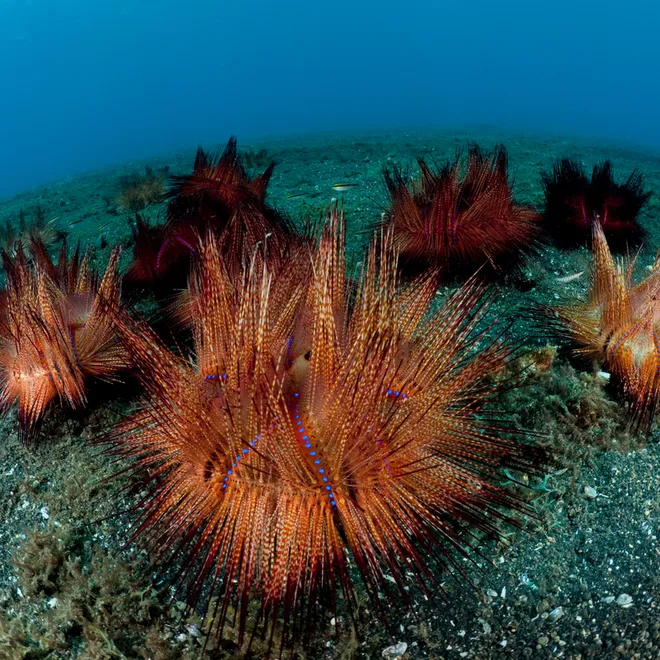
Echinoderms are those strange, sometimes slimy or spiky creatures that live on the ocean floor—think sea cucumbers, sea urchins, sea stars, and sea lilies. While they may look unsettling, these animals are ecologically important seafloor animals that help move and reshape sediments, influencing nutrient cycling and carbon storage in complex ways.
For one, some echinoderms feed on organic matter on the seafloor and can rework sediments through a process known as bioturbation. In certain habitats, this activity can reduce algae buildup and improve conditions for seagrass by allowing more sunlight to reach the leaves. Deposit-feeding echinoderms may also help recycle nutrients and influence water quality, although these effects vary by species and environment. In this sense, echinoderms function like “vacuum cleaners of the sea”: as they move slowly across the sandy bottom, they can help limit nutrient overload (eutrophication) and support overall water quality.
Echinoderms also contribute to carbon storage: One study estimates they help capture and store up to 100 million tons of carbon each year5,6, which is equivalent to the emissions from 85.5 million gas powered cars for a year. They do this by building calcium carbonate skeletons from dissolved carbon in seawater. When they die, their skeletons break down and become part of seabed sediments, where the carbon can remain locked away for long periods.
Though they may look a little odd, echinoderms deserve recognition as true ocean climate heroes.

© Anthony Busiello / WWF-US
Bonus: the bees of the sea
Did you know that the ocean might also have pollinators?
Sea grass is a crucial marine habitat that is also important for climate change mitigation. By capturing carbon dioxide through photosynthesis, building carbon-rich plant material, and trapping organic carbon in the sediments beneath it, healthy and undisturbed seagrass meadows can keep carbon locked away for decades or even centuries.
Just as bees and butterflies help pollinate flowers, scientists have recently discovered that some seagrasses may rely on marine invertebrates to help with their reproduction. One example is turtle grass (Thalassia testudinum), which found in shallow, sandy waters of the Caribbean and Gulf of Mexico. Reproduction in turtle grass is aided by small but important partners. Male flowers release pollen at night, when many invertebrates are active, and these animals carry the pollen to female flowers7.
A similar partnership exists between a small crustacean, Idotea balthica, and red seaweed Gracilaria gracilis. These isopods often cling tightly to the seaweed, which provides them with shelter from predators and a surface from which they graze on algae[CB2] . The seaweed benefits as the isopods help transfer reproductive cells (spermatia) from male plants to female plants, enabling fertilization8.
In this way, marine invertebrates play a quiet but vital role in supporting these carbon-storing ecosystems.

© Shutterstock
The bottom line
The ocean is a vast and interconnected network of ecosystems, shaped by both living and nonliving elements. Every organism—no matter how small—plays a vital role in sustaining the food web, maintaining ecosystem health, and showcasing how nature is one of our best heroes in the fight against climate change.
By recognizing and celebrating these tiny-but-mighty ocean heroes, we’re reminded that every form of life matters. WWF works to conserve and restore blue forests, which includes mangroves, seagrass, saltmarsh, and kelp, to tackle the interlinked crises of climate change, biodiversity loss, and coastal vulnerability.
More wildlife climate heroes
From otters to elephants and whales to wolves, different species have a vital role to play in combatting the impacts of climate change and maintaining planetary health.
See how wildlife is working hard to fight our planet's greatet threat.

© WWF-US / Keith Arnold
Sources
- https://pubmed.ncbi.nlm.nih.gov/24311124/
- https://www.nature.com/articles/s41467-019-12668-7
- https://www.sciencedirect.com/science/article/pii/S0169534716300763?via%3Dihub
- https://agupubs.onlinelibrary.wiley.com/doi/10.1029/2022GB007523
- https://www.nature.com/articles/ncomms12980
- https://www.science.org/doi/10.1126/science.abo6661?adobe_mc=MCMID%3D84642491739088231094049347991384876828%7CMCORGID%3D242B6472541199F70A4C98A6%2540AdobeOrg%7CTS%3D1659023737&_ga=2.258250698.1396648424.1659023705-689641651.1609118629
- https://esajournals.onlinelibrary.wiley.com/doi/full/10.1890/09-0553.1
- https://news.mongabay.com/2010/01/bottom-dwelling-sea-animals-play-surprising-role-in-carbon-sequestration/