What’s the biggest animal that has ever lived? Fascinating blue whale facts
Blue whales are the biggest animal to ever live—and that’s including dinosaurs!
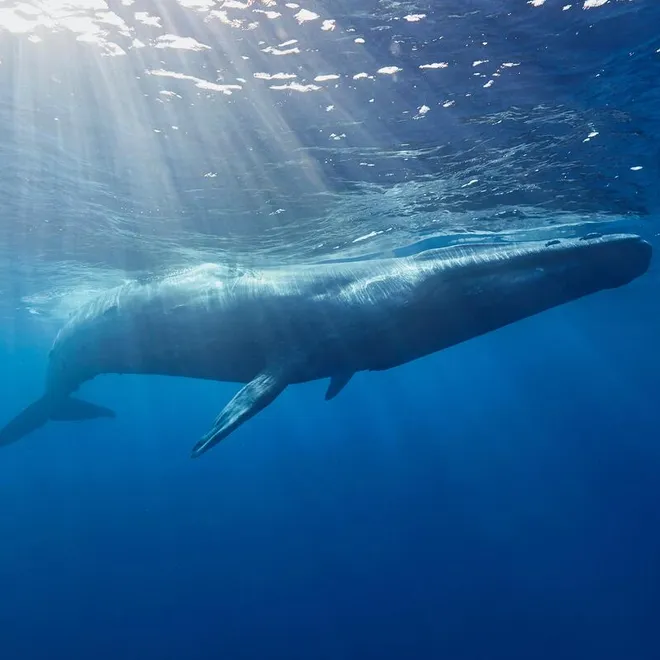
© Shutterstock / Ajit S N / WWF
Blue whales (Balaenoptera musculus) are some of the most impressive animals on Earth. Here are five things you should know about them.
1. Are blue whales the biggest animals to have ever lived?

© naturepl.com / Alex Mustard / WWF
Yes! Blue whales are the biggest animals to have ever lived. They can grow as long as three school buses (up to 100 feet) and weigh up to 200 tons—as heavy as about 33 elephants (the largest land mammal alive today, by the way). In fact, almost everything about blue whales is enormous. Their heart is the size of a Volkswagen Beetle, with an aorta so wide a human could crawl through it. Even as calves, they are already about 25 feet long and weigh over 7 tons, drinking roughly a bathtub’s worth of their mother’s milk each day!
2. How loud are blue whales?

© Richard Barrett / WWF-UK
Blue whales are the loudest animals on Earth. Their calls can reach 188 decibels—far louder than a jet engine, which tops out around 140 decibels. These calls are mostly too low-frequency for humans to hear, yet they can travel thousands of miles through the deep ocean. Blue whales use them not just to communicate, but also to navigate; by listening to how their calls bounce off underwater features like mountains and ravines, they can build mental maps of their environment.
3. What do blue whales eat?
Despite their size, blue whales are filter-feeders. They are baleen whales, meaning they have rows of flexible, fringed plates made of keratin (the same material as your fingernails) hanging from their upper jaw. Up close, they almost resemble rows of toothbrush bristles. These plates act as a sieve: blue whales take in huge gulps of seawater, then push it back out through the baleen, trapping krill and small fish inside. Because they are so humungous, they need enormous amounts of food. In fact, a blue whale can eat nearly 8,000 pounds of krill a day, and its stomach can hold up to a ton at a time!
4. Are there any hybrid blue whales?
Sightings of blue–fin whale hybrids were reported by whalers as early as the 1800s, and in recent years, these animals have been confirmed genetically. Blue whales and fin whales are both large, migratory baleen whales found in oceans around the world. Because their ranges and behaviors overlap, crossbreeding between these two iconic species is possible, even though they diverged genetically as far back as 11.6 million years ago in the late Miocene. Blue–fin hybrids tend to show a mix of traits: they are similar in size and bluish-gray color to blue whales, but often have a more fin whale–like dorsal fin, along with subtle speckling or mottling.

© naturepl.com / Mark Carwardine / WWF
5. Are blue whales endangered?
Like many other whale species, blue whale populations were severely depleted in the 1800s by commercial whaling and have never fully recovered. Today, they face a host of human-induced threats, including ship strikes, entanglement in fishing gear, noise and chemical pollution, and climate change.
To help protect them, WWF and our partners have launched an initiative focused on safeguarding “blue corridors”—the specific, well-traveled routes whales use during their annual migrations. Drawing on satellite tracking, photo identification, and other data, the Blue Corridors report maps these routes and highlights key hotspots where human activity is increasing. It also identifies conservation opportunities and outlines practical solutions to reduce risks to whales along these critical pathways.
Learn more about blue whales.
© WWF-US / WWFGifts
Adopt a blue whale
Support WWF’s global efforts to protect wild animals and their habitats and choose from kits with plush and more.
Sources
https://www.sciencedirect.com/science/chapter/edited-volume/abs/pii/B978012373553900033X
https://www.worldwildlife.org/species/whale/blue-whale/
https://wwf.org.au/what-we-do/species/blue-whale/
https://www.nps.gov/places/blue-whale.htm
https://www.fisheries.noaa.gov/species/blue-whale
https://www.bbcearth.com/news/the-loudest-voice-in-the-animal-kingdom