Koleen Haldeman
Bringing the Arctic to the Midwest
Koleen Haldeman, an educator at Papillion LaVista Community Schools Zoo Academy located within Omaha’s Henry Doorly Zoo and Aquarium, brought the Arctic into the heart of the Midwest after receiving Natural Habitat Adventures’ Churchill Polar Bear Scholarship Grant, transforming a firsthand polar expedition into a real-world learning experience that reshaped how her students understand human-wildlife coexistence and conservation in a changing climate.
© Courtesy of Koleen Haldeman
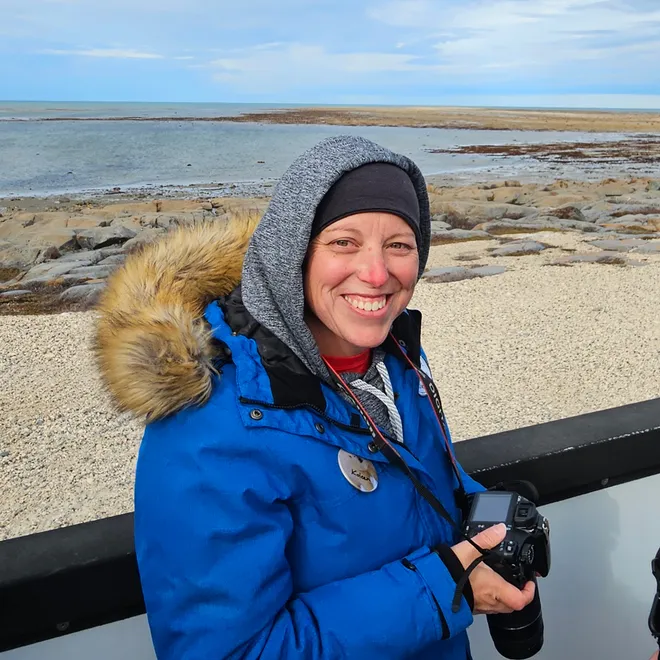
As a recipient of Natural Habitat Adventures second annual Churchill Polar Bear Scholarship Grant, I had the extraordinary opportunity to embark on a learning expedition to Churchill, Canada, where I observed polar bears in the wild and learned firsthand about Arctic ecosystems and the complex relationship between wildlife and the people of Churchill. Witnessing polar bears in their natural habitat - adapted to one of the harshest environments on Earth - provided insight that extended far beyond textbooks. Equally impactful was learning how the community of Churchill practices coexistence with polar bears through education, respect, and conservation-driven strategies.

© Courtesy of Koleen Haldeman
Inspired by this experience, I brought Arctic conservation stories and knowledge back to Nebraska, sharing them with my Zoo Academy students, as well as with education and animal care staff at Omaha’s Henry Doorly Zoo and Aquarium. My students were immediately captivated by my firsthand accounts of polar bear anatomy, genetic adaptation, and the cascading effects of climate change on Arctic ecosystems. The authenticity of my experiences sparked curiosity and led to meaningful cross-disciplinary scientific discussion.
I intentionally integrated knowledge from the expedition into multiple courses. In comparative anatomy, students examined structural adaptations that allow polar bears to conserve heat and thrive in extreme cold. In genetics, students explored population adaptation, gene flow, hybridization between grizzly bears and polar bears, and the consequences of rapid environmental change. In conservation service learning, students analyzed human - wildlife coexistence strategies through classical conditioning and reflected on how similar models could be applied to communities worldwide. The lessons also connected polar bear anatomy to the biomagnification of toxic chemicals in aquatic environments, helping students understand how their daily actions, even from thousands of miles away, can impact Arctic ecosystems.

© Koleen Haldeman
The experience proved impactful for students, who gained both scientific understanding and a personal connection to Arctic wildlife. Many students reported that hearing real-life accounts made conservation feel immediate, relevant, and necessary. Polar bears became more than distant symbols of climate change, they became real animals facing tangible challenges that each of us can help address through our everyday choices.
Resources from the WWF website extended my students' learning by providing conservation initiatives in Churchill, including community-based polar bear safety protocols, species monitoring, and efforts focused on climate resilience. Students explored current projects, research updates, and conservation strategies from WWF to understand how conservation organizations work with local communities to create solutions. These resources mixed with my firsthand experience led to emotional connection to the challenges facing Arctic ecosystems and encouraged them to brainstorm ways they can make a difference, even from the Midwest.
Through my participation in this expedition, I continue to extend the impact of Arctic conservation far beyond Churchill, empowering Midwest students with knowledge, empathy, and a lasting commitment to protecting the natural world.