Waste not
Florida students and teachers take on school food waste—one lunch tray at a time
By
-
Lee Poston
Photography by
-
Rebecca Drobis
Illustrations by
-
Nick Slater

© WWF-US/Rebecca Drobis
It’s 9:30 on a Wednesday morning and Melissa Miskovsky is rallying a classroom of boisterous fifth graders at Orlando’s Citrus Elementary School.
“What does it mean when something is decomposing?” Miskovsky asks. The question flashes on a TV monitor, followed by four multiple-choice answers. Eager hands thrust into the air, including that of Madison R., who exclaims, “Oh, I know what that means!”
Students enter answers on their tablets before Madison triumphantly reads the correct response aloud: “Decomposing materials return valuable nutrients to the soil, supporting plant growth and ecosystem function.” When the class’s answers are displayed on the monitor, shouts of joy erupt; every single student chose the correct answer. Clearly, Miskovsky has taught them well.
The teacher then encourages her students to think beyond the quiz to how the questions relate to what they eat—and, more importantly, don’t eat—in the cafeteria. You can almost see the children connect the dots, realizing that everything they eat is part of a much larger, interconnected system that they have the power to affect.
“It’s important for students to understand the ‘why’ behind what we are doing,” Miskovsky says about her classes’ deep dive into the issue of food waste. “They need to understand the impact it has on our community and our planet. Understanding their impact at school can help build concepts about cause-and-effect relationships as well as the interdependence among all living things.”
This soft-spoken, eloquent evangelist for eliminating waste in schools was so bothered by how much cafeteria food at her previous school ended up in the landfill that when she learned the district had secured a US Department of Agriculture grant to support waste reduction in 21 schools, she jumped at the chance to take part. “I was seeing so much food thrown away every day when I had lunch duty, it made me crazy,” she says. “So when I saw this opportunity, I thought, ‘well, here’s a great way to fix this problem.’”

© WWF-US/Nick Slater c/o Folio Art
Myth: Food share tables violate food safety standards.
Reality: Share tables are safe and allowed when schools manage them properly and follow appropriate food safety guidelines—like keeping perishable items at safe temperatures, checking expiration dates, and ensuring all packaging stays sealed.
Orange County Public Schools is the eighth largest school district in the country, with 207,000 students and 24,000 employees. It has made waste reduction—specifically food waste—a pillar of its 2030 sustainability goals. To support the school system, WWF provided a grant for Citrus and four other schools to conduct food waste audits and educational programming as part of the Food Waste Warriors program.
What the audit found was startling: Food made up approximately half the waste stream at all five schools.
It’s not an isolated issue—and Miskovsky isn’t alone in her concern. The problem of perfectly good food going uneaten and left to decay in landfills is a global problem that contributes to climate change and negatively impacts ecosystems, wildlife, and food security. But unlike some of the planet’s most complex environmental challenges, solutions related to food waste are plentiful and relatively easy to do.
“Food is not trash,” Miskovsky says. “It should be eaten, and if it’s not eaten, it can be composted and turned into fertile soil.”
That’s music to the ears of Mary Jane Chandler, WWF’s program officer for food loss and waste, who through the Food Waste Warriors program is helping tackle the problem in US schools, which serve 4.9 billion lunches every year. The initiative offers a suite of K-12 classroom lesson plans, toolkits, and activities designed to build a better understanding of where those billions of lunches come from—and where they go.
“Food Waste Warriors is all about turning the cafeteria into the classroom, getting kids thinking and asking questions,” Chandler says. “They’re using their hands as they’re eating their food, so it’s already this interactive space, so how can we integrate sustainable food education and behavioral practices as well?”

© WWF-US/Rebecca Drobis
A world of waste
Forty percent of all food produced on the planet is wasted. In the US, roughly 10 million tons of crops don’t even make it off the farm because of labor shortages, extreme weather, low market prices, overproduction, or simply because it doesn’t meet the cosmetic standards of America’s grocery stores.
The food that does make it into schools feeds nearly 30 million students (about the population of Texas) every day, making schools one of the largest food service systems in the US. A 2019 study by WWF, based on food waste audits from 46 schools, found that each student wastes an average of 39.2 pounds of food per year. When applied to all schools nationwide, that amounts to as much as 530,000 metric tons of food (excluding milk) sent to landfills from K-12 schools annually, equal to 1.9 million metric tons of greenhouse gas pollution—or the weight of 106,000 elephants.
“Food carries a huge—and hidden— environmental footprint,” says Pete Pearson, WWF’s vice president for food loss and waste. “Food waste awareness campaigns typically show mountains of fruit and vegetables rotting in landfills, but it’s the waste of animal proteins, dairy, or seafood—while less evident by volume—that is the real tragedy.
“It may look like you’re not wasting much by dumping an unopened milk container in the school trash, but that’s just the tip of the iceberg,” he says. “Much of what’s lost, including all the embedded resources that go into milk production—like energy, water, land, labor, and nature—is unseen. That’s what you’re really wasting.”
Agriculture is among the largest drivers of biodiversity loss globally—which means, in theory, you could draw a line from many of the planet’s endangered species to the burgers or Tater Tots® served on elementary school lunch trays. Some projections suggest that by 2050, agricultural production will be responsible for a staggering 70% of all terrestrial species losses. Agriculture (including forestry and other land use) also accounts for 22% of global greenhouse gas emissions and sucks up 70% of the world’s dwindling freshwater supplies.

© WWF-US/Nick Slater c/o Folio Art
Myth: Food waste reduction programs take time and resources away from other core requirements like math and science.
Reality: These programs can be incorporated into STEM lessons, helping to build skills in critical thinking and data analysis, Earth science, and math.
When it comes to planetary impacts, it seems the food that keeps us alive is one of the things that’s hurting us the most.
It’s for these reasons that WWF began the Food Waste Warriors program in 2018 as an extension of its broader focus on global food systems and biodiversity. From humble beginnings as a classroom teaching tool, the program is now active in nearly 1,000 schools across 31 states. The interactive curricula include guidance on waste audits and tracking data, practical ideas including “share tables” and “share refrigerators” where students can place unopened or uneaten food for others to take, and an advocacy framework that empowers young people to drive change around food issues, from local school boards to state legislatures.
Back at school, Chandler is playing a wildlife-themed “cootie catcher” game with one of Miskovsky’s students after helping another build a LegoTM panda. Miskovsky is with another group, demonstrating how to weigh leftover food and sort out what can be composted from what’s headed for the landfill. The activities come from the Food Waste Warriors curriculum, and judging by the class’s rapid-fire questions, wide-eyed enthusiasm, and bursts of creativity, it’s clear: Hands-on activities are a powerful way to cement the many ways food and biodiversity overlap.
For the curriculum to truly succeed, Chandler says it should embrace and build on skills being taught in other classes, such as math and science, and be adaptable enough to conform to a particular school system’s existing standards.
In many schools, its principles are woven into complementary lesson plans—the science behind food waste, the math used to calculate and track the weight of compost, or the geography of where food originates.
“While the curriculum meets teaching standards around food webs or how food grows or the importance of wildlife,” says Chandler, “it’s also teaching them observation and critical thinking skills and allowing them to connect it to their daily life.”
That’s certainly the case with Ruben P., a quiet fifth grader who has translated his knowledge into action on the home front. “I talked to my parents about it,” he says. “I told them it was fun to compost, it helps the Earth, and it helps plants when they send it to the garden. We have a fruit tree in our backyard, and we’re trying to compost our waste so when it turns into soil, we can put it around the tree, so I can give it nutrients.”

© WWF-US/Rebecca Drobis
From classroom to cafeteria
As she marshals her class into a single line and walks them to the cafeteria, Miskovsky remembers when she once thrust her bare arm into a composting bin to dig out a ketchup packet, telling her disgusted students that it’s important not to contaminate the compost. “It was a nice little teachable moment—to show that I was willing to roll up my sleeves and get dirty for the bigger cause,” she says.
When she arrived at Citrus, Miskovsky found a kindred spirit in Daniel St. Onge, a like-minded, energetic teacher and the driving force behind the school’s participation in Food Waste Warriors. “For the past few years,” says St. Onge, an instructional coach who focuses on math and science, “the amount of stuff that’s getting thrown away, the amount of food that’s unwrapped and in containers … it all just went straight into the trash. I mean, we were filling the trash cans.”
Before tackling the problem, however, St. Onge had to gain the trust of Food and Nutrition Services Manager Kim Alshakur, who radiates compassion for kids and was recently named Influencer of the Week by the West Orange Times. After peppering St. Onge with questions about implications for food costs, staff time, and feasibility, she quickly became a believer.
“I was very persistent with my manager, saying, ‘I see a lot of food waste, a lot of kids being hungry. Let’s try to participate in this so we can make sure it’s a success,’” Alshakur recalls. For the 2024–25 school year, 88.7% of the student population at Citrus qualify for federally supported free lunches and academic support.
As students move along the cafeteria line, Alshakur constantly reminds them that if they don’t want something on their tray, they can leave it on the share table for another student who may still be hungry. “They love that,” she says with a wide grin.
© WWF-US/Nick Slater c/o Folio Art
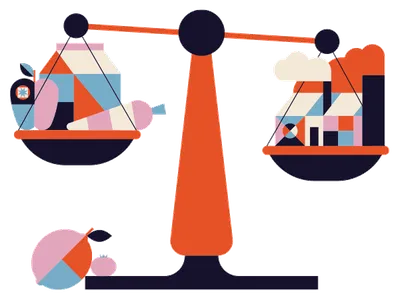
Myth: With so many other environmental challenges, like climate change and species loss, food waste in schools isn’t that important.
Reality: Food waste is closely linked to many global issues, including wildlife loss, climate change, and overuse of water resources.
St. Onge, Miskovsky, and Alshakur’s hard work has translated into big results. Since Citrus Elementary joined the program in August 2024, the school has converted 16,388 pounds of food waste into compost. The 21 OCPS schools that piloted the program have seen similar results. A total of 263,675 pounds of discarded food that would have previously ended up in landfills is instead nourishing new vegetables and fruits.
Sharing is caring
The discarded milk cartons that frustrated St. Onge are one of the most visible symbols of how policy, guidelines, and lunchroom sustainability intersect.
According to a 2019 WWF report, US schools toss an estimated 45 million gallons of milk each year. Producing just one gallon requires 144.2 gallons of water, which means that the milk discarded annually by schools represents enough wasted water to fill nearly 10,000 Olympic-sized swimming pools. In fact, the CO2 released in producing all that milk is equivalent to the annual emissions of 77,000 gas-powered vehicles—an environmental toll that’s multiplied when waste goes to landfills or incinerators.
“You don’t have to serve everything that you’ve got,” Pearson says. “You can give students options to take things.” Most institutions, he argues, already know when food is likely to go uneaten. “But we’ve got these myths about what’s required that stand in our way—and they actually create waste. You don’t have to take a milk carton, for instance, just to throw it in the trash.” As food insecurity grows in America, the program serves a dual purpose: preventing waste while reducing hunger. During 2024–25, OCPS share tables recovered and redirected 21,000 pounds of food to community food-recovery programs or into other students’ hands.
Pearson advocates for bulk milk dispensers that allow children to take only the amount of milk they need in a glass instead of a carton. WWF’s study found that around 32 cartons of milk are wasted per student each year. If they use jugs or milk dispensers, however, those numbers drop.
© WWF-US/Rebecca Drobis
© WWF-US/Rebecca Drobis
Completing the circle
As lunch wraps up, Isabella I. and Ruben P. roll compost bins past every table; students dump their leftovers before filing out. St. Onge pitches in as a compost collector, gathering half-eaten apples, untouched empanadas, and leftover milk while trading the occasional joke and offering encouragement.
The compost bins are then picked up by O-Town Compost and taken across town, where founder Charlie Pioli and his team have already collected more than 450,000 pounds of food waste and lunch trays (made from compostable fibers) from the 21 OCPS pilot schools. “We haul it all to local farms, who process it into finished compost,” Pioli says. “Then we bring that [compost] back so they can fertilize their school’s gardens and ultimately tell that circular story: that food waste is not trash—it’s actually a resource that can help to grow more food.”

© WWF-US/Nick Slater c/o Folio Art
Myth: Starting a new food waste reduction program is too expensive.
Reality: Schools can launch food waste reduction programs for as little as $2,500—and save money through lower food purchasing costs and trash disposal fees.
It took Pioli three years to compost his first million pounds. Now he hits that mark every three months, demonstrating the increasing demand for composting, which he attributes to new city and state regulations, growing public awareness of the impact of solid waste, and lower barriers to entry in the industry.
“It’s one of those rare instances in capitalism where growth is actually good for the environment,” he says.
Getting to scale
In the schools where Food Waste Warriors has been implemented, WWF estimates a 14.5% reduction in food waste and a 12% reduction in milk waste. But to truly make a long-lasting impact, the program needs to reach as many of the nation’s more than 100,000 schools as possible.
“I would love to see this become an institutionalized part of the National School Lunch Program, with lunchrooms across the country actively monitoring the food they serve and the waste they generate, and those lessons embedded in a curriculum that teaches students about the ecology and origins of our food,” Pearson says.
Chandler cites the low barrier to entry as a key reason Food Waste Warriors is an ideal fit for schools of all sizes, including those with limited resources. “It’s simple to implement and intentionally designed to be flexible, low cost, and low stress,” she says. “All it takes to get started are a few basic tools—a scale, some bins, a cart, a cooler, and a few student or staff volunteers.” Grants or local partnerships, like those offered by WWF, can often help schools cover some expenses as well.
The financial benefits alone justify scaling up, Chandler adds, noting that cutting food waste in all schools could save $1.7 billion annually. “Think about what that could mean for resources, for school infrastructure, for staffing capacity, for food.”
Pearson agrees, noting that programs like Food Waste Warriors can drive meaningful change from the ground up. “These types of initiatives don’t require millions in government funding,” he says. “What’s needed is local-level action. Sponsoring a school cafeteria food waste reduction program is one of the most impactful steps a local community or business can take on behalf of a healthier planet. We want students to imagine a world without waste.”
Miskovsky adds, “I hope that students are able to realize that they do have power and that even these small things that we do in our day-to-day lives can impact the world at large.”
WITH GRATITUDE for their generous support of WWF’s work to improve the planet’s food systems and help stop food waste in schools: VoLo Foundation

© Sarah Mosquera / WWF-US
Explore more
Keep reading this issue of World Wildlife magazine