Wisdom Keepers
In South Dakota and across the Great Plains, Native-led efforts to return bison to their ancestral homes are restoring Indigenous lands and lifeways.
By
-
Benjamin Alva Polley
Photography by
-
Sarah Mosquera
Illustrations by
-
Nick Slater

© WWF-US/Sarah Mosquera
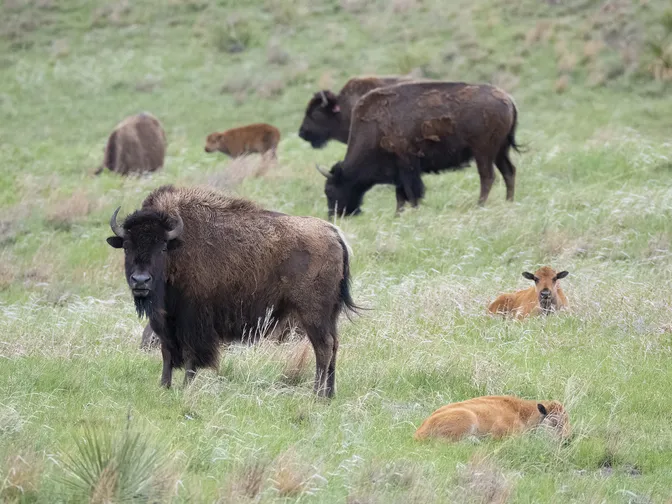
On a 100-degree day in mid-June, a few dozen shaggy, coffee-colored bison stand in a field, their tails swishing vigorously in rhythmic arcs to ward off flies. Their bodies rock gently back and forth as they pant in the heat, grunting softly.
At the front of the herd, an elder female begins to walk, and soon the others follow her lead, meandering slowly across the vast, rolling grasslands of the Wolakota Buffalo Range in southern South Dakota.
Monica Rattling Hawk, an enrolled citizen of the Oglala Lakota Nation and a WWF Tribal liaison, watches them go by. Older cows play a crucial role in the herd’s survival and well-being, she explains. Matriarchs like these guide family units of about a dozen cows and their calves, leading them to food, water, and mineral sources—and steering them clear of threats.

© WWF-US/Sarah Mosquera
“Matriarchs hold the responsibility for a herd and a family, sharing wisdom with their daughters and keeping the herd intact,” she says. “As Lakota people, we are a matriarchal society too.”
Established on the Rosebud Reservation in 2020 with support from WWF, the US Department of the Interior, and others, the Wolakota range is home to more than 1,100 bison (or buffalo)—one of the largest Tribal-owned and -managed herds in North America. Eventually, the 28,000-acre tract of grassland could support as many as 1,500 animals.
“The prophecies say that when bison return strong, so will the strength of our people.”
The bison’s return to this ancestral land is part of a Tribal-led effort across the Great Plains to regenerate the land, the economy, and the culture of Native Nations that traditionally lived with buffalo.
Now the Tribal Buffalo Lifeways Collaboration, an alliance launched in 2024 among Native Americans in Philanthropy, WWF, and other partners, seeks to expand upon that legacy. Building on the organizations’ complementary strengths and working in partnership with the US Department of the Interior and US Department of Agriculture, the alliance aims to bring bison back to Tribal lands and expand herds at an unprecedented scale.
The relationship between the Lakota people and bison is a sacred one. According to the Tribe’s origin story, people first emerged from the spirit world alongside the bison at Washun Niya, or Wind Cave, located about 175 miles west of Wolakota. The first bison were a gift from the creator that would lead people to water and teach them how to survive.
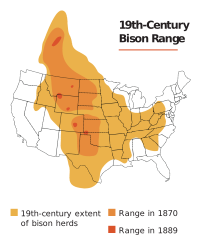
The Lakota, like other Plains Tribes, migrated nomadically alongside the bison, which once numbered in the tens of millions, setting up temporary camps and relying on the animals for virtually every aspect of daily life, including food, shelter, clothing, and tools.
As the herds moved across the plains, they not only nourished the people but also the land, playing a vital role in maintaining the ecosystem. “Their grazing patterns encourage the growth of native grasses,” says WWF’s bison program manager Dennis Jorgensen. “Their hoof action also aerates the soil, improving water penetration and seed germination. And the bisons’ wallows—depressions created when they roll on the ground—collect rainwater and provide important breeding habitats for amphibians.”
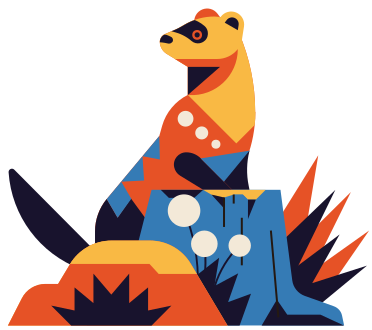
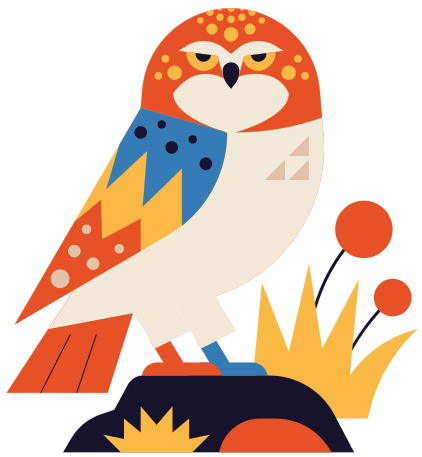
These bison-grazed grasslands in turn support a wide range of other animals, including prairie dogs, black-footed ferrets, burrowing owls, and migratory birds.
For millennia, the bison, the land, and the people existed and evolved as one. Then, in the 1800s, European settlers and hunters swept west, decimating the herds. Some slaughtered the animals to meet a growing demand for hides. Others acted under US government campaigns aimed at starving, displacing, and wiping out the Native Peoples who depended on them.
The eradication of the bison also significantly degraded the health of the grasslands, and cattle and other livestock introduced in their place overgrazed some plants, further reducing biodiversity. By 1884, no bison were left at Wind Cave; by 1889, only around 500 plains bison remained.

© WWF-US/Sarah Mosquera
Meanwhile, Plains Tribes endured another blow: the forced removal from their lands and relocation onto reservations. Framed as a pathway to assimilation, the Dawes Act of 1887 intentionally broke up communal Tribal lands, redistributing small individual allotments to Native Peoples and selling over 90 million acres to settlers. At the same time, federal policies banned Indigenous languages and ceremonial practices and forced Native children into government-run boarding schools.
Stripped of bison, food, land, cultural lifeways, and their children, Native Nations suffered extreme poverty, food insecurity, and disconnection from the land that had sustained them—the effects of which have reverberated across generations.
On the Rosebud and neighboring Pine Ridge reservations—two of North America’s poorest communities—health issues are widespread. Rates of cancer, diabetes, and alcoholism are disproportionately high. Access to healthcare and housing is limited, and food insecurity, poverty, unemployment, drug use, and suicide weigh heavily on many families. Life expectancy is far below the national average.
Returning bison to Native lands is integral to restoring both the ecological health of the grasslands and the health of Indigenous Peoples, says Rattling Hawk. “Lakota prophecies say that when bison return strong, so will the strength of our people.”

© WWF-US/Sarah Mosquera
About 90 miles east of the Wolakota Buffalo Range, that vision is taking shape at the home of Rattling Hawk’s daughter, Alex Romero-Frederick, and son-in-law, Wayne Frederick. Together, the two own and operate a private family ranch on the Rosebud Reservation—the oldest Native-owned ranch in the county—on land originally allotted to Wayne’s sixth great-grandmother, Tawacin Waste Win, or Good and Compassionate Woman.
Wayne, a citizen of the Sicangu Lakota Oyate, grew up around bison. His father, Thomas Frederick, was once the director of the Tribe’s Department of Game, Fish, and Parks, and was the first to bring bison back to the Rosebud Reservation. In 1980, the US Department of the Interior approved Thomas’s request to acquire 25 bison as surplus from Wind Cave National Park, where, in 1913, conservationists had helped reestablish a herd.
But when the bison were on their way to the reservation, Wayne says, the governor of South Dakota tried to block the convoy over an unsubstantiated fear that the bison would spread brucellosis (a bacterial infection that can cause cows to lose fetuses) to cattle. So Thomas brought them in—driving a semi full of bison himself—taking the long way to the reservation through Nebraska to South Dakota.
Wayne and his father managed the herd on Rosebud for years, and Wayne later played an instrumental role in establishing the Wolakota Buffalo Range. Now, he and Alex are working to establish a commercial herd on their own Rez Raised Ranch, where cottonwood trees line the creek bottom near the couple’s house and a line of buttes rises against the horizon to the west.
© WWF-US/Nick Slater c/o Folio Art
Their son, Cedar, who manages the herd, is repairing a tractor he uses to harvest hay while Alex and their daughter, Summer, are preparing bison burgers for lunch. Both children were homeschooled on the ranch so they could learn and live closer to the land, says Alex. Summer is now enrolled at Colorado State University, where she’s studying to become a veterinarian; she, too, hopes to continue to work with bison.
Alex’s dream has always been to raise animals, and she believes it was momentous that she met her husband. “It was a bonus that he and his father brought back the buffalo,” she says. “It feels like a lot of prayers were said a long time ago to bring us all together.”
Ranchers in South Dakota, including those on the Rosebud Reservation, raise mostly cattle. Until recently, that included the Fredericks, though over the past 15 years they have run their cattle to mimic bison, employing a rotational grazing system to maintain healthy grasses and soil. They hope to eventually transition away from cattle altogether.
Start-up costs for running bison, like installing taller and stronger fences, can be prohibitive. But Alex developed a business plan to make it possible, and in 2022 the Fredericks welcomed their first five bison to the ranch. Not long after, they expanded their herd by 28 more through a partnership between The Nature Conservancy and the Tanka Fund, a nonprofit supporting family- and community- based Native bison ranchers.
The Fredericks want their ranch to serve as a proof of concept for other local ranchers, demonstrating that bison can be both profitable and better for the land.
© WWF-US/Nick Slater c/o Folio Art
In pastures grazed by bison, for example, the family has already seen a resurgence of wildflowers and native plants. “My daughter and I noticed an uptick in diversity this past year,” says Alex. “I see more birds returning, big deer, antelope, and even badgers and ferrets. A lot of our relatives are coming back.”
“We’re working hard to change a mindset,” she continues. “We decided to be the example, showing others that if we can do it, anyone can.”
“When the creation story was told to us, those buffalo were there to show us how to live,” adds Wayne. “Restoring buffalo is my duty. I want to see them on the plains, as common as cattle.”

© WWF-US/Sarah Mosquera
Four hours west of Rosebud, Heather Dawn Thompson, vice president of Native Nations Conservation and Food Systems at WWF and a citizen of the Cheyenne River Sioux Tribe, stands in a pasture dotted white with flowering yuccas. Wearing a dress adorned in a traditional Lakota manner with ribbons and bison tracks, she watches on as a group of bison calves give chase, one rust-red calf after another springing forward, flexing all four legs in the air, as if flying.
This land—the Dakota Partnership Ranch, formerly known as the 777 Bison Ranch—has deep historical roots for the Lakota Nations and once served as a migratory corridor for bison herds roaming between the Black Hills and the grasslands farther south. In October 2024, a land trust purchased the 26,276-acre tract, which is home to nearly 2,000 bison, to protect it from development.
But when the ranch changed hands, the land and the bison were sold separately, putting the herd’s future at risk. So WWF stepped in to ensure that 300 bison, including matriarchs and their families, could remain—thereby also ensuring that the animals can pass along their four decades of knowledge about the land to future generations.
“If these animals can recover from almost complete destruction to become strong, happy, and healthy, then any of us can.”
For Thompson, who previously led efforts focused on bison and food sovereignty at the US Departments of Agriculture and the Interior, the work is both personal and professional. She is a direct descendant of Mary Good Elk Woman, of the Miniconjou band of the Lakota people, and her husband, Frederick Dupree.
In the 1880s, Good Elk Woman is said to have sent her husband and son on an expedition to round up bison before the species vanished forever. With the handful of calves they caught, they established a small herd—one of just five private herds in the late 1880s that effectively saved the species.
It’s a legacy that Thompson is intent on honoring, and one she says that WWF and its partners have been working to strengthen. “Tribes have been essentially doing this on their own with almost no resources,” she says. “They’ve been fighting to ensure the buffalo are safe. It’s helpful to have large entities now supporting their work.
“Seeing the calves with their mothers fills me with hope,” she continues. “If these animals can recover from almost complete destruction to become strong, happy, and healthy, then any of us can.”
Rattling Hawk believes the return of bison to Native lands is reconnecting Tribal communities with their heritage and honoring their sacred relationship with bison. “Just as bison heal the landscape, the return of our matriarchal societies will also improve our ways and bring back ancient wisdom,” she says.
As an example, she points to the fact that more young women are exploring their identities through Isnati, coming-of-age ceremonies where they learn traditional Native women’s roles, medicines, and songs. “Today, we see far more young women participating than ever before. Those old lifeways are returning, and the young women taking part in them will be our leaders, restoring essential pieces to our societies.”
The bison’s return is also meeting material needs. The herd Wayne once managed on Rosebud helps supply free lunches for local students, and he sees food sovereignty as central to the vision he and Alex share for Rez Raised Ranch.

© WWF-US/Sarah Mosquera
“During our first harvest, we gave all the meat away to thank the community,” he recalls, and the couple plans to sell future harvests to Tribal members at affordable prices. Ultimately, they aspire to maintain 250 bison—supporting both cultural purposes and community health.
After lunch, Alex and Wayne walk the ranch with Rattling Hawk, discussing the herd’s future. A small group of bison assembles and forms a circle around Rattling Hawk, like elder matriarchs forming a protective ring around a calf.
It seems auspicious, and Rattling Hawk’s thoughts shift to her own grandchildren.
“I envision Cedar and Summer not facing the health disparities we do today,” she says. “Their hearts, minds, and bodies will be pure. I believe bison will be our salvation.”
WITH GRATITUDE for their generous support of WWF’s work to restore bison and support Native Nations in the Great Plains:
Anonymous | Binnacle Fund of the Tides Foundation | The Katherine J. Bishop Fund | David Cook | Cynthia Ann and Harry Eisenberg | Ove W. Jorgensen Foundation | Susan Jorgensen and Alice Gillaroo | Olseth Family Foundation | Joseph and Gene Swedish Family Foundation | Turner Foundation | Elizabeth Walsh and John Stephenson
© Sarah Mosquera / WWF-US
Explore more
Keep reading this issue of World Wildlife magazine