Sanctuary on Colombia's Chocó Caribbean Coast expands its conservation area to over 220,000 acres
Expansion triples the area co-managed by Afro-Colombian communities, home to critical nesting beaches for leatherback sea turtles

© Fílmico Colombia/WWF-US
The Acandí, Playón and Playona Wildlife and Flora Sanctuary, located in the Gulf of Darién region on the border with Panama, has expanded its conservation area to include San Francisco and Cabo Tiburón, more than tripling its size from 65,000 acres to more than 220,000 acres.
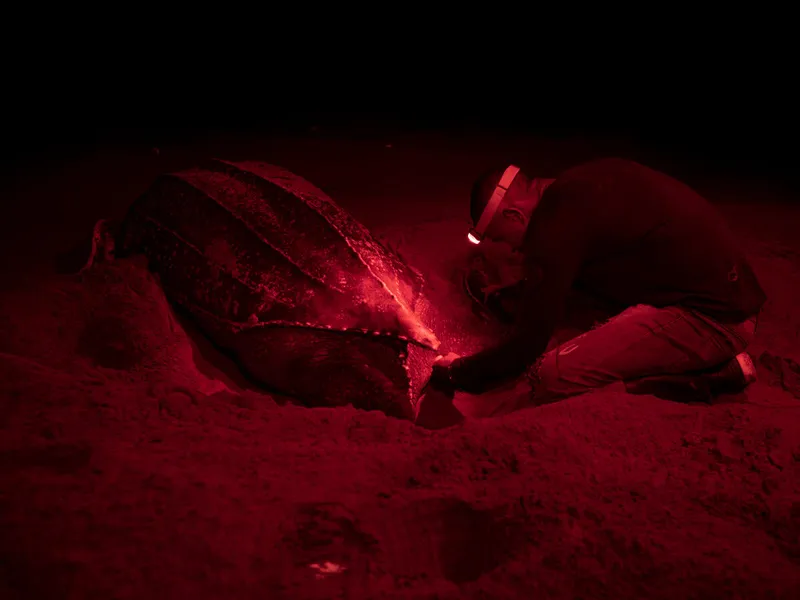
The newly renamed Acandí, Playón, Playona, San Francisco and Cabo Tiburón Wildlife and Flora Sanctuary (Acandí) is recognized for harboring one of the largest leatherback sea turtle nesting beaches in the world. It features a unique combination of coral reefs, mangroves, and coastal wetlands that support a wide variety of marine and coastal species.

© Fílmico Colombia/WWF-US

© Fílmico Colombia/WWF-US
“This expansion is more than a vast area on a map. It is a concrete instrument for protecting strategic marine-coastal ecosystems on the border with Panama, and it demonstrates that it is possible to build conservation models with the people who protect them and who promote ecotourism opportunities in Acandí.”
—Luisz Olmedo Martínez Zamora, Director of Parques Nacionales Naturales de Colombia
Key benefits of this expansion include enhanced protection for emblematic species such as sea turtles—including the leatherback (Dermochelys coriacea), hawksbill (Eretmochelys imbricata), green (Chelonia mydas), and loggerhead (Caretta caretta). These species hold deep social and cultural significance for local communities, and their protection will be strengthened as part of this expansion, alongside other species of regional importance.

© Fílmico Colombia/WWF-US
“When the pen came down on the signature, the Leatherback Turtle breathed more deeply in La Playona. She felt that her beach was not just a shore: it was home, law , and protected territory. Because to protect the Caná is to protect the water, the mangrove , and the word of the elders. ”
—Emigdio Pertuz, legal representative of Cocomanorte
© Fílmico Colombia/WWF-US
Like many natural areas in Colombia, this sanctuary faces significant threats, including deforestation, drug trafficking networks, irresponsible and unsustainable fishing, plastic pollution, and the impacts of climate change and beach erosion. This expansion strengthens Acandí’s management capacity to protect nature while integrating new natural and cultural values into its administration.
This achievement is, above all, the result of years of work, knowledge, and territorial stewardship by the Afro-Colombian communities of Acandí. Acandí is jointly managed by Colombia’s Natural National Parks and the community councils of Cocomanorte, Cocomaseco and Cocomasur, who are dedicated leaders in protecting the marine and coastal areas of the Gulf of Darién.
Acandí’s co-management structure protects both the natural and cultural riches of the region, ensuring communities maintain decision-making power in their collective territories. Expanding the sanctuary also increases the protection of Afro-Colombian culture through the preservation of Caribbean beaches, seagrass beds, and coral reefs that support ancestral practices such as traditional sustainable fishing and cultural tourism.

© Fílmico Colombia/WWF-US
“This management plan becomes the compass to guide conservation actions, strengthen the protection of species and consolidate the commitment of communities and institutions to this protected area.”
—Efraín Ballesteros Garcés, legal representative of Cocomaseco
Acandí is one of five marine areas included in Herencia Colombia, which has expanded or created nearly 44 million acres of marine protected areas since it was launched in 2022.
The first Project Finance for Permanence initiative launched with the support of Enduring Earth, Herencia Colombia supports 101 protected areas and seven connective corridors across Colombia, from the peaks of the Andes to the expanse of the Eastern Pacific Ocean and Caribbean Sea. This program not only preserves biodiversity but also promotes the socioeconomic development of communities by integrating conservation, effective management, good governance, and prosperity.