Ending wasted food in cities creates jobs and dramatically reduces methane emissions
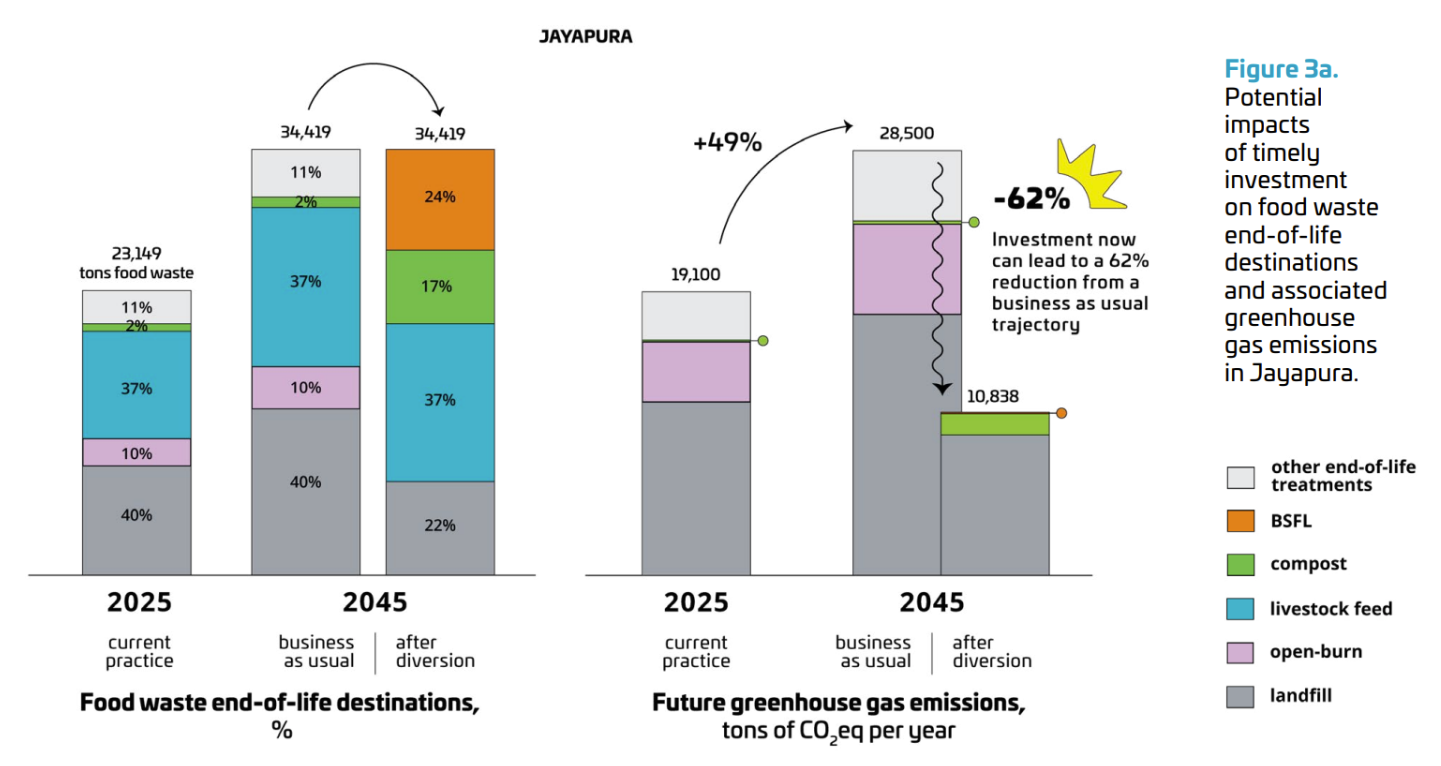
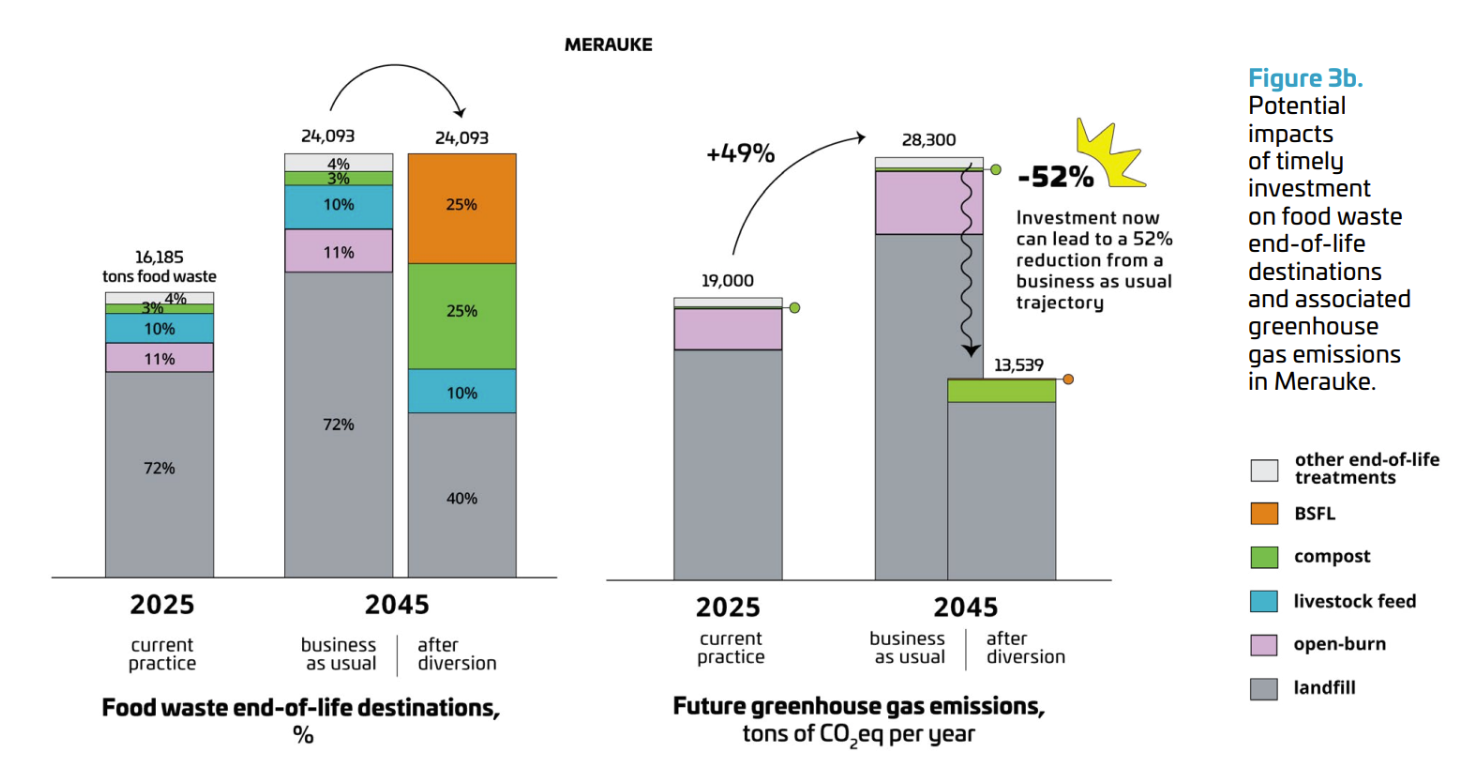
By scaling immediate investments into organic infrastructure and behavior change, Jayapura and Merauke could see a 62% and 52% projected decrease in future methane emissions by 2045.
By
Food waste is a major issue in Indonesia, and organics are the largest material (by volume) going into overflowing landfills. But it is not simply a disposal problem—it is a systems challenge and one of that country’s most immediate opportunities for climate action and sustainable development. Indonesia needs to get food and organics out of the trash and recognize that doing so can become an economic engine that creates value for communities, farmers, and for food security.
It’s an issue not only in Indonesia, however. WWF research found that moving the largest 200 cities in the world to composting and landfill diversion would cost approximately $160 billion over 10 years, based on forecasted population growth. The price only grows larger as we wait to invest. Why aren’t investment banks aggressively investing with governments in organic collection and soil manufacturing? There should be an immediate financial imperative to solve a problem that is literally in every city and town in the world. It’s the equivalent of a penalty kick in soccer – a concentrated, high-impact opportunity to change the game.
Recognizing that reducing food loss and waste is one of the fastest and most cost-effective climate solutions available today, WWF-US and WWF-Indonesia partnered with Delterra to explore how this transformation can occur in practice.
Together we implemented projects in Jayapura and Merauke Regencies in Papua—two fast-growing but under-resourced urban areas facing rising waste volumes, limited waste collection coverage, and minimal processing of organic material. The projects established baseline data, strengthened political interest and municipal capacity, and tested community-based behavior change interventions rooted in local values.

© Jürgen Freund / WWF
The state of food waste in Indonesia
Indonesia generates an estimated 23–48 million metric tons of food waste each year, an amount of food whose value is equivalent to 4–5% of GDP and which generates up to 7.3% of national greenhouse gas emissions. Wasted food and organic material also represents the largest share of Indonesia’s waste stream, accounting for more than 40% of total waste.
Indonesia is uniquely positioned to become a global leader in solving the issue of waste thanks to strong national policy momentum, including a national roadmap, integration into development plans, a forthcoming presidential regulation, and standardized measurement systems. As the national strategy envisions better recycling of plastics and a potential to bring more incineration of waste online, it should be noted that food waste and organic material is generally a very poor fuel for incinerators since it’s composed mostly of water with a very low energy value.
The best strategy for any country is to get food and organics into a dedicated manufacturing and industrial process and encourage food waste prevention.
Jayapura generates roughly 23,100 tonnes of food waste annually and Merauke about 16,200 tonnes, with an estimated 50% and 83% respectively being landfilled, openly dumped, or burned under current practices. Analysis further reveals a substantial proportion of edible food waste in both locations, highlighting missed opportunities for prevention, recovery, and redistribution and emphasizing the potential to redirect waste to other uses.
Why is waste so high, despite national ambition to reduce it?
Formal collection, separation, and treatment of organic waste in the two cities is extremely limited: Jayapura’s Environmental Department operates in just 3 of 19 districts and relies on dumping without treatment, while Merauke serves only one district and lacks a formal processing system, despite some informal diversion by pig farmers and waste pickers.
These local conditions reflect broader implementation challenges, including unenforced source separation regulations, gaps in infrastructure and budgets (with waste spending around 0.3% of regency budgets versus the national recommendation of ~3%), limited access to capital, weak offtake markets for recovered food or compost, and insufficient institutional capacity and partnerships.
By scaling immediate investments into organic infrastructure and behavior change, both cities could see a 62% and 52% projected decrease in future methane emissions by 2045 – not to mention jobs and economic development from benefiting industries like composting and black solider fly production, both of which benefit agriculture and sustainable development.
Forecasting Key Financing + Potential Emissions Reduction
With wasted food projected to grow by 49% in both regencies by 2045, the proposed diversion strategy targets about half of potential wasted food across the two regencies (Figures 3a and 3b). Jayapura and Merauke must close their solid waste management budget gaps and allocate CAPEX and predictable OPEX for waste collection and organic waste processing. This could be achieved by investing in solutions like centralized composting at a regency waste facility combined with home composting, and nature-based treatment using Black Soldier Fly (BSF) larvae.
While community practices and traditional norms discourage waste and support informal reuse, the absence of reliable services, financing, and coordinated governance prevents these efforts from scaling into sustainable, systemwide solutions.
Bringing it all together
From May to December 2025, WWF partnered with Delterra to apply a systemic approach to food waste reduction and methane mitigation in Jayapura and Merauke. Building on previous Delterra initiatives tested in Bali, this collaboration was an end-to-end demonstration of how awareness and behavioral change, local capacity building, and waste-system improvements can effectively integrate within a low-infrastructure context.
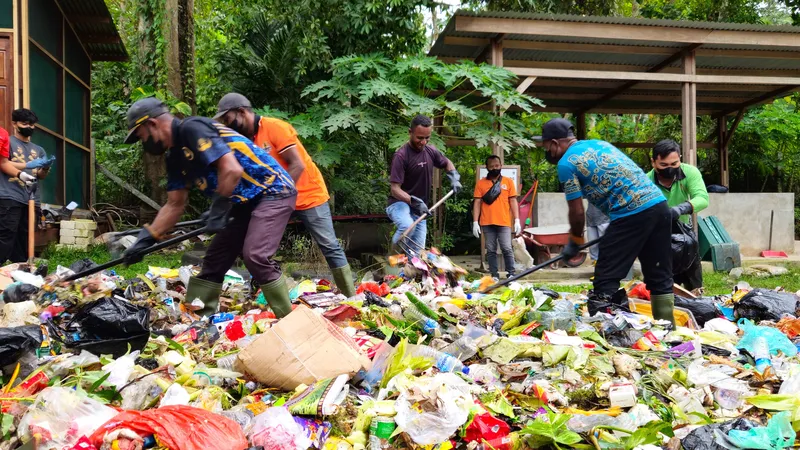
© Osorio Embulaba / WWF
A central component of the work with Delterra was demonstrating behavior-change interventions at the household level, delivered through trusted community institutions such as youth groups and faith-based organizations. These projects tested simple, culturally relevant actions including better meal planning, portion control, food storage, and waste sorting.
Rice was the single largest contributor to edible food waste in both cities. Key barriers included difficulty estimating portions, children not finishing meals, and reluctance to eat reheated rice or papeda. Informal diversion of food scraps to pig farmers represents an existing pathway worth formalizing.
The household-level interventions involved 15 households across Jayapura and Merauke. In Jayapura, edible food waste per capita decreased by 44% (0.09 to 0.05 kg/capita), likely due to improved portioning and meal planning, while in Merauke it increased (0.02 to 0.06 kg/capita), driven by seasonal mango surplus, rising rice leftovers, and children’s uneaten food—underscoring the need for sustained, seasonally responsive interventions.
What we learned
Project findings demonstrate both the scale of the challenge and the potential opportunities. Educators strengthened their knowledge, communities showed willingness to change, and both cities identified clear opportunities to improve waste management systems.
Households are the largest source of food waste in both locations, and a significant portion of discarded food remains edible—highlighting immediate potential for prevention, recovery, and redistribution.
Crucially, the projects confirm that awareness alone is not sufficient. Meaningful progress requires coordinated, systems-level action that integrates behavior change, infrastructure investment, policy reform, and capacity building. Even in low-infrastructure settings, this integrated approach can deliver measurable results when grounded in local context and implemented incrementally.
What's next?
START WITH PREVENTION AND REDUCTION by raising awareness, supporting schools and community groups, and reducing waste at the source.
SCALE COMMUNITY-LEVEL SOLUTIONS such as home composting, neighborhood compost hubs, animal-feed reuse, and decentralized processing.
INVEST IN CENTRALIZED SYSTEMS through creative financing that creates green jobs and a manufacturing industry that returns resources back to soils, farms, and communities.
By pairing data-driven insights with culturally grounded interventions and sequenced investment, cities can transition from fragmented waste systems to integrated, scalable models. This transformation unlocks significant opportunities to reduce methane emissions, improve food security, protect biodiversity, and create resilient local economies.

© Osorio Embulaba / WWF
Bottom line:
The Papua projects in Jayapura and Merauke Regencies show that even in a low-infrastructure context, meaningful progress is possible when national policy ambition is paired with city-level implementation, culturally grounded community engagement, robust data, blended finance, and targeted investment in organics systems.
We don’t need more “pilot projects”. We know what works. Indonesia has a rare alignment of need, policy momentum, and practical evidence— positioning it to move decisively to scale.
The missing element is creative financing. It’s time for the world’s development banks and financiers to be bold and scale investments. This is a financial imperative that must happen in EVERY city in the world.
When cities act and have investment in organic processing and business development, countries like Indonesia can transform wasted food from a climate and food security liability into a solution for people, nature, and the economy. Jayapura and Merauke have shown that delivering on methane mitigation is not theoretical—it is already underway, and Indonesia is positioned to show the world what accelerating that progress looks like.