Finding new pathways
While multilateral cooperation remains essential, the urgency of plastic pollution demands new, results‑driven pathways alongside traditional treaty processes to deliver real, rapid change for people and the planet.

By

© Markus Winkler
We are living in a moment of reassessment. The multilateral rules and coalitions that have governed our international order for decades are straining under the weight of challenges they weren't designed to handle at the speed we now need.
When Mark Carney stood at Davos and said we need to "pull down the signs," he correctly diagnosed what many of us working on the Global Plastics Treaty negotiations have been experiencing firsthand. I share his frustrations. And for us to move forward, we need to recognize that multilateralism is not the only tool at our disposal.
International cooperation and the structures that enable it remain essential. Global challenges require global solutions. But we also need to be honest when the traditional pathways aren't delivering at the pace the crisis demands and be willing to chart new ones alongside the old.
What Pulling Down the Signs Actually Means
The multilateral system has delivered extraordinary achievements, from the Montreal Protocol saving the ozone layer to MARPOL mobilizing global pollution action. These processes work. They've proven their value.
Carney certainly wasn’t calling for us to abandon international cooperation. And neither am I. What I believe he was saying—and what I'm arguing here—is that we should pursue new avenues to achieve it. We need to stop treating multilateralism as the single pathway. We need to see it as part of a broader framework for action that can be built upon, worked around, or reformed when it fails to deliver. And right now, for plastics, that means negotiators lifting their eyes from the procedural trenches and refocusing on what they actually came to do: deliver transformative, lasting change. Getting treaty design right is therefore the central challenge.
Effective agreements don't just set targets; they restructure the underlying logic that shapes what states and companies find it rational to do. The goal is mechanisms that make compliance and participation the obvious choice over time, and that build their own momentum: early movers creating conditions that make standing apart increasingly costly and joining increasingly attractive. Given how limited initial participation may be, impact in the treaty's early years has to be the starting point, not an afterthought.
The legitimacy of this treaty—and of environmental multilateralism more broadly—won't be judged by how many countries were in the room when it was adopted. It will be judged by what it actually changes. The impasse we're in is a leadership test for the states that came to negotiate in good faith. Procedural obstruction has a substantive answer: design a treaty that is effective enough, enforceable enough, and economically compelling enough that the path to adoption becomes clear. The case for multilateralism is made not in words, but in results.

© WWW.ROYCRUZ.COM
A Different Kind of Hope
I continue to believe in the power of collaboration. I still think global challenges require global solutions. But I've stopped believing that the pathways we've inherited are the only ones available to us.
Here's what gives me hope: we know exactly what needs to be done, and the research proves it can work.
The Breaking the Plastic Wave analysis also shows that with ambitious, complementary actions across the entire plastic system (what they call "System Transformation") we could reduce annual plastic pollution by 83% by 2040. Not incrementally. Not eventually. Eighty-three percent.
The tools exist: reuse systems, improved product design, enhanced collection and recycling, upstream controls on production. We don't need to invent new technologies to make this happen. We need to deploy what we already have at scale.
With a new INC chair in place, we now look to Ambassador Julio Cordano of Chile to show strong leadership and use all of the tools in the toolbox to drive this process toward finally securing a treaty that will deliver the long-term environmental, economic and health benefits our planet needs.
The challenge wasn't to throw up our hands. It was to get creative. To explore different ways to get where we need to go. To recognize that sometimes protecting the process means sacrificing the outcome, and we can no longer afford that trade-off.
Moving Forward
The next phase of Global Plastics Treaty negotiations will be critical. We may still achieve the comprehensive, legally binding agreement the world needs. I sincerely hope we do, and am encouraged by the election of Ambassador Cordano, and the approach laid out in the first HOD meeting.
But if we don't—if the process once again prioritizes procedural purity over planetary urgency—then it's time to pull down the signs.
It's time to build new pathways alongside the old ones. Time to create economic and political realities that make plastic pollution too costly to continue. Time to stop treating multilateralism as an end in itself and start treating it as one of many means to the end that actually matters: a world without plastic pollution.
The signs Carney talked about aren't just markers on a road. They're warnings. They're telling us that the route we're on isn't getting us where we need to go. Sometimes the most responsible thing you can do is find a new path.
The planet doesn't have time for us to do otherwise.
Join the conversation
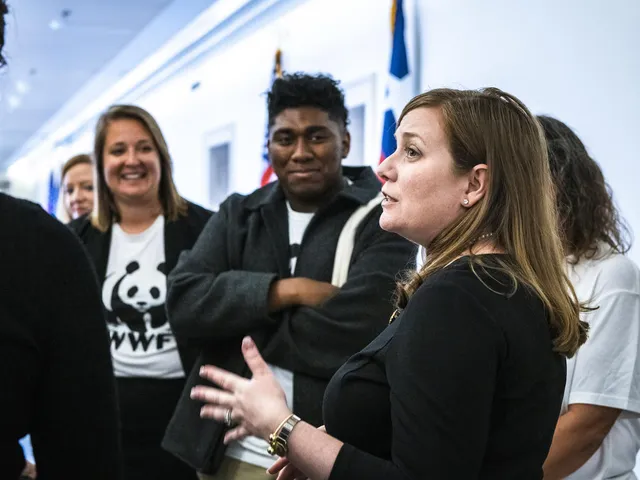
© WWF-US / Darren Higgins
Connect with Sustainability Works on LinkedIn
Stay current with insights from sustainability leaders and rising stars—fresh ideas, technical depth, and bold thinking across industries.