Disease and deforestation
Emerging research shows that land use, and specifically deforestation, can increase the risk and spread of infectious diseases. Forest loss and fragmentation lead to greater concentrations of disease pathogens and more frequent interactions between animal hosts, vectors, and humans.
© Kevin Schafer / WWF-Canon
Approximately half of today’s infectious diseases are zoonotic in origin — meaning they transmit to humans from other animals — including COVID-19, Ebola, malaria, and Lyme disease. As outbreaks and pandemics threaten global health and economies, scientists are looking at the origins of zoonotic disease and why these spillovers from animals to humans are on the rise.
Ebola & West Africa
Ebola is a rare but severe and often fatal disease, with a mortality rate of 50%. The virus is zoonotic in origin, and fruit bats are the most probable natural host. Transmission likely occurs from wildlife (fruit bats, porcupines, or nonhuman primates) to humans and then spreads among people. Recent research also indicates that humans can now act as intermediate hosts and can serve as long-term Ebola virus reservoirs that trigger new outbreaks.
Region disease profile
Studies of Ebola outbreak sites in West and Central Africa demonstrate links between forest loss or disturbance and the spread of the virus. Researchers found that most cases of Ebola transmission to humans – or “spillovers” – occurred in areas where there was the greatest forest disturbance which leads to increased contact between people and wildlife. Forest loss was found to be the greatest risk factor for Ebola, more than high human population density or other favorable viral conditions.
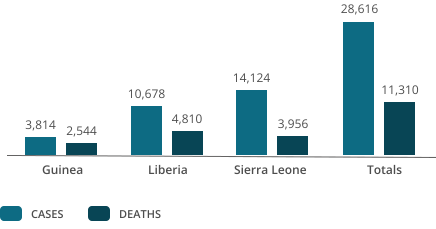
Ebola cases in West Africa
- Since its identification in 1976, Ebola has killed more than 13,000 people, with all cases originating in Africa. The outbreak in West and Central Africa between 2014 and 2016 was the most severe, with more cases and deaths than all other outbreaks combined.
- Recent research indicates that humans can now act as intermediate hosts and can serve as long-term Ebola virus reservoirs that trigger new Ebola outbreaks.
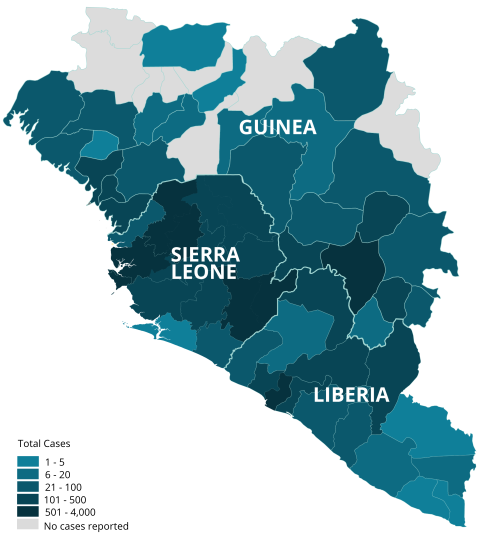
Total cases and deaths as of 04/13/16
2014-2016 Ebola Outbreak in West Africa. (n.d.). Centers for Disease Control and Prevention. https://www.cdc.gov/vhf/ebola/history/2014-2016-outbreak/index.html
Drivers of deforestation in West Africa
Smallholder farming Expanding agriculture, due to an increased population and shifts in diet, leads to most of the world’s deforestation.
Mining operations Rich in natural resources, including diamonds, gold, and coltan (used in cell phones), the West African forests are threatened by major mining companies and the unsustainable infrastructure they often bring.
Small-scale timber extraction Illegal and unsustainable logging, usually resulting from the demand for cheap wood and paper, is the primary driver of forest degradation.
Fuelwood and charcoal Wood and charcoal are popular fuel choices for cooking and heating in many communities. About half of the illegal removal of timber from forests worldwide is thought to be for use as fuelwood.
What WWF is doing
Conserving the Congo Basin is a massive effort, requiring collaboration on many levels, from local communities to multinational partnerships. WWF works to ensure better conservation of natural resources and more sustainable methods for their extraction to minimize impacts on forests. We also help communities reduce pressure for fuelwood by providing alternative fuel sources to timber and charcoal. By developing alternative, more sustainable livelihood opportunities, we support communities as stewards of their forests and their resources.
Malaria and the Amazon
Malaria affected 228 million people globally in 2018 and resulted in an estimated 405,000 associated deaths. Research shows that deforestation is linked to increases in malaria across different regions and different species of mosquitoes. Malaria is one of the infectious diseases with the most research on its ties to deforestation and may offer scientists insights into other zoonotic diseases.
Region disease profile
A 13-year study of 795 municipalities in the Amazon found a 10% increase in deforestation led to a 3.3% increase in rates of malaria. The early stages of deforestation – as forest edges shift and change – showed the greatest impact on malaria outbreaks. Studies noted that regional ecological variables, different mosquito species, and environmental variables will affect mosquitoes’ ability to develop and transmit the malaria parasite.
- Deforestation is linked to malaria through increases in sunlight and standing water that provide favorable breeding sites for mosquitos, as well as the loss of biodiversity and increases in human exposure to infected mosquitos.
- Studies reveal that while some vector mosquitoes require deep forest shade, other mosquitoes require partial shade and can thrive on forest edges or in areas with reduced tree cover.
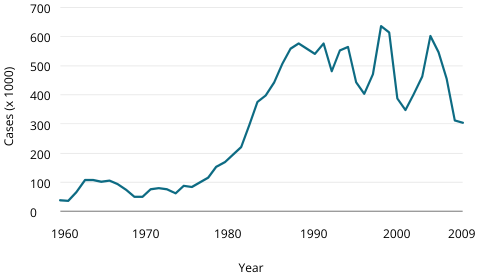
Cases of malaria in the Brazilian Amazon
MacDonald, A. J., & Mordecai, E. A. (2019). Amazon deforestation drives malaria transmission, and malaria burden reduces forest clearing. Proceedings of the National Academy of Sciences, 116(44), 22212. https://doi.org/10.1073/pnas.1905315116
Drivers of deforestation in the Amazon
Cattle ranching Beef is one of the leading drivers of tropical deforestation. In South America, cattle ranches are ravaging the Amazon and other landscapes.
Large-scale agriculture Rising demand for crops like soy has created incentives to convert forests to farmland and ranch land. Once a forest is lost to agriculture, it is usually gone forever.
Smallholder farming Expanding agriculture, due to an increased population and shifts in diet, is responsible for most of the world’s deforestation.
Transport infrastructure As agriculture, logging, and other businesses expand into forests, trees are cleared for new roadways and access further into forest landscapes.
Large-scale logging High demand for timber products, weak enforcement, and poorly implemented trade rules lead to logging practices that destroy forests.
Small-scale timber extraction Illegal and unsustainable logging, usually resulting from the demand for cheap wood and paper, is the primary driver of forest degradation.
Mining operations Rich in natural resources, including gold and iron, Amazonian rain forests are threatened by major mining companies and the unsustainable infrastructure they often bring.
Fires Wildfires around the world are bigger, more intense, and lasting longer than ever before. Each year they destroy or degrade millions of acres of forest around the world.
Hydroelectric power A boom in hydroelectric power has put regions like the Amazon at risk. Poorly planned dams lead to forest degradation and deforestation.
What WWF is doing
Protecting and conserving the Amazon – a region two-thirds the size of the United States – is a big job. WWF has been working in the Amazon for 40 years and is at the forefront of efforts to protect its forests and help its communities. We engage local communities and partner with governments to identify solutions that bridge the need for sustainable livelihoods and effective conservation.
Lyme disease and the North American forest
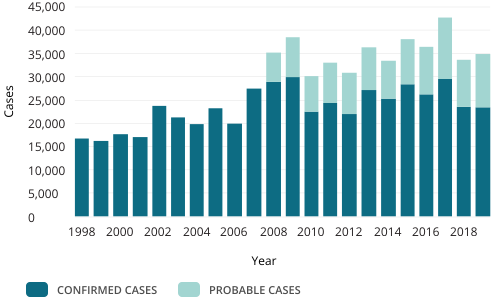
Each year, approximately 30,000 cases of Lyme disease are reported in the United States – the most reported vector disease in the country. Lyme disease is a species of bacteria passed to humans through ticks that act as vectors – consuming the blood of an infected animal (host) then carrying the virus to humans through tick bites.
Region disease profile
Lyme disease is most widespread in the Northeast U.S., where suburban and exurban development infringe on forests. According to several studies, forest fragmentation increases the risk of human exposure to Lyme disease, as wildlife and ticks come in closer contact with humans. Forest loss or fragmentation can also diminish the number of species living in a certain area as some die off or find new habitats. With less biodiversity, there is greater risk of human exposure to the disease.
- A study in southeastern New York State found that forest fragmentation leads to diminished biodiversity in forested areas as certain species die off or find new habitats and results in a higher risk of human exposure to Lyme disease.
- The findings confirmed the “dilution effect” – that species diversity lowers the risk of Lyme disease as some animals – like tree squirrels – are not competent hosts and cannot spread the disease. Greater biodiversity increases the chance of these incompetent vectors.
Reported cases of Lyme disease in the United States
Lyme Disease: Data and Surveillance. (n.d.). Centers for Disease Control and Prevention. https://www.cdc.gov/lyme/data-research/facts-stats/surveillance-data-1.html
Drivers of deforestation in the North American forest
Forestry Poor forest management, illegal logging, and growing demand for forest products contribute to rampant deforestation and degradation.
Fires Wildfires around the world are bigger, more intense, and lasting longer than ever before. Each year they destroy or degrade millions of acres of forest around the world.
Urban expansion As human populations grow and expand from cities to suburbs and exurbs, forest degradation increases and raises the risk of zoonotic spillover.
What WWF is doing
The demand for timber, wood products are driving forest loss. WWF engages with companies to help reduce their forest footprint and support other on-the-ground actions — like forest restoration. We also encourage consumers to choose wood and paper products that are from responsibly managed forests.