Publications
-
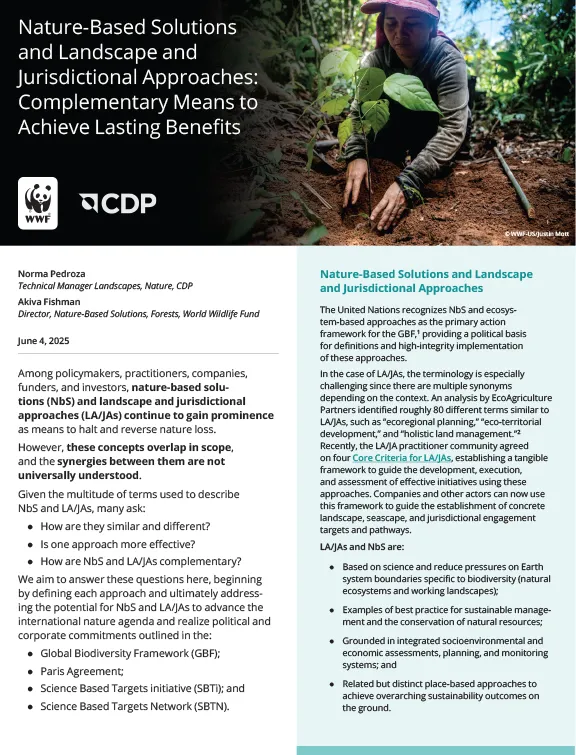
Among policymakers, practitioners, companies, funders, and investors, nature-based solutions (NbS) and landscape and jurisdictional approaches (LA/JAs) continue to gain prominence as means to halt and reverse nature loss.
However, these concepts overlap in scope, and the synergies between them are not universally understood.
Given the multitude of terms used to describe NbS and LA/JAs, many ask:
- How are they similar and different?
- Is one approach more effective?
- How are NbS and LA/JAs complementary?
In this piece, WWF and CDP aim to answer these questions, beginning by defining each approach and ultimately addressing the potential for NbS and LA/JAs to advance the international nature agenda and realize political and corporate commitments outlined in the:
- Global Biodiversity Framework;
- Paris Agreement;
- Science Based Targets initiative; and
-
Science Based Targets Network.
-
As part of the Ellen MacArthur Foundation’s and WWF’s engagement to support the development of an ambitious and effective international legally binding instrument, this document outlines examples of reuse initiatives across the Global South. This document contains a selection of case studies illustrating reuse initiatives across the Global South. Each case study is presented with essential details, including application, organization, geographic reach, and key statistics.
-
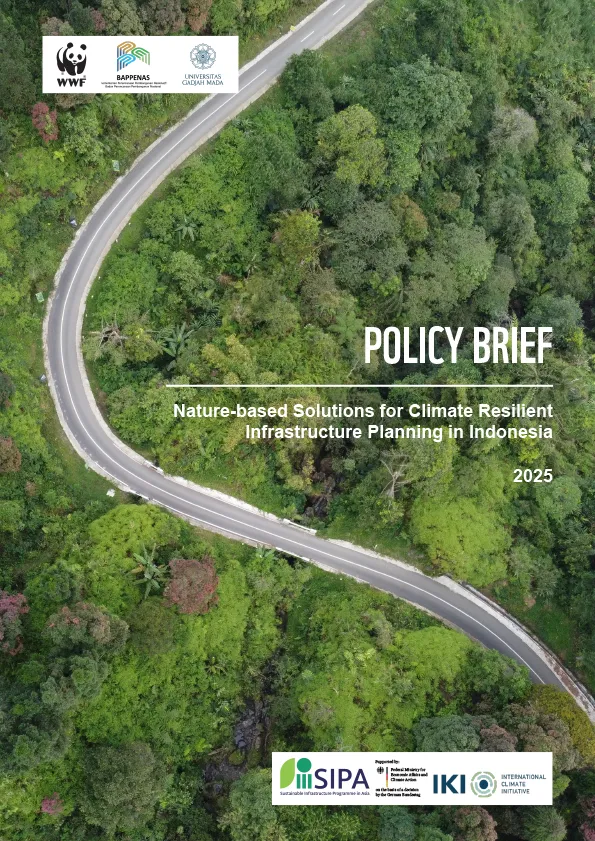
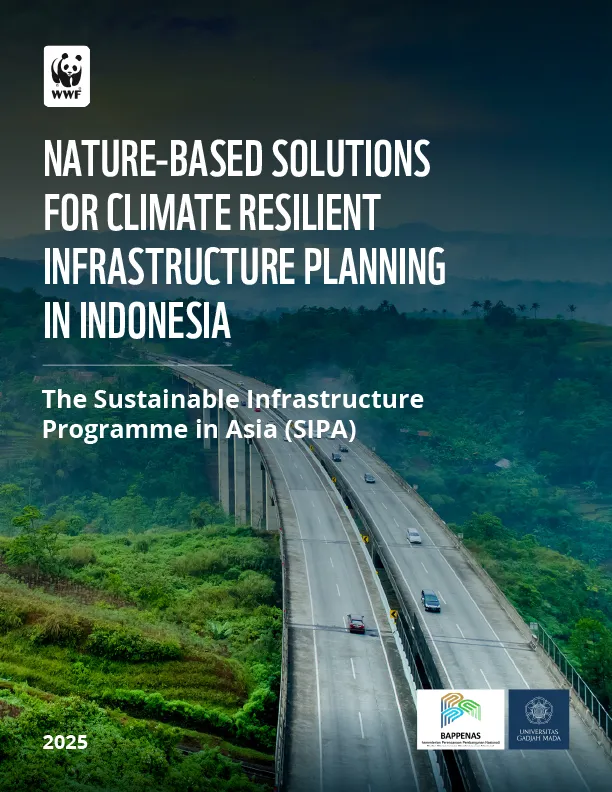
This brief summarizes the results of modeling analysis to determine potential priority areas for Nature-based Solutions (NbS) for climate resilience for people and infrastructure in Indonesia. Four key benefits provided by nature were assessed: sediment retention (erosion control), flood risk reduction, water recharge (for supply), and coastal protection (of people and infrastructure). It closes with recommendations for how to integrate these analyses in infrastructure development, climate adaptation, and conservation planning moving forward. The analysis provides useful information for planners within Ministry of National Development Planning (Bappenas), Ministry of Agrarian Affairs and Spatial Planning / National Land Agency (ATR/BPN), Ministry of Public Works, Ministry of Environment, Ministry of Forestry, Geospatial Information Agency (BIG), National Research and Innovation Agency (BRIN), the Peat and Mangrove Restoration Agency (BRGM), local government units, and other relevant government departments at the national and subnational levels in guiding infrastructure planning and siting decisions.
-
KEY FINDINGS:
- Ecosystems most impacted by road infrastructure and settlement development provide significant benefits, supporting climate resilience for nearly half the population, 147 million people, and 68% of the road network, on just 16% of Indonesia‚'s lands.
- Evaluating all intact ecosystems nationwide that could support NbS benefits, conserving priority priority areas on 18% of Indonesia‚'s land area supports climate resilience for 113 million people and 44% of the road network.
- Restoring degraded forests found on just 11% of the country provides the best opportunities to invest in multiple NbS to enhance climate resilience, benefiting roughly half the population, 143 million people, and a little over half, 47,000 km or 53% of the road network..
- The majority of these priority areas are outside the protected area network, necessitating new regulatory approaches or land use management schemes for successful conservation or restoration efforts.
- There are, however, also immediate "win-win" opportunities for NbS investments under conservation or restoration inside protected areas and Key Biodiversity Areas that would simultaneously support climate resilience for people and infrastructure and biodiversity outcomes.
- These analyses can serve as valuable inputs to support NbS mainstreaming to achieve climate and biodiversity goals in national and subnational policies and their implementation, including in the Medium and Long-Term Development Plans and associated processes.
- Achieving this requires investments in training and capacity building programs at all levels across these ministries and key departments in how to assess and integrate NbS in infrastructure planning. WWF and the University of Gadjah Mada (UGM) have developed such training materials for this purpose under the SIPA project.
- To ensure maximum utility for planners across departments and ministries, maps and associated data should be integrated into existing key ministry and departmental web platforms and centralized national data and mapping platforms.
-
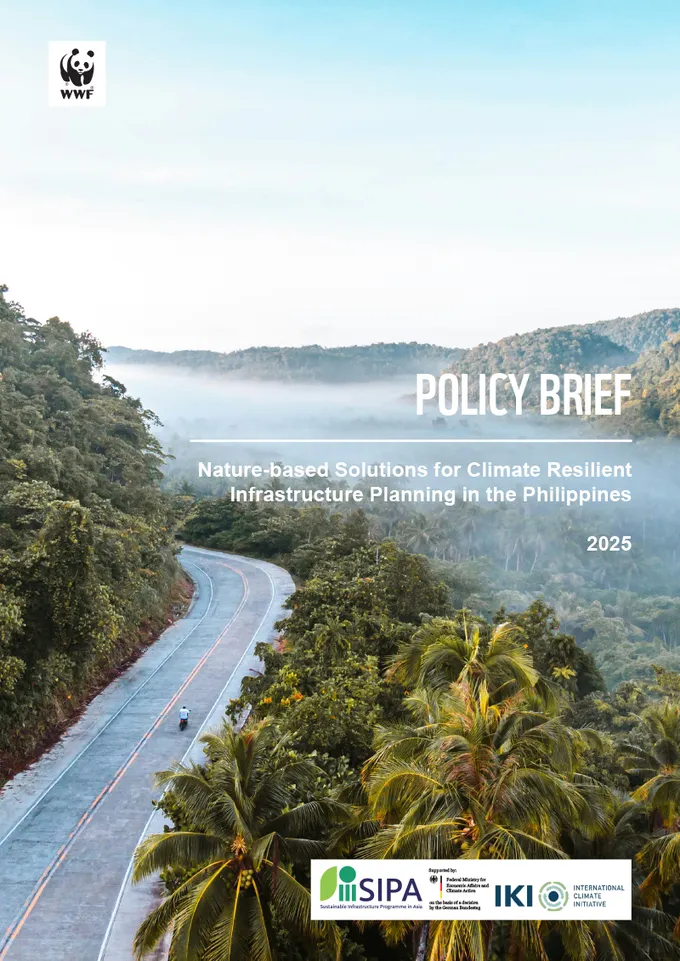
This brief summarizes the results of modeling analysis to determine potential priority areas for Nature-based Solutions (NbS) for climate resilience for people and infrastructure in the Philippines. Four key benefits provided by nature were assessed: sediment retention (erosion control), flood risk reduction, water recharge (for supply), and coastal protection (of people and infrastructure). It closes with recommendations for how to integrate these analyses in infrastructure development, climate adaptation, and conservation planning moving forward. The analysis provides useful information for planners at the Department of Economic Planning and Development (DEPDev), the Department of Public Works and Highways (DPWH), the Department of Environment and Natural Resources (DENR), local government units, and other relevant government agencies at the national and subnational levels in guiding infrastructure planning and siting decisions.
-
Amid rising climate extremes and mounting water crises, WWF‚'s Drop by Drop 2024 report offers a powerful glimpse into how collective action can transform water stewardship across the textile and apparel industry. Through on-the-ground programs in five key river basins‚ – spanning T√ºrkiye, Pakistan, Viet Nam, India, and China‚ – WWF and its partners have delivered measurable progress: saving millions of liters of water, piloting regenerative cotton farming, restoring freshwater habitats, advancing green financing, and scaling wastewater reuse. These efforts not only help safeguard biodiversity and bolster climate resilience but also offer a blueprint for sustainable industry transformation. Dive into the full report to discover how shared water challenges can be met with shared solutions.
-
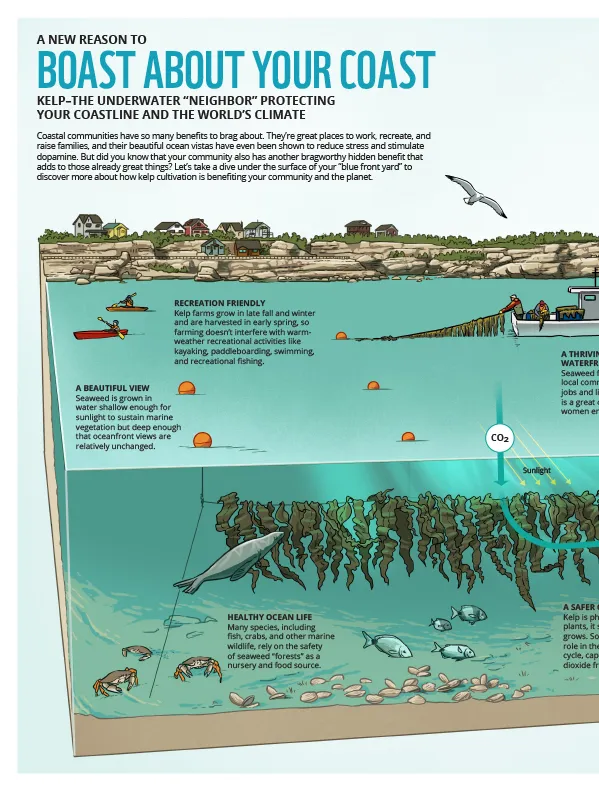
Coastal communities have so many benefits to brag about. They‚'re great places to work, recreate, and raise families, and their beautiful ocean vistas have even been shown to reduce stress and stimulate dopamine. But did you know that your community also has another bragworthy hidden benefit that adds to those already great things? Let‚'s take a dive under the surface of your "blue front yard" to discover more about how kelp cultivation is benefiting your community and the planet.
Infographic Series
- The VIP Under the Sea
- Boast About Your Coast
- What to Know About the Grow
- Innovation That Helps Conservation
-
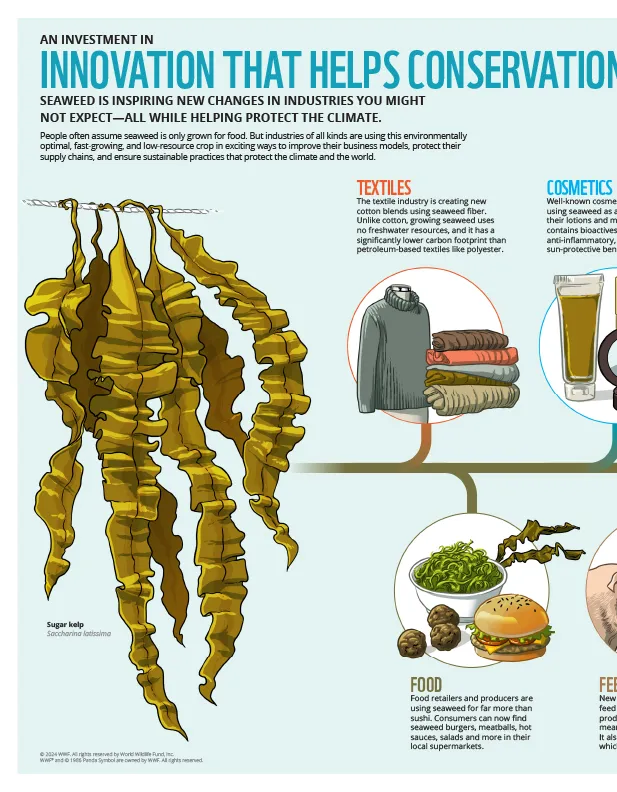
People often assume seaweed is only grown for food. But industries of all kinds are using this environmentally optimal, fast-growing, and low-resource crop in exciting ways to improve their business models, protect their supply chains, and ensure sustainable practices that protect the climate and the world.
Infographic Series
- The VIP Under the Sea
- Boast About Your Coast
- What to Know About the Grow
- Innovation That Helps Conservation
-
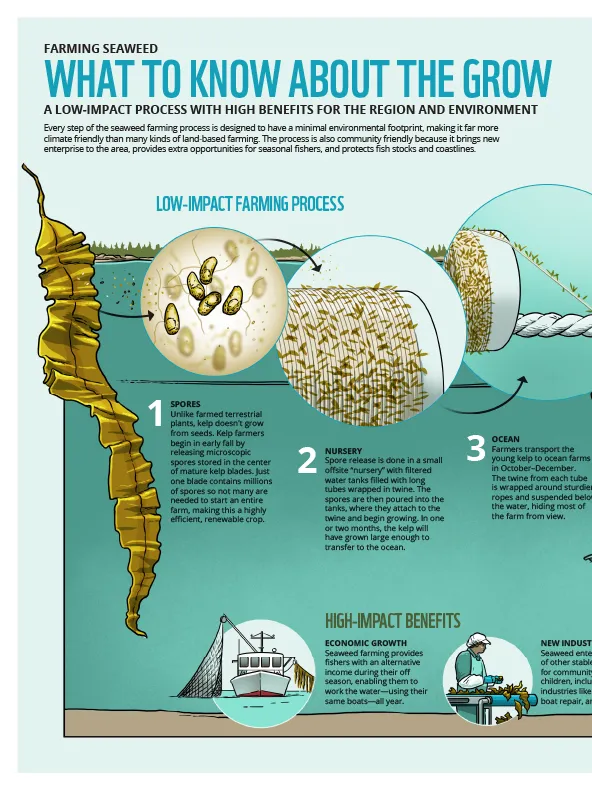
Every step of the seaweed farming process is designed to have a minimal environmental footprint, making it far more climate friendly than many kinds of land-based farming. The process is also community friendly because it brings new enterprise to the area, provides extra opportunities for seasonal fishers, and protects fish stocks and coastlines.
Infographic Series
- The VIP Under the Sea
- Boast About Your Coast
- What to Know About the Grow
- Innovation That Helps Conservation
-
WWF has established the following position on plastic crediting and plastic neutrality.
Updated May 2025. Originally published January 2021.