Publications
-
The Open Government Partnership and Anti-Corruption in Conservation: Templates for Collective Action
The Open Government Partnership (OGP) is a collaboration of over 150 national and local governments and more than 1000 civil society partners working to promote transparent, participatory, inclusive, and accountable governance. OGP offers a promising opportunity to bring transparency, participation, and accountability to the governance of natural resources, as participating governments collaborate with their civil societies to commit to concrete, impactful reforms to bring transparency, accountability, and participation to bear on the most relevant and important challenges those publics face. This guidance shows how conservation organizations can start taking advantage of OGP as a possible key platform for accomplishing conservation priorities.
Visit the TNRC Knowledge Hub for more resources.---
This content is made possible by the generous support of the American people through the United States Agency for International Development (USAID). The contents are the responsibility of World Wildlife Fund (WWF) and do not necessarily reflect the views of USAID, the United States Government, or individual TNRC consortium members.
-
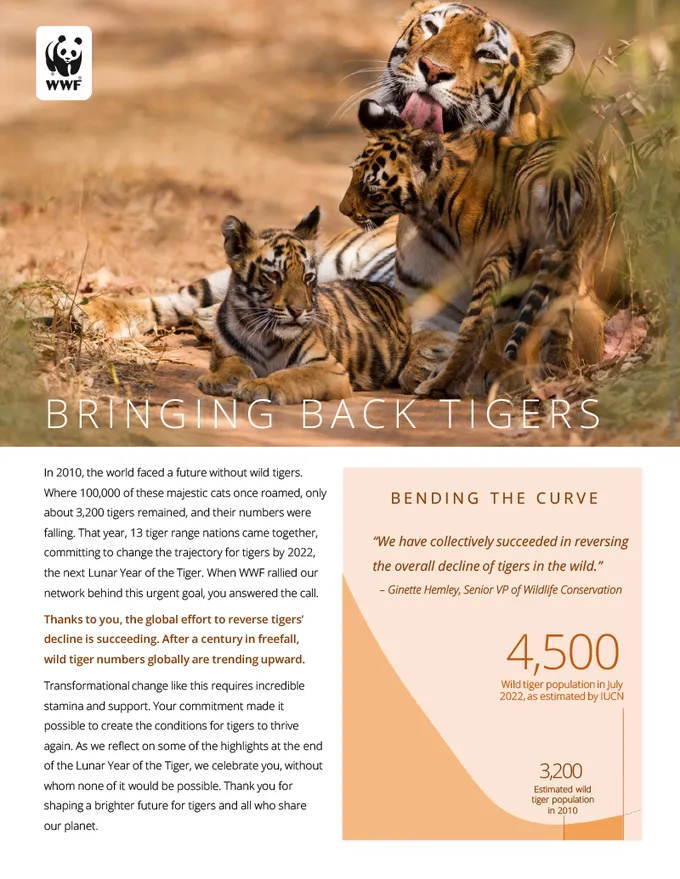
In 2010, the world faced a future without wild tigers. Where 100,000 of these majestic cats once roamed, only about 3,200 tigers remained, and their numbers were falling. That year, 13 tiger range nations came together, committing to change the trajectory for tigers by 2022, the next Lunar Year of the Tiger. This report outlines the actions WWF, governments, and communities have taken to help tigers recover, and the impact of that work.
-
The Farm Bill is among the most significant federal policies providing direct support to the US agriculture sector and affecting the conservation of the nation's soil, land, and water resources. Noted for its decades of bipartisan support, the Farm Bill governs many of the nation's most influential food, agriculture, and conservation programs. World Wildlife Fund urges Congress to pass a 2023 Farm Bill that addresses the ever-increasing challenges facing rural communities and the landscapes and natural resources they depend upon. We need a Farm Bill that invests in farmers, ranchers, and forest owners to make agriculture net zero by 2040, end habitat conversion, and reverse species decline while supporting the viability of US producers.
-
This document is a printable version of the introductory guide on the Social Norms and Behavior Change (SNBC) topic page of the Targeting Natural Resource Corruption (TNRC) Knowledge Hub. It provides information, guidance, and tools for practitioners who seek to integrate social norms and behavior change approaches into their context-specific programming responses.
---
This content is made possible by the generous support of the American people through the United States Agency for International Development (USAID). The contents are the responsibility of World Wildlife Fund (WWF) and do not necessarily reflect the views of USAID, the United States Government, or individual TNRC consortium members.
-
Sand is the world's most consumed raw material after water and an essential ingredient in our everyday lives. It is central for the construction of roads, bridges, and buildings. The material is also fundamental in the manufacturing of glass and silicon computer chips.
Yet the world is facing a growing sand shortage without readily available alternative materials. As infrastructure construction booms, the dramatic increase in demand for sand has led to rising tensions, violent conflict, and degraded ecosystems.
As global demand continues to rise faster than natural sources can sustain, it is crucial to manage sand sustainably. WWF and partners are exploring the issue and working to advance policy and practice related to this growing global challenge.
In recognition of the growing social, economic, and environmental impacts of the global sand crisis, WWF, and Northwestern University (ISEN) organized a series of seminars, convening global experts from across disciplines and sectors to explore solutions. The Call to Action Report distills key recommended action items focused on research, practice, and policy based upon the seminar series presentations and discussions.
-
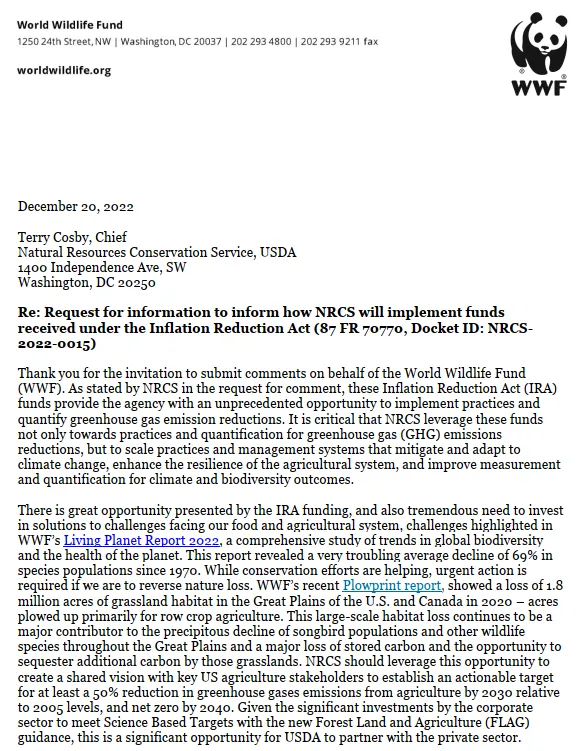
To affect positive change for climate, nature, and people, NRCS should leverage IRA resources to prioritize and enable a significant step forward for robust, regenerative, and resilient food systems. WWF offers recommendations in response to the agency‚'s questions to ensure and enable NRCS programs to address climate change, sustain biodiversity and nature, and support rural communities.
-
This document is a printable version of the introductory guide on the Situation Analysis topic page of the Targeting Natural Resource Corruption (TNRC) Knowledge Hub. It provides corruption-relevant guidance for practitioners to strengthen their context-specific programming responses.
---
This content is made possible by the generous support of the American people through the United States Agency for International Development (USAID). The contents are the responsibility of World Wildlife Fund (WWF) and do not necessarily reflect the views of USAID, the United States Government, or individual TNRC consortium members.
-
This practice note is based on interviews with 18 people who worked in or with justice systems in Africa, Asia, and South America, to understand their perception of the effect case monitoring can have on corruption in the justice system. Monitoring cases can help identify and highlight weaknesses in the justice system and reduce corruption vulnerabilities related to wildlife crime cases. But projects must be designed with appropriate scope and resources, as impact takes time and is difficult to measure. Monitoring is likely most effective when monitors use multiple cases to identify patterns of red flags that indicate systematic failures. This note recommends several good practices, based on the interviewees' and authors' experiences. However, these practices must always be tailored to a specific context.
For more resources and tools, visit TNRCproject.org.
---This content is made possible by the generous support of the American people through the United States Agency for International Development (USAID). The contents are the responsibility of World Wildlife Fund (WWF) and do not necessarily reflect the views of USAID, the United States Government, or individual TNRC consortium members.
-
-
The Targeting Natural Resource Corruption (TNRC) project is a five-year USAID-funded project that brings together a consortium of conservation and anti-corruption experts to harness knowledge, generate evidence, and support more effective anti-corruption programming in conservation and natural resource management. The TNRC consortium is led by World Wildlife Fund (WWF) with the U4 Anti-Corruption Resource Centre at the Chr. Michelsen Institute, TRAFFIC, and the Terrorism, Transnational Crime and Corruption Center (TraCCC) at George Mason University.
---
This content is made possible by the generous support of the American people through the United States Agency for International Development (USAID). The contents are the responsibility of World Wildlife Fund (WWF) and do not necessarily reflect the views of USAID, the United States Government, or individual TNRC consortium members.