How scientists use scat in conservation
Scat offers a noninvasive method to study and protect wildlife
© Suyash Keshari / WWF-International
Key takeaways
- Scat provides detailed, noninvasive data. Scientists can extract DNA from feces to identify species, individuals, and health status without needing to capture or even see the animal.
- Scat helps track population size and stability. Scat analysis allows researchers to estimate population numbers, monitor genetic diversity, and detect changes over time—key for protecting endangered species.
- Scat reveals diet, habitat use, and movement. By studying what’s in scat and where it’s found, scientists learn what animals eat, how they move, and how they interact with their environment
Discovering clues on the forest floor
Conservation biology is modernizing rapidly, from AI-driven analysis to drone surveillance to remote sensing. But not every breakthrough is housed in some new, fancy hardware—sometimes it comes straight from the forest floor.
For conservation biologists, scat—or animal fecal matter—is a goldmine of information about the presence of elusive species, their movements, and the overall health of wildlife populations.
What can scientists learn from scat?
From a single stool sample, scientists can uncover an astonishing range of information, including species presence, individual identity, population size, and so much more. It may be a waste product, but scat is packed with biological treasure—especially DNA. Even better, scat is often the easiest non-invasive sample to collect, particularly when a species is not captured well by camera traps or live capture is costly, stressful, or simply not feasible. As a result, scat sampling has become a powerful and popular tool for studying elusive, rare, or hard-to-capture wildlife.

© WWF-US / Justin Mott
Scat allows wildlife biologists to monitor the presence and health of small populations
One of the central challenges in studying endangered species is that their populations are often small, elusive, and difficult to detect. To overcome this, scientists frequently use scat as a noninvasive source of information to confirm a species’ presence in potential habitats and to assess the health of individuals and populations. DNA extracted from fecal samples can provide many insights, including individual identification, relatedness among individuals, lifespan, and breeding patterns. For small populations, this information is essential for determining whether the population is likely to persist or decline.
For example, researchers at UC Davis have used scat sampling to monitor the health of a small population of Sierra Nevada red foxes (Vulpes vulpes necator), a rare and endangered subspecies that was once thought extinct. The foxes are seldom detected by camera traps or live trapping—the process of safely capturing and releasing wild animals—and are now primarily monitored through their feces. By repeatedly sampling scat at the same field sites over multiple years, scientists were able to identify individual foxes and track changes in the population across generations. Within a few years, they detected two new males whose genetic contributions substantially improved the population’s health by increasing genetic diversity, ultimately leading to rapid population growth. This study underscores the value of using scat to monitor and assess demographic and genetic changes in small, vulnerable populations.
Scat helps scientists estimate the abundance of elusive, rare, or dangerous species
Scientists can also use scat-derived DNA to estimate abundance—the number of individuals of a species within a given area. This metric is important because it allows scientists to track whether the population is increasing, decreasing, or stable. For many endangered, rare, or dangerous species, traditional methods such as live trapping can be impractical or risky. In these cases, scat sampling offers an effective and safe alternative for obtaining population abundance estimates.

© Andrew S. Wright / WWF-Canada
In the Lake Tahoe Basin of California and Nevada, American black bears (Ursus americanus) live near people, leading to frequent conflict. Black bears are attracted to local towns because they provide reliable sources of food and shelter, increasing the rate of human-bear interactions. These interactions can be dangerous for both people and bears, prompting scientists to estimate bear density in the Lake Tahoe region to better inform management programs. Researchers spent the summer wandering the Tahoe Basin in search of bear scat, whose DNA revealed approximately 2.18 bears per square mile in the area—making it one of the densest populations of black bears ever recorded.
Scat provides valuable clues about the diets of animals rarely seen feeding in the wild
Researchers can analyze fecal DNA to understand the diets of rare and endangered species, which helps reveal how animals use habitats and interact within ecosystems. For example, if a species depends heavily on a single food source, scientists can prioritize protecting it to preserve the species’ ecological niche and ensure it remains available and abundant. Similarly, if an endangered species shares its niche with a non-native species, conservationists can anticipate increased competition, which may threaten the native species’ survival. Lastly, diet analysis via scat samples can directly inform management actions, especially for herbivores, providing valuable information on which plants should be reintroduced to restoration zones.
This was the case for the salt marsh harvest mouse (Reithrodontomys raviventris), an endangered species endemic to San Francisco’s coastal wetlands. By analyzing fecal DNA, scientists found that this species had the narrowest diet among local mouse species, with the native plant pickleweed (Salicornia) and the non-native plant fat-hen (Atriplex) as primary food sources. The salt marsh harvest mouse’s diet also overlapped substantially with that of other mice, including the non-native house mouse (Mus musculus). This niche overlap suggests that increases in house mouse populations could intensify competition, potentially displacing the already endangered salt marsh harvest mouse. By studying mouse diets through fecal sampling, scientists identified potential pressure points threatening this endangered species’ survival.

© davemhuntphotography / Shuttertstock
Scat reveals how animals travel through and interact with their environments
© Shutterstock / PACO COMO / WWF-International
Habitat fragmentation occurs when formerly continuous areas of native vegetation become patchy and disconnected, making it difficult for wildlife to move between areas. This can limit access to critical resources and eventually isolate populations. As human impacts grow worldwide, habitat fragmentation is one of the biggest threats to wildlife. Conservationists need to understand how animals move to manage the landscape better and protect essential corridors that wildlife use to access habitat. Particularly when gold-standard approaches like GPS collars are infeasible, scat sampling is one way scientists can gather this information.
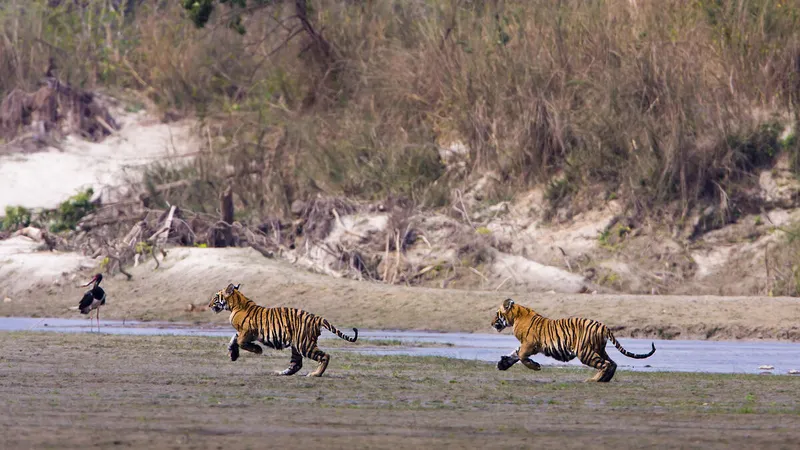
In the Terai-Arc landscape, a biodiversity hotspot in India and Nepal, scientists used genetic data from scat sampling to learn how animals move through landscapes and connect habitat patches. By pairing genetic data with geospatial data—where feces were found and how habitat features are distributed in the area—they identified 219 tigers and 19 tiger movement corridors, 10 of which need immediate conservation attention. Scat-derived genetics demonstrated that the Terai-Arc landscape maintains connectivity for tigers, meaning animals are not just present in isolated patches but are still able to move between them—good news for India’s tiger population.
And scat can tell us so much more about wildlife
As these examples show, animal scat is a remarkably powerful and versatile scientific resource—and scientists are still discovering new ways to unlock its potential. For instance, a preliminary proof-of-concept study demonstrates that scientists can pinpoint the geographic origins of individual gorillas from scat samples. This innovative use of fecal DNA has major implications for wildlife forensics, as it could allow law enforcement to identify the original locations of confiscated gorilla parts involved in the illegal wildlife trade, helping agencies, rescue centers, and range states trace and disrupt trafficking networks.
How WWF uses scat sampling
At WWF, wildlife biologists Dr. Cody Aylward and Dr. Robin Naidoo are leveraging scat sampling for elephant conservation. By collecting dung from African elephants across multiple parks in the Kavango-Zambezi transfrontier conservation area (KAZA), they seek to understand the implications of elephants' movements—and barriers to movement—across the landscape. This fecal DNA data can be compared with existing movement data from elephants wearing GPS collars to determine whether the connectivity insights derived from movement data are also reflected in the genetics of elephants in KAZA.

© Cody Aylward
“You can learn so much from poop,” Aylward said. “With just one trip to the field, you can collect information about how many animals are out there, how they're related to one another, how they move, what they eat, what diseases they're carrying, and other indicators of population health like genetic diversity. No other kind of sample can give you that level of information without even needing to see or disturb the animal.”
Soon, excrement expert Aylward will bring his scat skills to Southeast Asia, where he will apply manure‑based methods to estimate Asian elephant populations in Viet Nam and Cambodia. Looking ahead, fecal DNA could also allow him to explore other critical aspects of elephant ecology, including diet, disease, and population health.
Test your scat knowledge with our quiz.
© WWF-US / WWFGifts
Adopt a tiger
Support WWF’s global efforts to protect wild animals and their habitats and choose from kits with plush and more.