What do gorillas eat? And other gorilla facts
Gorillas eat stems, herbs, bark, and fruits, in addition to insects like termites
© NATUREPL.COM/ANDY ROUSE/WWF
Gorillas, the largest living primates, are found in central and eastern Africa. They have a well-developed social structure and often exhibit behavior and emotions similar to humans, including laughter and sadness. Habitat destruction, disease, and poaching remain threats to gorillas. WWF is working to increase protection across its range, both within and outside officially designated protected areas, such as in the Republic of Congo, and to promote responsible gorilla tourism.
Read on for some answers to common questions about gorillas.

© WWF-US/Allard Blom
1. What do gorillas eat?

© Gesa Koch-Weser / WWF
Gorillas stick to a mainly vegetarian diet, feeding on stems, herbs, bark, and fruits. However, they also have an appetite for insects, breaking open termite nests to eat the larvae.
2. Do gorillas live alone?

© Brent Stirton / Reportage for Getty Images / WWF
Gorillas move around in family groups that can range from a couple of individuals to more than 40 members. A dominant male leads the group, holding the position for years.
3. How many gorilla species are there?
There are two gorilla species—the eastern and western gorilla—and they live in equatorial Africa, separated by about 560 miles of Congo Basin forest. Each has a lowland and upland subspecies: the Cross River gorilla and mountain gorilla.
4. How closely related to gorillas are humans?
Gorillas share 98.3% of their DNA with humans. Charismatic and intelligent animals, they are our closest cousins after chimpanzees and bonobos.
5. How do gorillas help forests?
© naturepl.com / Christophe Courteau / WWF
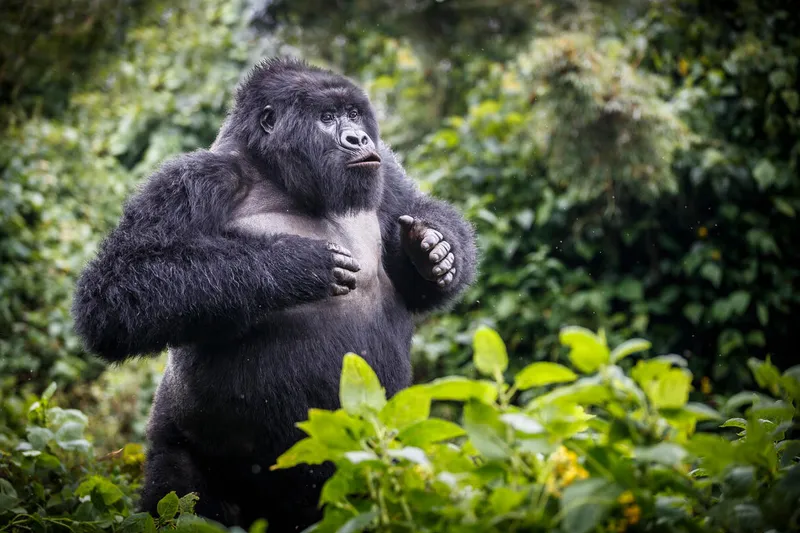
Gorillas are considered an “umbrella” species, meaning that protecting their habitat helps protect a host of other mammals, birds, plants, and insects sharing the same habitat. Because their survival depends on large, undisturbed forests, management plans built around gorillas often reduce habitat fragmentation, overexploitation, and disease risks for many other species, including humans. These forest management plans also help mitigate climate change, as gorillas live in some of the world’s most important tropical forests. In fact, the Congo Basin is often referred to as part of the “lungs of the planet” because it absorbs such vast amounts of carbon.
Gorillas also help promote plant diversity. They disperse seeds through their dung, especially for large‐seeded fruits that smaller animals cannot swallow. Also, they move seeds across large home ranges, helping promote genetic diversity in plant populations. As they move and feed, they break branches and create small gaps in the canopy, allowing light-demanding plants to establish and increasing plant species richness. Healthy gorilla populations indicate relatively intact, functioning forests, so declines in gorillas can signal wider ecosystem degradation that threatens multiple species.
6. What threats do gorillas face?

© Andy Isaacson / WWF
Diseases such as Ebola, habitat destruction and fragmentation, and poaching threaten gorillas. These include the western lowland gorilla (Gorilla gorilla gorilla), found in the forests of Central Africa, the Cross River gorilla (Gorilla gorilla diehli), a critically endangered subspecies living in a small region along the Nigeria-Cameroon border, the eastern gorilla lowland gorilla, or Grauer’s gorilla (Gorilla beringei graueri), which inhabits the forests of the eastern Democratic Republic of Congo, and the mountain gorilla (Gorilla beringei beringei), famous for living in the high-altitude forests of the Virunga Mountains and Bwindi Impenetrable Forest. Most gorillas live outside of protected areas. WWF works with local communities and other partners, including logging companies, to assure gorilla protection, both inside and outside formally protected areas.
7. How big do gorillas get?

© Staffan Widstrand / naturepl.com / WWF
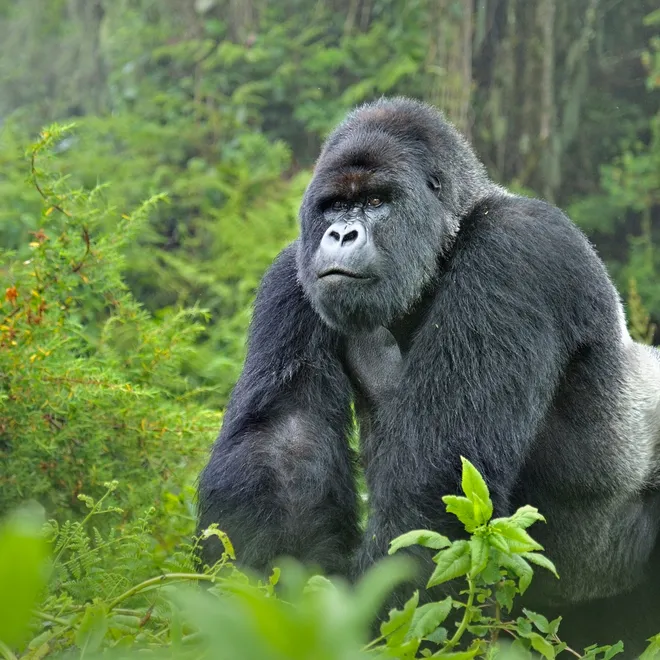
Adult male gorillas weigh up to 440 pounds and can reach a height of six feet when standing on two legs. Mature male gorillas are known as “silverbacks” for the white hair that develops on their back at about 14 years of age.
8. How often do gorillas give birth?
Females have a gestation period of 8.5 months and nurture their young for several years. Generally, females give birth to one baby every four to six years. This slow population growth makes it harder for gorillas to recover from any population decline.

© naturepl.com / Eric Baccega / WWF
9. How do I see gorillas in person?
Gorillas carry strong cultural, ethical, and educational value, helping people connect emotionally with forest conservation and support broader biodiversity and climate action. Ecotourism creates many livelihoods in areas where gorillas exist, creating financial incentives for communities and governments to keep forests standing rather than convert them to agriculture or other extractive uses.

© Andy Isaacson / WWF-US
10. Does wildlife crime affect gorillas?
While poaching of gorillas for food is uncommon, unselective hunting with snares—set to catch other wildlife, such as antelopes and bush pigs—often kills or injures them. Additionally, the illegal trade of live gorillas and other great apes or their body parts is a problem across Central Africa. WWF works with partners to monitor this trade and supports efforts to enforce wildlife laws more effectively.
You can help gorillas
© WWF-US / WWFGifts
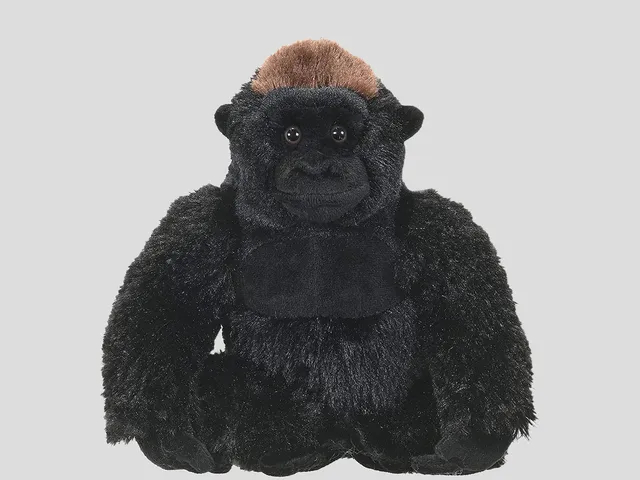
Adopt a gorilla
Support WWF’s global efforts to protect wild animals and their habitats and choose from kits with plush and more.