What's the difference between a seal and a sea lion?
Seals and sea lions differ in size, flippers, and how they move.
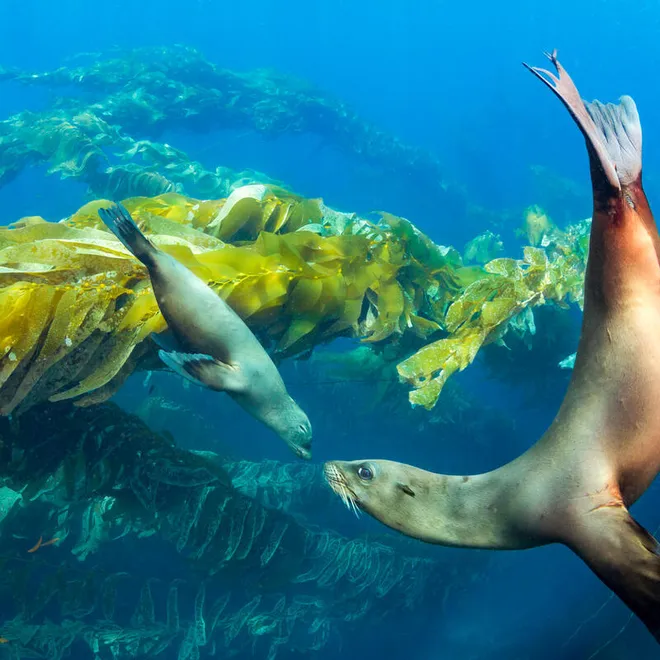
© David Fleetham / naturepl.com / WWF
Key takeaways
- Seals and sea lions can be differentiated by physical traits and behavior differences
Sea lions have visible ear flaps and large rotating flippers. Seals don't have visible ears, move by scooting on their belly, and usually move less on shore. - Pinnipeds play a critical role in ocean ecosystems
Seals and sea lions are predators that help keep fish and squid populations in check. They are also prey for apex predators like orcas, sharks, and polar bears. - Many pinniped species are increasingly under threat from human activity and climate change.
Overfishing, entanglement in fishing gear, habitat loss, pollution, disease, and shrinking sea ice are putting several seal and sea lion species at risk.
“Look, a seal!” cried a friend at the pier. What she was actually looking at was a sea lion, but it’s an easy mistake to make—especially going off body shape alone. Here are some ways you can remember the differences between seals and sea lions.
Seals and sea lions are both pinnipeds—a clade of marine mammals that also includes walruses. Though they may look similar, there are some key differences that make these “sea puppies” unique. Let’s dive in!
Snapshot: seals vs. sea lions
Rule of thumb: if it’s barking, walking, and staring at you, it’s probably a sea lion. If it’s quietly resting on the beach, it’s probably a seal.
Seals

© Candice Bressler
- Generally smaller
- Ear holes
- Smaller flippers; hind flippers point away from their body
- Belly-scoot to move on land
- Quieter vocalizations
Sea lions

© Antonio Busiello / WWF-US
- External ear flaps
- Larger flippers; hind flippers can rotate
- Can “walk” on land with their flippers
- Very loud; will bark!
Seals
There are more than 30 species of “true seals” (family Phocidae) found around the world, ranging from the minuscule three foot Baikal seal to the massive Southern elephant seal, which can grow over 20 feet long and weigh more than 8,800 pounds. While they range widely in size, all true seals can be identified by their ears: sea lions and fur seals have ear flaps, but true seals have only tiny holes for ears. Seals are also much less adept at moving on land than sea lions—while sea lions can somewhat waddle around on their flippers, seals must inch and roll forward awkwardly on their bellies, as their hind flippers cannot rotate under their bodies.
Seals can also be distinguished from sea lions by their vocalizations: Seals tend to be quieter, with small squeaks and grunts. Sea lions, on the other hand, bark and yell, reaching ear-splitting volumes. Seals also spend much less time on land than sea lions, though they must come ashore at least once a year to breed and give birth.
Sea lions (and fur seals)
Sea lions and fur seals are both considered “eared seals” and belong to a biological family known as “Otariidae.” Aptly named, they can be distinguished from their true seal counterparts by their small ear flaps and are often larger than true seals. Sea lions can also maneuver on land much easier than seals, due to their rotatable back flippers. Last but not least, sea lions are loud! They bark, roar, and growl.
So what’s the difference between a sea lion and a fur seal? One of the biggest tells is their fur. Fur seals have much thicker fur, consisting of a dense and luscious undercoat covered by longer hairs on top. Sea lions, in contrast, have a much less prominent undercoat. Sea lions also tend to be larger and have a wider, dog-like or bear-like face shape, while fur seals have longer, pointier snouts.
There are six species of sea lion: Steller’s (or Northern) sea lion, the California sea lion, the Galápagos sea lion, the Australian sea lion, the South American sea lion, and the New Zealand sea lion. These species are generally found in coastal areas of the Pacific Ocean.
There are 9 species of fur seal: the Northern fur seal, the Antarctic fur seal, the Subantarctic fur seal, the South American fur seal, the New Zealand fur seal, the Guadalupe fur seal, the Juan Fernández fur seal, the Galápagos fur seal, and the Brown fur seal (sometimes split into Cape fur seal and Australian fur seal). Only one of these species is found in the Northern hemisphere, while all others are found South of the equator.
Why do they matter?
Pinnipeds are important species in their marine ecosystems and are critical to maintaining balance within their food web. As mid-level predators, they keep populations of fish, crustaceans, and squid in check. At the same time, they are important prey for apex predators, like great white sharks, orcas, and polar bears.
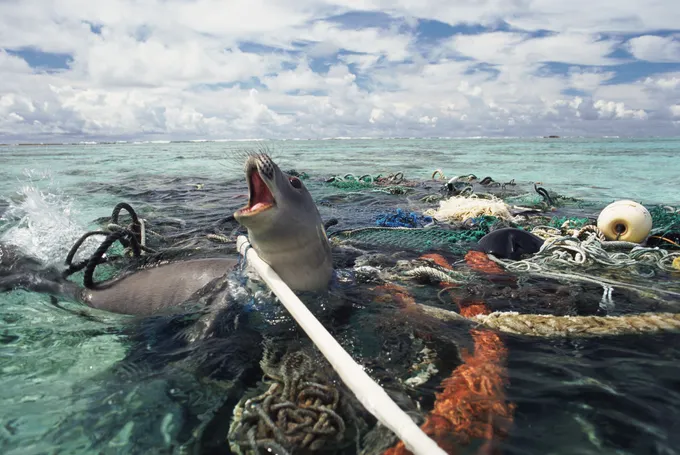
© naturepl.com / Michael Pitts / WWF
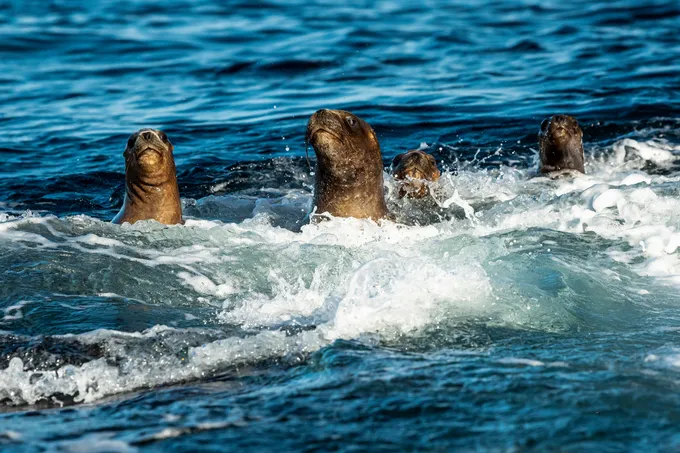
© Meredith Kohut / WWF-US
Threats to pinnipeds
Many pinniped populations are under threat, including the Hawaiian and Mediterranean monk seals, the northern fur seal, and the Australian, Galapagos, and New Zealand sea lions. The pressures seals and sea lions are facing are only increasing.
In the past, many pinnipeds were targeted by hunters for their fur, leading to the extinction of some species, such as the Japanese sea lion and the Caribbean monk seal. While hunting is more restricted today, pinnipeds now face a host of other anthropogenic threats. One of the greatest is climate change, which especially affects species that rely on sea ice. Less sea ice means fewer places to rest, breed, and escape predators, putting these animals at risk.
Entanglement in fishing gear is another hazard for seals and sea lions, often leading to injury and sometimes drowning. Overfishing is also a major issue: As commercial fisheries deplete ocean fish stocks, pinnipeds have less prey available, threatening their survival. Compounded by habitat loss from coastal development and pollution from plastics and other chemicals, pinnipeds are facing a perfect storm.
Lastly, small, threatened populations are especially vulnerable to disease, which has been a serious problem for endangered Mediterranean monk seals and New Zealand sea lions.
How WWF is taking action to protect pinnipeds
WWF works to reduce bycatch, support sustainable fishing practices, protect critical coastal habitats, and advocate for marine protected areas that benefit seals, sea lions, and other marine wildlife.
Specifically, WWF works to strengthen protections for critical habitats and advance community-led conservation for vulnerable species in our priority seascapes, including the Eastern Pacific Ocean and Arctic.
In the Arctic, we are advancing ArcNet—an interconnected system of blue corridors across the Arctic Ocean—to protect wildlife habitat, including that of northern fur seals and other ice seals such as ringed and bearded seals. In the south, WWF works with communities to monitor wildlife in Chile’s Pitipalena-Añihué Multi-Use Coastal Marine Protected Area, where hundreds of South American sea lions were recently recorded.
By protecting the ecosystems where seals and sea lions live and improving our understanding of their population status and resilience to climate change, we help ensure these amazing animals continue to thrive.

© Antonio Busiello / WWF-US