© Karine Aigner/WWF-US
Bonobos
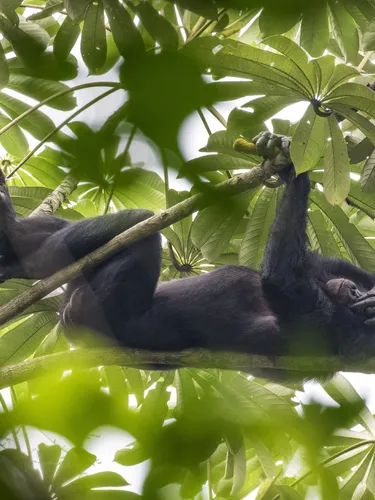
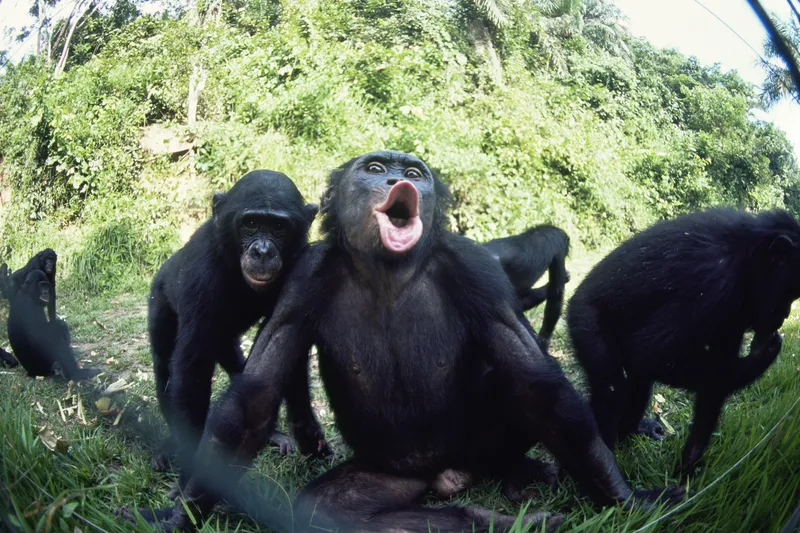
Bonobos and chimpanzees look similar and both share 98.7% of their DNA with humans—making these two ape species our closest living relatives. Bonobos are usually a bit smaller, leaner, and darker than chimpanzees. Their society is also different—bonobo groups tend to be more peaceful and are led by females. They also maintain relationships and settle conflicts through sex. However, bonobo life isn’t entirely violence-free; if two groups of bonobos come together, they may engage in serious fighting.
Wild bonobos can only be found in forests south of the Congo River in the Democratic Republic of Congo (DRC). They weren’t recognized as a separate species until 1929. Much remains unknown about the bonobo—including the extent of its geographic range. Efforts to survey the species over the past decades have been hampered by the remote nature of its habitat, the patchiness of its distribution, and years of civil unrest within the DRC.
Civil unrest and communities facing economic barriers in the area around the bonobos’ forests have contributed to bonobo poaching and deforestation. Though the size of the bonobo population is largely unknown, it has likely been declining for the last 30 years. Scientists believe the decline will continue for the next 45 to 55 years due to the bonobo’s low reproductive rate and growing threats.
Bonobo facts
- Status View status categories and descriptions
- Endangered
- Population
- 10,000–50,000
- Scientific name
- Pan paniscus
- Weight
- 68–86 pounds
- Height
- 28–35 inches
Why bonobos matter
© naturepl.com / Karl Ammann / WWF-Canon
Our peace-loving cousins are still a mystery
Bonobos share 98.7% of their genetic code with humans, making them, along with chimpanzees, our closest living relatives. Given the inaccessibility of most of their range and political instability in The Democratic Republic of the Congo, much still remains unknown about bonobos.
Threats to bononos

© Shutterstock/Gudkov Andrey
Poaching
Humans hunt bonobos to eat them, trade them as bushmeat, keep them as pets and for use in traditional medicine. Specific bonobo body parts are believed to enhance sexual vigor or strength. The number of bonobos lost to poaching each year is not known, but the number of bonobo charms available in parts of the Democratic Republic of Congo suggests that poaching may be common.
Habitat loss
Only part of the bonobo’s range lies in protected areas. Salonga National Park is estimated to contain 40% of the remaining bonobo population. A growing and moving human population, combined with slash-and-burn agriculture and commercial logging, leaves bonobos outside parks at risk of losing their homes.
Civil warfare
Civil unrest in the region around the bonobo’s home territory has led to many bonobo deaths. In addition, unrest has made modern weaponry and ammunition more available, enabling hunting, and the military has at times sanctioned the hunting and killing of bonobos.
“Bonobos are fascinating creatures and little understood. They have the only great ape society led by females, with a sophisticated social structure that encourages cooperation and peace.”
Dr. Richard Carroll Vice President, Africa Program
How WWF is taking action to protect bonobos

© Karine Aigner/WWF-US
Monitoring populations
WWF has provided training, equipment, and field supplies to the Congolese Nature Conservation Authority (ICCN) and non-governmental organizations conducting surveys of bonobo populations. After the first survey of Salonga National Park, which WWF and ICCN have co-managed since 2015. found fewer bonobos than expected and greater amounts of human disturbance, additional efforts were made to monitor and protect these animals, which have been largely successful.
Supporting law enforcement
To combat the rampant problem of poaching, WWF has provided training, improved transportation, and communication and other field equipment for antipoaching units in Salonga National Park and helps the Congolese Wildlife Authority (ICCN) to establish sustainable funding for antipoaching activities in the park.
Protecting habitat
A survey of large mammals in the DRC’s Lac Télé-Lac Tumba Landscape revealed a previously unknown population of bonobos, a population that has the highest density and largest group size of the animals anywhere in their range. After this discovery, WWF helped to establish the Lac Tumba-Lediima Nature Reserve, which will help to protect this dwindling species.
Promoting ecotourism through bonobo habituation program
In 2023, WWF launched a bonobo habituation program (BHP) in Salonga National Park in DRC with the intention of habituating bonobos to human presence for the purpose of implementing a tourism project and conducting research to better understand bonobos and how to protect them. Our goal is to develop sustainable bonobo tourism that provides incentives for the well-being of local communities while ensuring the viability of the bonobo population.
WWF is supporting research and monitoring of habituated groups of bonobos to help protect them from zoonoses and minimize disease transmission between humans and wildlife. From data collected from animal carcasses and non-invasive samples of urine and feces, we can understand the presence of possible pathogens such as Ebola and Anthrax to prevent a larger-scale outbreak and possible pandemic.
How you can help
© George Walsh
Strengthen the Endangered Species Act
More than 99% of the species listed under the Endangered Species Act have avoided extinction due to the law’s protections. Today, those protections are under threat — at the exact moment wildlife needs them most.