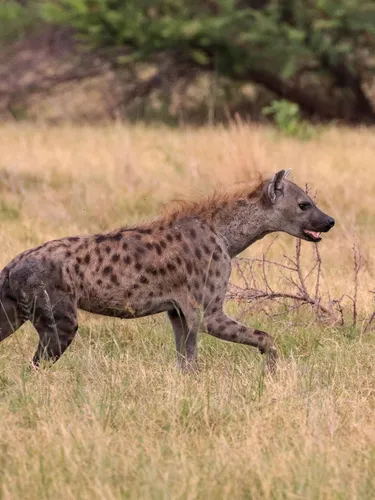
© WWF-US / Jeff Muller
Spotted hyena
Spotted hyenas are keystone predators whose role extends far beyond scavenging; as skilled hunters, they play a vital role in maintaining healthy ecosystems. There are four species of hyena: brown (Parahyaena brunnea), striped (Hyaena hyaena), spotted (Crocuta crocuta), and aardwolf (Proteles cristata). The spotted hyena—also known as the laughing hyena—is the second largest carnivore, just after lions. Despite their dog-like faces, hyenas are actually closer relatives of cats, mongooses, and civets. As adults, spotted hyenas have coarse, sandy-brown fur covered in dark spots. Though as cubs, they are solid dark brown or black; young pups have the darkest spots, which fade as they age.
Hyenas are highly social and can be found in groups known as “clans,” which have a unique and complex social structure. In fact, hyena clans are more like those of primates such as baboons or macaques than those of other social carnivores like lions: they live in well-defined dominance hierarchies determined by female lineages, giving higher-ranking females priority access to resources.
Spotted hyena clans are matriarchal. Females are larger than males and display dominance through higher aggression. Female hyenas also have genitalia that are almost indistinguishable from male genitalia, appearing highly “masculinized.” Clans can include up to 90 individuals, and females remain in the clan they are born into for their entire lives, while males often disperse once they mature.
Hyenas are also highly territorial, particularly around their den, where cubs are raised. To defend their territories, hyenas use a variety of tactics, such as vocal displays and scent marking—they even mark territorial boundaries by urinating and defecating in communal areas known as latrines. While territories vary in size, hyenas will venture beyond their protected zone to forage. In fact, the famous hyena “laughter” is a signal to other clan members indicating a food source. Interestingly, while hyenas live in clans, they often forate alone and are typically only seen together in specific instances: at kills, when defending their territory, and at the communal den.
While many assume that hyenas are scavengers, they are formidable predators, equipped with excellent night vision and some of the most powerful jaws in the animal kingdom that can even crush bone. Hyenas kill about 70% of their own prey, hunting both day and night and eating whatever is convenient—from termites to ungulates, and even larger animals like giraffes or Cape buffalo. Endurance athletes, they pursue prey over long distances until it tires, at which point they move in for the kill.
Spotted hyena facts
- Status Learn more about endangered status categories and explanation
- Least concern
- Population
- 27,000–47,000 individuals
- Scientific name
- Crocuta crocuta
- Weight
- 77–185 lbs., with females weighing more than males
- Height
- 30-33 in. tall
- Length
- 37-60 in. long
- Habitats
- Savannas, grasslands, shrublands, woodlands, semi-desert and mountainous areas (up to 13,000 feet)
News and stories
Why they matter
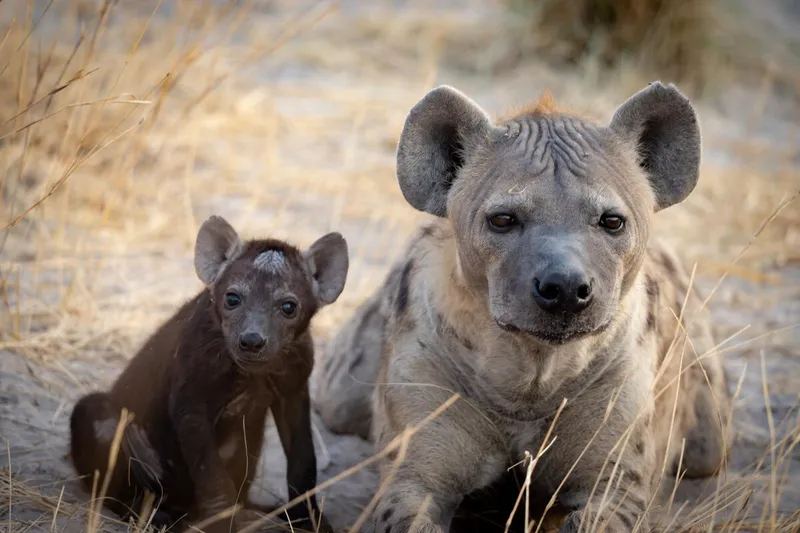
© Danielle Brigida / WWF-US
Though they don’t get as much attention as lions, hyenas are essential keystone predators in many ecosystems throughout Africa, and their presence can indicate ecosystem health. Spotted hyenas are the most abundant large carnivore and therefore play an important role in maintaining prey populations like ungulates. They also remain present in areas where other apex predators have been pushed out, making their role even more vital. Lastly, hyenas play an important role in ecosystems services such as disease control by consuming carcasses and waste matter.
Threats to spotted hyenas

© Jasper Doest / WWF-Netherlands
Human-wildlife conflict
As human populations expand, humans and wildlife are living in closer proximity to one another. As a result, human–wildlife conflict arises, with hyenas frequently caught at the center of these interactions. Often, this is driven by retaliation over livestock being killed—spotted hyenas are one of the main species responsible for depredation. In fact, hyenas are classified as “vermin” in Ethiopia. Shooting, spearing, and poisoning are common methods to kill hyenas both inside and outside protected areas, with accounts of entire clans being wiped out by poisoning. Another cause of mortality is accidental trapping in snares intended for ungulates, accounting for over 50% of adult mortality in the Serengeti. Road mortality is on the increase as tarred roads that facilitate the transport of mining equipment and raw materials bisect conservation areas.
Habitat loss
Growing human populations have led to widespread loss, degradation, and fragmentation of hyena habitat. Areas that once provided ample space for wildlife are increasingly encroached upon by expanding settlements and agriculture. In particular, overgrazing by livestock displaces prey species, contributing to declines in hyena populations. Additionally, the construction of towns and roads fragments habitats, restricting animal movement and isolating populations. Together, these pressures degrade African ecosystems and further threaten hyena survival.
How WWF is taking action on spotted hyenas

© Jasper Doest / WWF-Netherlands
In southern Africa’s Kavango Zambezi Transfrontier Conservation Area (KAZA), many amazing African carnivores—including spotted and brown hyenas—live alongside almost 3 million. To reduce conflict, it’s necessary to understand where and how large carnivores move to identify hot spots of carnivore activity within the landscape. WWF works with partners—like the Kwando Carnivore Trust in Namibia—to collect and analyze data from satellite collars to identify key corridors, inform land-use and conflict management decisions, and lower the risks for people and wildlife. As a result of this work, WWF and partners published an analysis of the movements of more than 200 collared carnivores in Namibia, highlighting the long dispersal range of lions, wild dogs, and spotted hyenas, which reinforces the case for large, connected areas of secure habitat. One spotted hyena traveled a record-shattering distance of around 3,700 miles. Partners across KAZA are also building predator-proof livestock enclosures that help reduce depredation on livestock, promoting coexistence between people and large carnivores, like spotted hyenas. In fact, enclosures across Botswana, Namibia, and Zimbabwe have been 100% effective in protecting livestock.
How you can help
© Chris Schmid
Pledge to protect nature
Do your part to protect what you love in your daily life. Nature needs us all more than ever.