© Barrett&MacKay / WWF-Canada
North Atlantic right whales
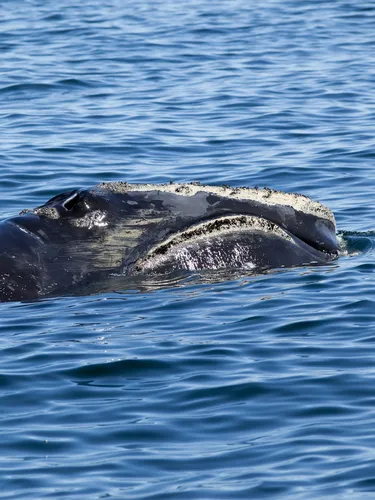
The North Atlantic right whale can easily be identified by the white calluses on its head, which are very noticeable against the whale’s dark gray body. It has a broad back without a dorsal fin and a long, arching mouth that begins above the eye. This baleen whale feeds by swimming through a swarm of plankton with its mouth open and its head slightly above the surface. Right whales are found more often in coastal waters, especially during the breeding season.
North Atlantic right whale facts
- Status Learn more about endangered status categories and explanation
- Endangered
- Population
- 366
- Scientific name
- Eubalaena glacialis
- Weight
- About 70 tons
- Length
- 45–55 ft.
- Habitats
- Oceans
News and stories
Why North Atlantic right whales matter
© Barrett & MacKay / WWF-Canada
The North Atlantic right whale is one of the most endangered of all large whales, with a long history of human exploitation and no signs of recovery despite protection from whaling since the 1930s. It is now mostly found along the Atlantic coast of North America, where it is threatened by entanglement in fishing gear and ship collisions. Some scientists believe these whales have gone extinct in the eastern North Atlantic and now survive only along the east coast of the US and Canada.
Threats to North Atlantic right whales

© Barrett & MacKay / WWF-Canada
North Atlantic populations have been decimated by historical over-exploitation by the whaling industry. The species gets its name from early whalers, who considered them to be the "right" whales to hunt. Today, the species is threatened by ship collisions, entanglement in fishing nets, and separation from calving areas because of shipping traffic. With such a small, slow-growing population, any threatening factor may have a significant impact.
Ocean noise
A 2012 scientific study suggests that underwater noise created by passing ships could be hindering the ability of whales to communicate. Scientists measured a significant amount of chronic noise (“acoustic smog”) in a critical North Atlantic right whale feeding area. The results indicate that whales may be having a hard time hearing each other most of the time in that area. This can affect their ability to find food and mates, navigate, avoid predators, and take care of their young.
Bycatch
Even though they are large animals, whales can become accidentally caught in fishing nets. Such entanglement can cause serious injury or even death. For example, fishing gear may wrap around a whale’s mouth and prevent them from feeding, or they can drown in a net from not being able to surface for air.
Climate change
Warming oceans can affect the food sources whales need to survive. Large patches of tiny plants and animals that they feed on will likely move or change in abundance as climate change alters seawater temperature, winds, and ocean currents. The shift in food availability due to climate fluctuations has already hurt the reproductive rates of the endangered North Atlantic right whale.
How WWF is taking action to protect North Atlantic right whales

© Damian Lidgard / WWF-Canada
Improving whale protection
The International Whaling Commission (IWC) is the body charged with regulating whaling and addressing the vast number of other threats (shipping, climate change, and bycatch) to whales, dolphins, and porpoises in our oceans. WWF works to make the IWC more effective in reducing threats to whales.
Safer shipping lanes
WWF has reached significant milestones regarding the protection of the North Atlantic right whale. This includes a shift of the shipping lanes in Canada's Bay of Fundy in 2003, which reduces the risk of ship strikes of right whales in Canadian waters by up to 80%. However, collisions in US and other Canadian waters remain a major conservation problem for the species.
Experts

How you can help
© WWF-US / WWFGifts
Adopt a humpback whale
Support WWF’s global efforts to protect wild animals and their habitats and choose from kits with plush and more.