How canopy bridges help wildlife deep inside the Amazon
By
-
Mark Johanson

© WWF-US / Yawar Motion Films
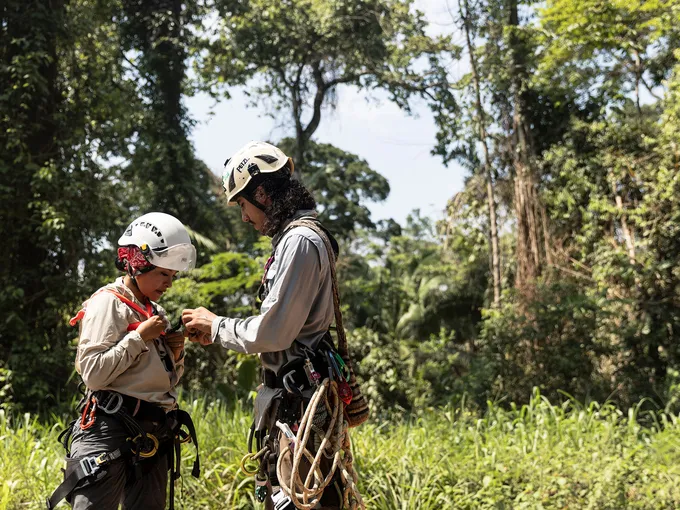
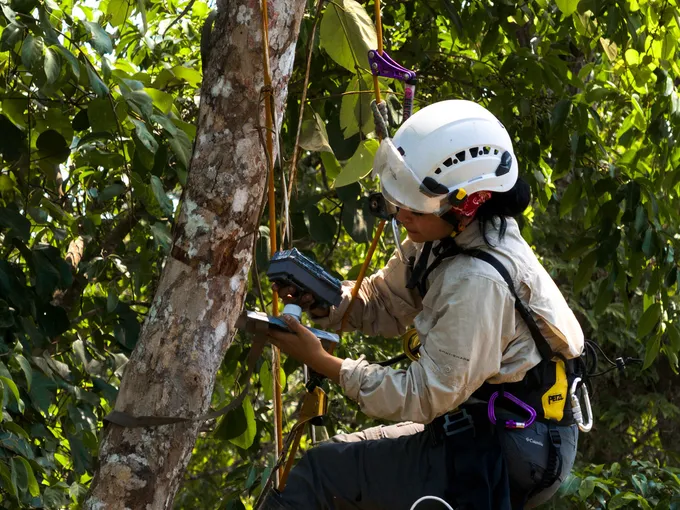
With a harness around her waist, a helmet on her head, and carabiners dangling from her waist, Vania Tejeda could easily summit a mountain. Yet here, deep in the Amazon of Peru’s Madre de Dios region, there isn’t an elevated patch of land in sight. Instead, the former WWF-Peru wildlife officer has her eyes affixed on a towering fig tree.
She ascends about 70 feet into the rain forest canopy, using her biceps—but mostly her legs—to hoist her way up fixed ropes. In the sky above, where scarlet macaws squawk by like fleeting rainbows, are two hanging rope bridges. They droop over an orange dirt road that divides this rain forest in two.
“We have a lot of big infrastructure like roads and drainage systems, that is useful for people, but we often don’t see the impacts it has on fauna,” Tejeda explained before ascending, noting that some animals don’t have the evolutionary capacities to descend from the treetops and walk on the ground. This is a big problem because, “many of these arboreal species are seed dispersers, and the forest depends on them for regeneration.”
© WWF-US / Yawar Motion Films
© WWF-US / Yawar Motion Films
This particular forest is more than 500,000 acres in area (220,000 hectares) and is one of Peru’s largest Forest Stewardship Council® (FSC®)-certified timber concessions for forest management. The forest’s operator, Maderacre, only extracts an average of one to three trees per hectare every 20 years. And because there’s no hunting, it’s a biodiversity hot spot. Yet, it’s also crisscrossed by logging roads.
That’s where the canopy bridges come into play. They’re a key mitigation measure to restore canopy connectivity for the Amazon’s tree-living fauna, such as porcupines, sloths, and monkeys, whose territories have become fragmented by linear infrastructure. A single road can isolate an animal from shelter, feeding resources and potential mates, hampering daily life and dividing species into distinct subpopulations, which can diminish genetic diversity.

© WWF-US / Yawar Motion Films
Terrestrial wildlife crossings like overpasses and underpasses have become popular conservation tools everywhere from Canada’s Banff National Park to the Veluwe woodlands in the Netherlands. After all, they make wild animals and human motorists safer. Canopy bridges take that concept up into the trees—but in a much simpler and cost-effective way.
Tejeda’s mission is to check how effective these bridges are by seeing how many animals and species use the bridges and how often. The first step today is checking the camera traps she’s placed on either side of Maderacre’s canopy bridges. She needs to change their batteries and recover the images that will inform her research. Yet, it’s a grueling task. Mid-morning temperatures rise toward 100 degrees Fahrenheit, and her perspiration attracts swarms of sweat bees and flies, nearly turning her brown shirt black.
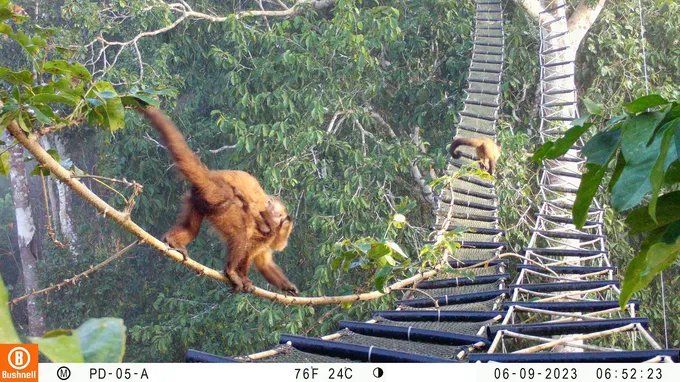
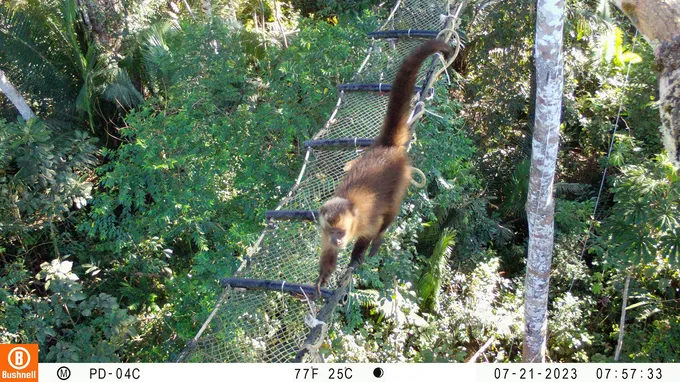
Back on the ground, the wildlife officer removes the mosquito net over her head and retreats into a pickup truck. She blasts the AC, cracks open the camera, and slips its memory card into her laptop, watching her screen populate with dozens of new videos. In one, a kinkajou awkwardly tiptoes across the bridge like a first-time tightrope walker, its long tail wagging in the air, searching for better balance. In another, a night monkey briefly skitters onto the bridge, peering over the edge with its owl-like eyes before heading back into the canopy.
© WWF-Peru
© WWF-Peru
Designing a bridge for a wild animal isn’t easy, Tejeda says. For starters, the ropes must be made of polypropylene, which can withstand high temperatures and humidity and last several years. Some bridges are just ropes that replicate vines linking two trees on either end of a road. Others are like long rope ladders with PVC tube rungs evenly spaced every foot or so.
“What we’re doing right now is piloting and testing different kinds of bridges with distinct designs to see which are preferred by different species,” Tejeda explains. Thanks to the camera traps, she knows that monkeys tend to feel more comfortable on bridges with mesh netting between each rung, while kinkajous prefer the extra support of crisscrossing X-shaped lines. There have been other surprises, too. Monkeys have been much more cautious about crossing the bridges, eyeing them for up to six months before giving them a go. Kinkajous and dwarf porcupines began using them right away.
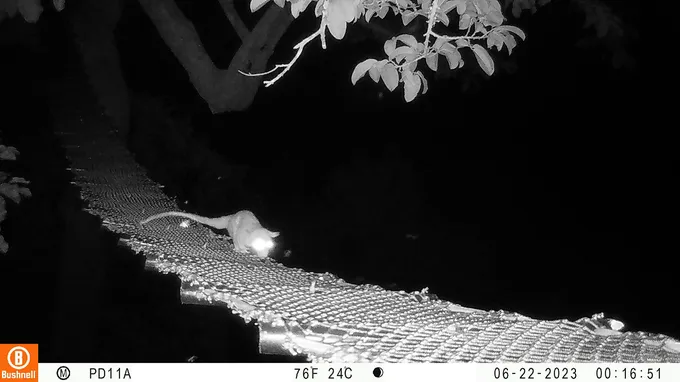
© WWF-Peru
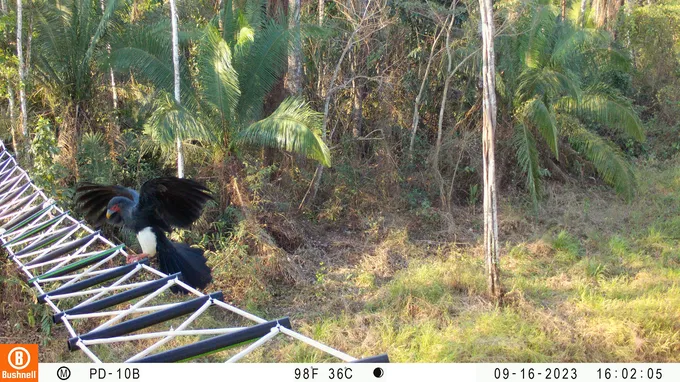
© WWF-Peru
Tejeda has placed nearly 20 canopy bridges across these logging roads since 2022 as part of work in partnership with Maderacre and supported by HP Inc. through Forests Forward, WWF's signature program for corporate action in support of nature, people, and a healthy climate. “At the end of the project, we need to prove that canopy bridges are working for these species and that they’re actually using them,” she says. “Then, we can show others that it’s a cost-effective tool [at about $200 per bridge versus tens of thousands to hundreds of thousands for an overpass or underpass].”
If all goes according to plan, canopy bridges could become a required mitigation measure for all Peruvian forest concessions. To alter the law, however, Tejeda first needs to gather more data. “People have to understand not only what we’re doing here, but why we’re doing it,” she says. “That’s how you change minds.”

© WWF-US / Yawar Motion Films