Publications
-
Giant pandas have a small population size, long generation time, low reproductive rate, and feed almost exclusively on bamboo, all of which make them less able to adapt to a changing climate. Explore these and other traits which make giant pandas vulnerable to climate change, as well as recommended climate-adaptive management strategies.

-
Peru has a historic opportunity to secure the investments in protected areas that have been made by the government of Peru and donors over the past 20 years. The opportunity is an innovative public-private partnership—called National Parks: Peru’s Natural Legacy—that brings together government commitments, international cooperation and private donors to create a permanent source of funding to properly manage the protected areas.
-
The assessment presented in this report shows where and how Myanmar‚'s natural capital contributes to clean and reliable drinking water sources, reduced risks from floods inland and storms along the coasts, and to maintaining the functioning of reservoirs and dams by preventing erosion. The results highlight areas that provide high levels of ecosystem services, where natural capital provides the greatest benefits to people and infrastructure. This initial assessment has focused on identifying important ecosystem service provisioning areas that benefit the greatest number of people at a national scale, emphasizing benefits to cities and other large population centres. Benefits to rural populations and to vulnerable subgroups are critical as well, and they should be considered in greater detail as a next step.
In addition, many of these areas important for ecosystem services provision coincide with areas important for biodiversity conservation. The effective management of these areas of synergy can help guarantee benefits to Myanmar‚'s people, infrastructure and wildlife not just now, but for decades to come.
-
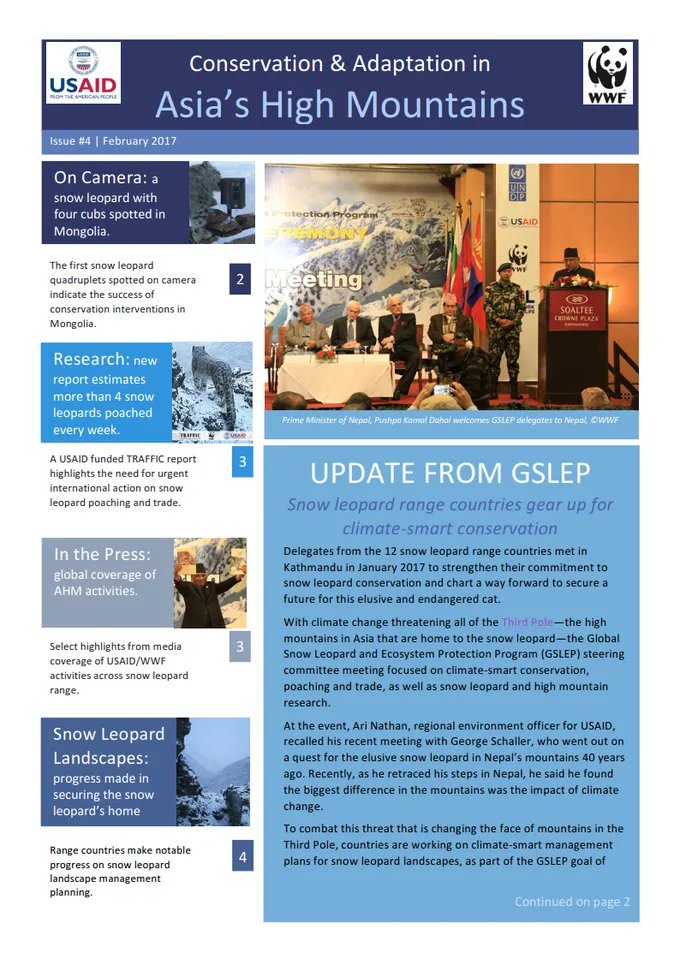
The February 2017 Asia High Mountains Project Newsletter with stories on the Second Global Snow Leopard and Ecosystem Protection (GSLEP) Program Steering Committee Meeting and release of the new TRAFFIC snow leopard crime report titled An Ounce of Prevention. (4 page Newsletter)
-
Countless companies, governments, NGOs, and indigenous peoples‚' organizations have committed to eliminate deforestation from the production of major agricultural commodities. While this global ambition shows great promise, considerable challenges lie ahead. In particular, these challenges include both a lack of transparency and traceability within commodity supply chains and the issue of illegality across production landscapes, which can leave stakeholders vulnerable to a number of economic, social, and environmental risks.
World Wildlife Fund-US, with support from Global Forest Watch, developed the Jurisdictional Risk Assessment to explore potential applications of public data platforms (such as Global Forest Watch) that allow companies, governments, and other end-users to assess certain jurisdictions and their potential association with illegal deforestation. This tool can help companies and governments prioritize and strengthen their traceability and due diligence efforts. Using palm oil and Indonesia as a pilot commodity and geography, we developed a set of key indicators that approximate deforestation risks at the district level based on the extent and rate of deforestation in areas where deforestation is not permitted to occur (e.g., in primary forests, protected areas, peatland, and Forest Estate) and through deforestation activities that are considered illegal (e.g., use of fire) in Indonesia.
Among other important considerations, the JRA is based primarily on historical remote sensing data and does not quantify social risks (e.g., land insecurity and labor rights). It is not intended to be used as a standalone tool with regard to procurement and sourcing decisions. However, the JRA can complement other sources of information‚ – in particular, local knowledge and consultations‚ – to paint a broader picture of deforestation risks that may be associated with illegal deforestation.
-
With support from Global Forest Watch, World Wildlife Fund-US (WWF) developed the Jurisdictional Risk Assessment to explore potential applications of public data platforms to help companies, governments, and other end-users assess certain jurisdictions and their potential association with illegal deforestation. This tool can help companies and governments prioritize and strengthen their traceability and due diligence efforts. Using palm oil and Indonesia as a pilot commodity and geography, WWF developed indicators to assess potential risk to forested ecosystems and their management in Indonesia by district. The sets of indicators represent: 1) primary forests, 2) peat lands, 3) protected areas, and 4) the forest estate (specifically, production forests and limited production forests). Depending on the ecosystem or managed area type, historical rates of deforestation, fire occurrence, and incompatible zoning of land uses (particularly by oil palm concessions) were selected as ways of evaluating risk. We used datasets from Global Forest Watch and associated websites, augmented by additional external sources. Download the PDF for more details on the JRA’s methodology.
-
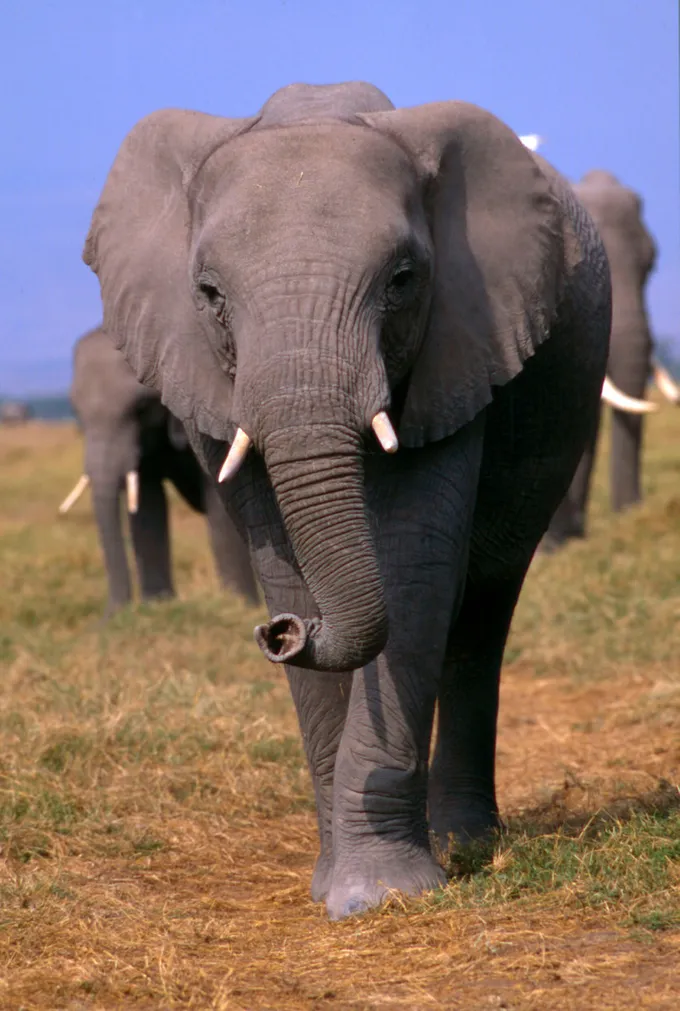
One of the biggest priorities for WWF‚'s wildlife team is to secure time-bound commitments and implementation of elephant ivory bans from three of the largest consumer markets and scale up consumer outreach efforts to reduce desire for elephant ivory. Reducing consumer demand for elephant ivory and mobilizing public support for policy change and enforcement are essential to combating illegal elephant ivory trade.
In an effort to tackle the challenge of "desire reduction" of consumers, WWF commissioned a guide, Reducing Desire for Elephant Ivory: A Psychosocial Guide to Address Elephant Ivory Consumption that presents a new lens through which to view conservation campaigns and their audiences taking on complex dimensions (psychological, cultural, social, and emotional) of elephant ivory consumption.
The purpose of the guide is to support efforts that directly address the active market for these goods and to build upon campaign strategies and amplify their effectiveness. In 2017 we would like to pilot this guide with our demand reduction work and with partners.
Watch: An innovative approach to reducing consumption of illegal products
-
Answers to important questions in regard to the 2016 Plowprint Report, such as: What is the methodology behind the report? Why was it developed? And, What is WWF doing to slow grassland loss?
-
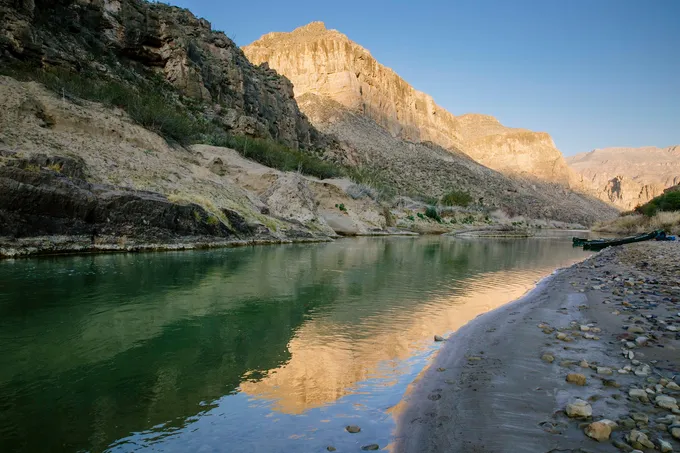
Companies are increasingly setting and pursing ‘water balance targets’ as part of their water stewardship strategies. The seeming simplicity of balance goals can be attractive – “we will restore a volume of water equal to the amount our business consumes.” However, the implementation is anything but simple, requiring the development of new quantification methodologies, corporate system guidelines and parameters, and verification and reporting processes. This paper explores the history, challenges and opportunities of water balance targets, and how important it is for such goals to be grounded in the realities of each unique watershed.
-
With massive infrastructure plans threatening all tiger landscapes and risking recent gains in tiger conservation, Asian governments must adopt a sustainable approach to infrastructure planning and construction or drive tigers toward extinction, according to a new analysis by WWF.