Publications
-
-
A new briefing from WWF and TRAFFIC finds distressing evidence of documented snaring cases involving a minimum of 387 big cats (tigers, leopards, snow leopards, and Asiatic lions) across seven Asian countries between 2012-2021, with a majority of cases documented outside protected areas. The data suggest tigers ( Panthera tigris ) and leopards ( Panthera pardus ) are particularly impacted by snaring, with more than a third of cases involving tigers (33%) and more than half of the documented cases involving leopards (63%).
The findings highlight the need for governments to take holistic, multi-pronged steps to halt snaring before big cat populations are pushed further to the brink of extinction. Offering a series of recommendations in order to tackle the threat, the report stresses that leadership from local communities, combined with an increase in the number and quality of adequately supported, effective, inclusive, and professionalized ranger workforces, are key to dismantling the impact of snares.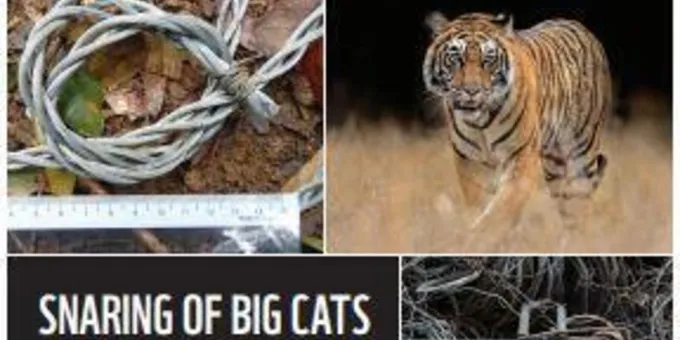
-
This report assesses the health of the Upper Rio Grande, a portion of the broader Rio Grande/Rio Bravo river that runs from the Rocky Mountains in Colorado, through New Mexico, to the Gulf of Mexico. The Upper Rio Grande basin supports around 6 million people in the US, including over 20 Tribal Nations and Pueblos, and unique species like the Silvery Minnow, Southwest Willow Flycatcher birds, and the Rio Grande cottonwood tree.
As the first-ever report card for the region, the assessment provides an expansive look at over 30 indicators of social, environmental, and economic health across the three states it covers. Additionally, this report card combines the standard report card methodology with an innovative modeling approach, Freshwater Resilience by Design, that can inform future decisions on appropriate management options.
The Rio Grande/Rio Bravo (RGRB) has been declared one of the 10 most endangered rivers in the world, suffering from limited water availability due to climate change, water management, infrastructure, and increasing water use.
The findings from this Basin Health Report can be used to easily explain technical scientific information, increase public awareness, and inform and influence decision-makers to improve the health of a watershed.
-
WWF‚'s Network-wide Ivory Initiative came to an end in June 2022, after more than four years of successful work, focused on demand reduction and policy advocacy to shut down Asia‚'s elephant ivory markets. The initiative was built on the game-changing decision by China in 2017 to shutter its domestic market for elephant ivory. WWF-US was one of the key architects, part of a collective drive alongside NGOs, governments, businesses, and other partners.
The Elephant Ivory Initiative Report: 2018-2022 is an independent assessment that highlights the legacy, achievements, and lessons learned.
-
As efforts to address the global plastic waste and pollution crisis increase, there is a growing focus on reuse as a solution. Reuse systems can provide a number of potential benefits over conventional linear approaches, but it is important to ensure that these systems are built on a solid set of principles. This position paper seeks to lay out a framework through which reuse systems can support WWF's vision of No Plastic in Nature.
This position paper was updated in January 2024 to include recommendations on return and refill modalities.
-
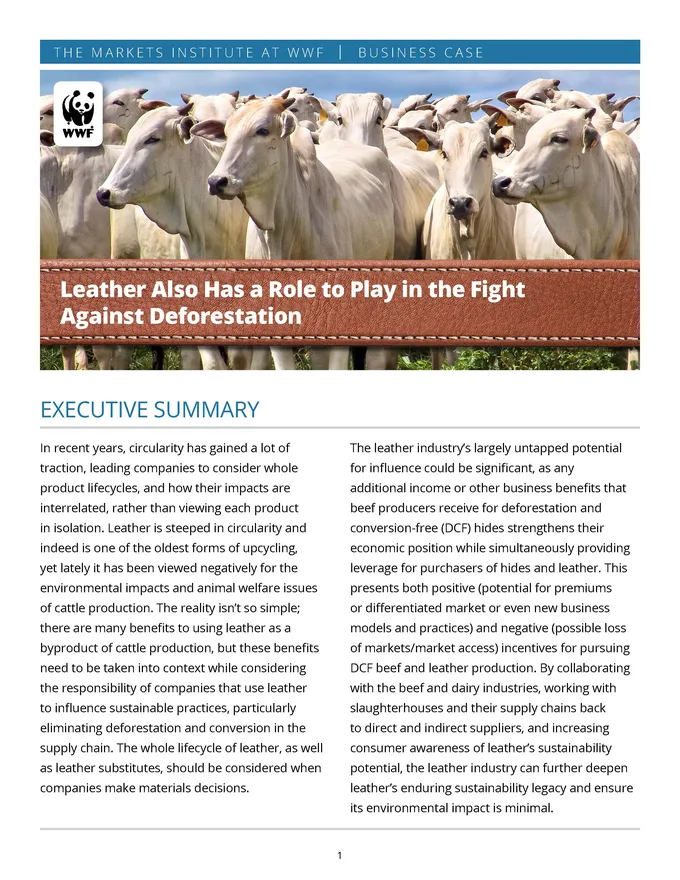
All buyers of cowhides or leather anywhere along the value chain ‚Äì from slaughterhouses to consumers ‚Äì have a role to play in driving more sustainable production and eliminating deforestation and conversion. Given leather‚'s status as a luxury good and association with quality, consumer pressure for and awareness of sustainable practices is high. Thus, leather companies and their customers hold a unique lever that can be used to encourage and support sustainable practices.
-
The report Crimes that Affect the Environment and Climate Change explores the relationship between environmental crime, biodiversity loss, and climate change. Co-authored by the UN Office on Drugs and Crime and WWF, the report explores illegal activity in marine and forest ecosystems and trafficking in waste to understand their impact on the environment.
The legal and judicial systems offer potential solutions to these problems that are under-utilized. The report offers potential paths forward for legal and judicial reform that emphasize the importance of measuring generational harm when calculating the impact of climate change on human well-being.
-
Learn about the Arctic Program's vision for healthy Arctic ecosystems that support the cultural, social, and economic needs of the people living there, and that protect the diversity of Arctic life.
-
Learn how WWF-US is engaging financial markets and deploying capital to strengthen the environmental, social, and economic resilience of the blue economy.
-
Learn how WWF-US is working with industry to drive net-positive impacts on biodiversity, people, and climate.