Publications
-
A climate vulnerability assessment for Asia High Mountains Project sites in the Kyrgyz Republic’s Central Tian Shan region. This vulnerability assessment focuses on the areas surrounding the Sarychat-Ertash State Reserve and the new Khan Tengri National Nature Park in southeast Issyk Kul Province. The assessment presents a brief overview of biodiversity and natural features of the Central Tian Shan region and examines climate change impacts on both under various future climate scenarios, with a particular emphasis given to impacts on glacial water resources. Vulnerability of development and livelihood activities to climate change is examined and possible adaptation strategies for ecosystems and livelihoods provided. (61 page Technical Report)
-
Up to half of plant and animal species in the world‚'s most naturally rich areas, such as the Amazon and the Galapagos, could face local extinction by the turn of the century due to climate change if carbon emissions continue to rise unchecked. Even if the Paris Climate Agreement 2C target is met, these places could lose 25% of their species according to this landmark study by the University of East Anglia, the James Cook University, and WWF.
This report examines the impact of climate change on nearly 80,000 species in 35 of the world‚'s most diverse and naturally wildlife-rich areas. It models a number of different climate scenarios‚ – from a no-emissions-cuts business-as-usual rise in global mean temperatures of 4.5C to a 2C global rise to keep to the upper limit of the Paris Agreement. Each area was chosen for its uniqueness and the variety of species, including plants, insects and animals, found there.
-
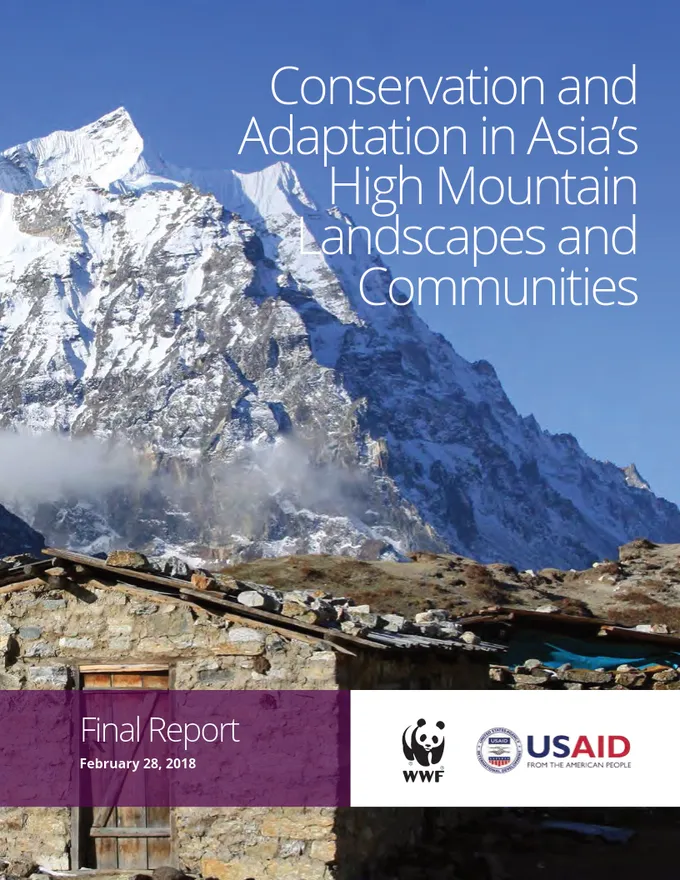
This is the final report for the WWF Conservation and Adaptation in Asia‚'s High Mountain Landscapes and Communities Project, commonly referred to as the WWF Asia High Mountains Project or AHM Project, which was active from October 1, 2012 to November 30, 2017. The report summarizes the AHM Project‚'s achievements with respect to snow leopard research, climate change research, community conservation, and climate adaptation actions for improved management of water, natural resources, ecosystems and livelihood activities in snow leopard range areas. The report also provides an overview of AHM Project support for the 12-nation inter-governmental Global Snow Leopard and Ecosystem Protection (GSLEP) Program. (126 Page Final Project Report)
-
Jurisdictional approaches seek to align interests and coordinate actions among governments, businesses, local communities, and NGOs toward shared conservation, supply chain sustainability, and green development goals. In May 2017, WWF convened a group of experts and practitioners for a workshop to analyze five leading jurisdictional initiatives in a peer-to-peer setting. Based on the conversations and expertise from this workshop, Tackling Deforestation Through A Jurisdictional Approach: Lessons From The Field, offers a full synthesis of lessons learned and jurisdictional case studies.
-
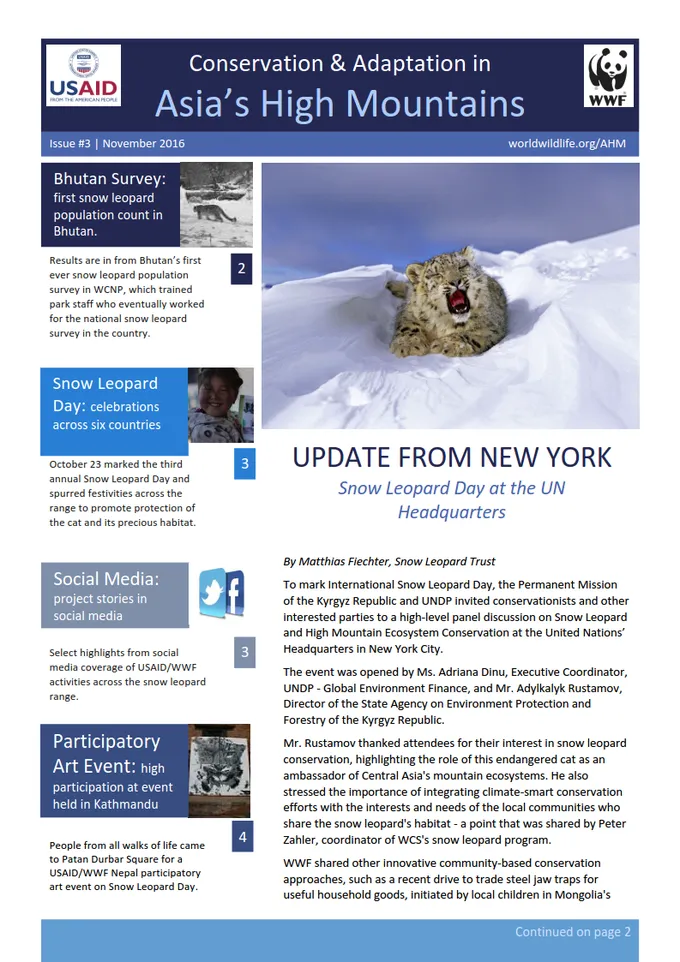
The November 2016 Asia High Mountains Project Newsletter with stories on International Snow Leopard Day events in India, the Kyrgyz Republic, Nepal, and New York City. Also includes a story on the results of Bhutan‚'s first ever snow leopard camera trap survey in Wangchuk Centennial National Park. (4 page Newsletter)
-
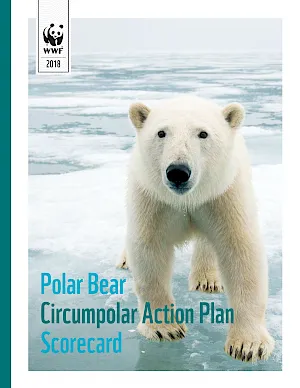
A report by WWF's Arctic Programme finds that the five countries responsible for the conservation of polar bears need to do more to secure a healthy future for the species.
-
An 8-part advice document addendum to the Global Snow Leopard and Ecosystem Protection (GSLEP) Program landscape management planning guidelines prepared by WWF and Snow Leopard Trust. Contains sections on: 1. Strategic Management Planning in Snow Leopard Landscapes; 2. Participation in Conservation; 3. Stakeholder Analysis in Snow Leopard Landscape Management Planning; 4. Integrated Management and Governance of GSLEP Landscapes; 5. Best Practices in Snow Leopard Conservation; 6. Incorporating Climate Change in Snow Leopard Landscape Management Planning; 7. Mapping to Support Snow Leopard Landscapes Management Planning; and 8. Green, Resilient Economic Development in Snow Leopard Landscape Management. (121 page Conservation Planning Guideline Addendum)
-
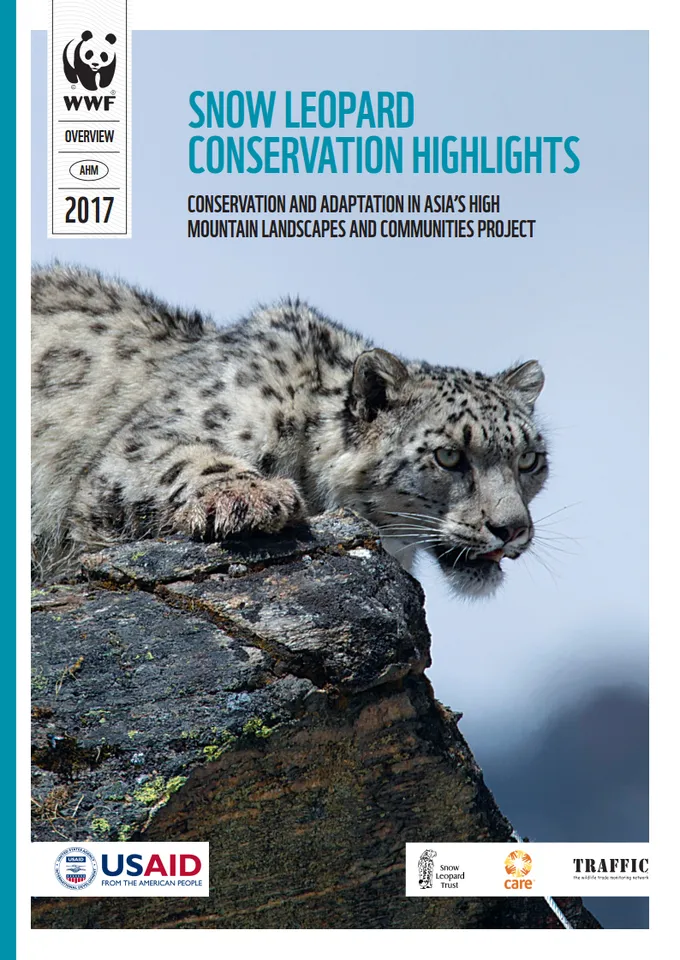
An overview of Asia High Mountains Project snow leopard conservation field activity highlights from Bhutan, India, Kyrgyzstan, Mongolia, Nepal, and Pakistan as well as highlights of range-wide AHM activities. (14 page Brochure)
-
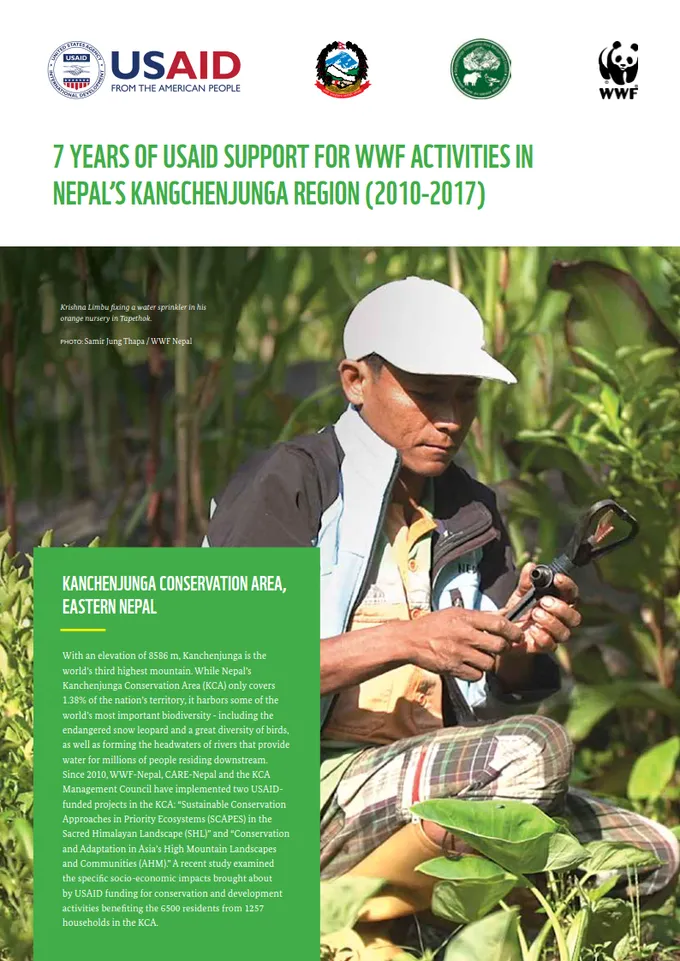
A quick look at WWF sustainable livelihood activities funded by USAID in the Kangchenjunga Conservation Area of Nepal under both the Asia High Mountains and Sacred Himalaya Landscape Projects. These activities included introduction of improved irrigation, greenhouse agriculture, improved pasture management, and improved cook stoves to this poor region. (2 page Brochure)
-
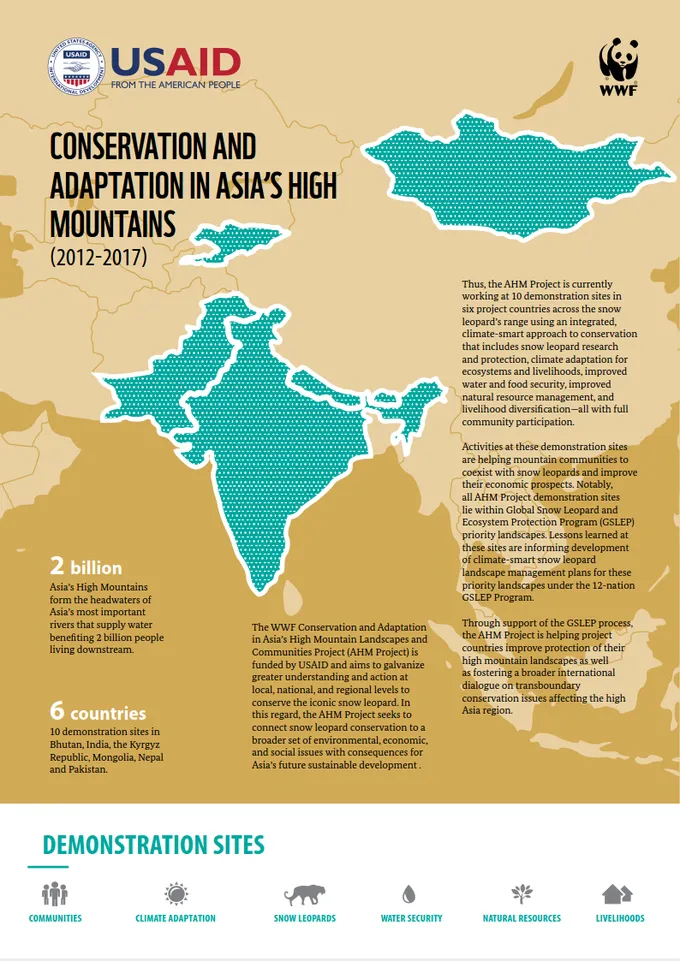
A quick look at the integrated climate-smart approach and achievements of WWF’s Conservation and Adaptation in Asia’s High Mountain Landscapes and Communities (AHM) Project funded by USAID. (2 page Brochure)