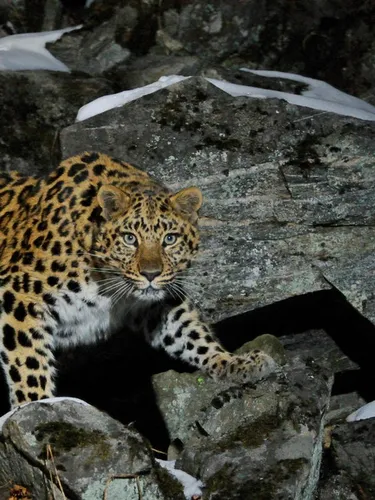
© naturepl.com / Vladimir Medvedev / WWF
Amur leopards
People usually think of leopards in the savannas of Africa but in the Russian Far East, a rare subspecies has adapted to life in the temperate forests that make up the northern-most part of the species’ range. Similar to other leopards, the Amur leopard can run at speeds of up to 37 miles per hour. This incredible animal has been reported to leap more than 19 feet horizontally and up to 10 feet vertically.
The Amur leopard is solitary. Nimble-footed and strong, it carries and hides unfinished kills so that they are not taken by other predators. It has been reported that some males stay with females after mating, and may even help with rearing the young. Several males sometimes follow and fight over a female. They live for 10-15 years, and in captivity up to 20 years. The Amur leopard is also known as the Far East leopard, the Manchurian leopard or the Korean leopard.
Amur leopard facts
- Status View status categories and descriptions
- Critically endangered
- Population
- More than 84 individuals
- Scientific name
- Panthera pardus orientalis
- Weight
- 70–105 pounds
- Habitats
- Temperate, broadleaf, and mixed forests
Why they matter
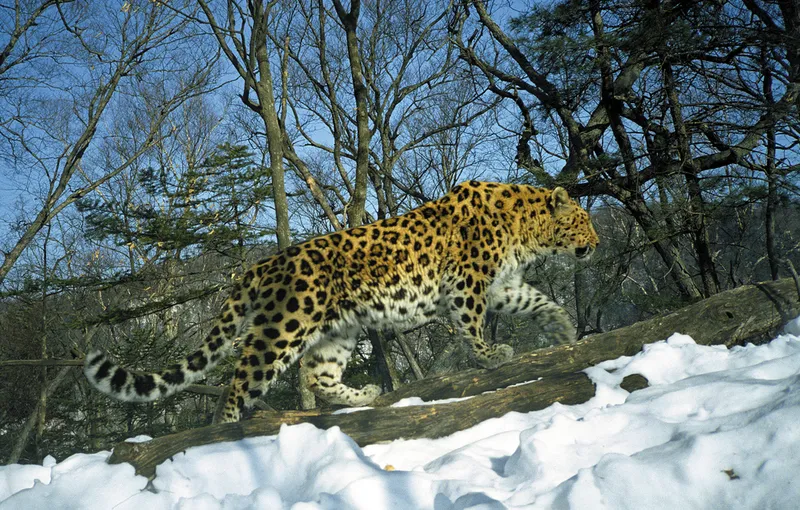
© WWF-Russia / ISUNR
The Amur leopard is important ecologically, economically and culturally. Conservation of its habitat benefits other species, including Amur tigers and prey species like deer. With the right conservation efforts, we can bring them back and ensure long-term conservation of the region.
Threats

© Vladimir Filonov / WWF-Canon
Prey Scarcity
There are still large tracts of suitable habitat left across the Amur in Russia and China. In China the prey base is insufficient to sustain large populations of leopards and tigers. Prey populations will recover if measures are taken to limit the poaching of prey species and the forests are managed for logging more sustainably. For the Amur leopard to survive for the long term, it needs to repopulate its former range. But for that to happen, prey populations need to recover first.
The Amur leopard is poached largely for its beautiful, spotted fur. In 1999, an undercover investigation team recovered a female and a male Amur leopard skin, which were being sold for $500 and $1,000 respectively in the village of Barabash, not far from the Kedrovaya Pad reserve in Russia. Agriculture and villages surround the forests where the leopards live. As a result the forests are relatively accessible, making poaching a problem—not only for the leopards themselves, but also for important prey species, such as roe deer, sika deer and hare, which are hunted by the villagers both for food and cash.
“Amur leopards are teetering on the brink of extinction. With the establishment of the Land of the Leopard National Park, in conjunction with other conservation efforts, we can now start to focus on how to begin bringing them back.”
Dr. Sybille Klenzendorf Managing Director, Species Conservation
How WWF is taking action
WWF works with local communities, regional authorities, government and other non-governmental organizations to save the Amur leopard and ensure the long-term conservation of the region.
Stopping poaching and trade
With such a small population left, the loss of each Amur leopard puts the species at greater risk of extinction. WWF supports antipoaching work in all Amur leopard habitat in the Russian Far East and in known leopard localities in northeast China. WWF implements programs to stop the illegal trade in Amur leopard parts. Together with TRAFFIC, the world’s largest wildlife trade monitoring network, we help governments enforce domestic and international trade restrictions on Amur leopard products. Amur leopards are listed on CITES Appendix I, prohibiting all commercial trade in the species.
A Safe Haven
Amur leopards received a safe haven in 2012 when the government of Russia declared a new protected area. Called Land of the Leopard National Park, this marked a major effort to save the world’s rarest cat. Extending nearly 650,000 acres it includes all of the Amur leopard’s breeding areas and about 60% of the critically endangered cat’s remaining habitat. The park is also home to 10 endangered Amur tigers. WWF lobbied for the establishment of this park in the Russian Far East since 2001.
Monitoring populations
WWF monitors Amur leopard populations and its habitat. Our camera traps have often yielded amazing results, allowing the world to catch a glimpse the world’s rarest wild cat. We also work to increase the population of leopard prey like roe deer, sika deer and wild boar including releasing such deer into new reserves in China to provide founder animals to rebuild prey populations.
Protecting Amur leopard habitat
This work includes increasing areas of protected land in both Russia and China, reducing illegal and unsustainable logging practices, and facilitating trade between companies committed to responsible forestry practices. In 2007, WWF and other conservationists successfully lobbied the Russian government to reroute a planned oil pipeline that would have endangered the leopard's habitat.
How you can help
© George Walsh
Strengthen the Endangered Species Act
More than 99% of the species listed under the Endangered Species Act have avoided extinction due to the law’s protections. Today, those protections are under threat — at the exact moment wildlife needs them most.