Madagascar: Glittering and bright
In Madagascar’s northernmost territory, a stretch of land and sea is home to a wild abundance of marine and terrestrial biodiversity—and the dedicated cadre of local leaders who protect it.
By
-
Sandy Ong
Photos by
-
Mac Stone
Illustrations by
-
Jovaney Hollingsworth

© WWF-US / Mac Stone
On a blistering summer morning under a piercing blue sky, Mariette Rabeta makes a beeline for the beach where a group of women have gathered on the dark sand, lambas skirts swirling at their ankles. They stand just beyond the last thatched hut of Rabeta’s village, Ampasindava, at the northernmost tip of Madagascar’s west coast.
Squinting in the harsh sunlight, Rabeta notes the needle-shaped limestone karst landforms in the distance—part of the island chain comprising Nosy Hara National Park. Nosy Hara is home to numerous endemic species, including the world’s second-smallest chameleon (Brookesia micra) and the majestic but critically endangered Madagascar fish eagle (the country’s national bird). And although she can’t see beneath the surface, Rabeta knows the water is teeming with resplendent corals, five species of sea turtles, all manner of fish, and even dolphins and whales.
The women are waiting patiently for a colorfully painted pirogue, a wooden fishing boat whose catch the group—part of the local women’s association Rabeta co-founded—will purchase, scale, gut, and smoke to sell in the district market to earn some extra income.

© WWF-US / Mac Stone
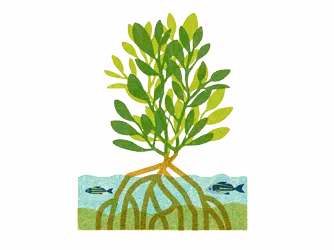
What she can see are the “blue forests” she has known all her life: the lush mangroves that line much of the area’s beaches, acting as a sentinel for its coastal inhabitants. “When I was young, the mangroves were good—there used to be lots of crabs and fish and shrimp,” recalls the grandmother of three, gazing at the half-submerged trees, their innumerable finger-thick prop roots protruding from the wet sand. “But then they got destroyed.”
In fact, Madagascar lost a fifth of its mangrove cover between 1980 and 2005, largely due to illegal logging for timber and charcoal. This loss, approximately the size of 80,000 soccer fields, is alarming given that mangroves play multiple critical roles: acting as nurseries for juvenile marine life, buffering shorelines against storms, and storing vast amounts of carbon—up to four times more per acre compared with terrestrial tropical forests.
Fortunately, the country’s mangroves are making a comeback. Deforestation rates have declined in the past decade, with forest cover increasing by 5%. In 2020 (the most recent figures available), Madagascar had over 685,000 acres of mangroves—more than 10 times the size of Washington, DC. The rebound is thanks to joint efforts by the government and other organizations—including WWF, whose conservation approach revolves around improving livelihoods and establishing alternative income streams, such as fish smoking, so that locals don’t feel pressure to clear-cut mangroves for their subsistence or income. WWF also helps community-based organizations carry out restoration projects to protect mangroves and other natural resources.
© WWF-US / Jovaney Hollingsworth
Infographic
Coast to Coast
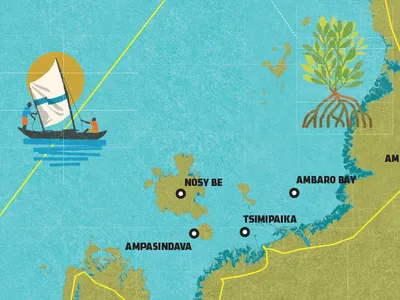
At the heart of WWF’s Southwest Indian Ocean Seascape lies the Northern Mozambique Channel, which includes the span of ocean between southern Tanzania, northern Mozambique, and western Madagascar.
DownloadRabeta’s group, Fikambanan’ny Vehivavy Mamiratsa Hiaro ny Nosy Hara (which translates as the Association of Brilliant Women for the Protection of Nosy Hara), regularly patrols nearby mangroves for illicit activities, organizes beach cleanups, and conducts tree planting, among other activities. “We live off the mangroves and marine resources,” she says. “That’s why we want to protect them.”
Nosy Hara, together with Ambaro Bay farther south, make up the Diana Seascape—a WWF flagship conservation program in Madagascar, the world’s fourth-largest island whose unique flora and fauna have earned it the nicknames the “eighth continent” and the “Galapagos of the Indian Ocean.”
Diana, spanning 4.2 million acres of the island’s northwestern coast, is known for a good portion of that exceptional biodiversity. “It’s one of the jewels of the Indian Ocean,” says Mihary Raparivo, Diana Seascape manager for WWF-Madagascar.
Ambaro Bay, for instance, is a Ramsar site—a measure that recognizes ecologically valuable wetlands—that supports 10% of Madagascar’s mangroves, five types of lemurs, and 99 bird species, half of which are unique to the area. Nosy Hara boasts some of the island’s most intact reef systems, with 93% of the Western Indian Ocean’s 369 coral species found in its waters, including some of the most climate-resilient coral reefs in the world.

© WWF-US / Mac Stone
“Another reason why Diana is so important is that it makes up the easternmost part of the Northern Mozambique Channel,” says Shauna Mahajan, who oversees the Southwest Indian Ocean (SWIO) Seascape for WWF-US. She’s referring to the nutrient-rich waters between southern Tanzania, northern Mozambique, and western Madagascar that make up the heart of the WWF priority region.
The channel—second only to the Coral Triangle in marine biodiversity—is an important migratory corridor and breeding ground for dozens of marine mammal species, including the dugong, humpback whale, and bottlenose dolphin. “Diana is very much a part of that whole channel, and as a result,” says Mahajan, “it’s really critical from a regional biodiversity perspective.”
But protecting this biodiversity and the nearly 900,000 people who call the area home is not without challenges. “We’re talking about a place with a backdrop of colonization that has led to extremely high poverty,” says Mahajan. The average Malagasy lives on less than $2 a day, and many rely heavily on natural resources to eke out a living, including using mangroves for firewood and reef fish for food, especially in rural communities like Ampasindava.
Couple poverty with limited government support, she adds, and you have a tangle of inadequate social support mechanisms to help the population meet their basic needs, as well as insufficient resources to enforce environmental laws and monitor protected reserves.
Adding fuel to the fire is climate change, which heats ocean waters and threatens fish stocks and coral reefs, worsens inland droughts, and drives migration to coastal areas—all of which puts even more stress on local resources. Moreover, warmer temperatures batter Madagascar with higher-intensity storms, inflicting US$87 million in damage annually and spelling bad news for a country that already ranks among the top 10 most vulnerable to tropical cyclones.
To protect Diana’s coastal communities—and especially those who make their living directly from the increasingly unpredictable sea—WWF partnered with local nonprofit Aquatic Service, the World Bank’s SWIOFish project, and the Malagasy Ministry of Fisheries and Blue Economy to launch a storm warning system in 2023. Volunteers receive a text with weather data such as wind speed and strength, which they then relay to fellow villagers via a public display board that uses simple iconography. The early warning system is now available countrywide, and to date, more than 60 villages have adopted it, reducing wind-related fatalities at sea by 98%.
But climate change is also altering weather patterns in other ways. “We used to get the trade winds three to four months a year, but now they last about six months,” says Rabeta as she watches the long-awaited pirogue come aground in a small mangrove clearing, its crew unloading their catch. Her association pays fishers 10,000 ariary (US$2.26) per kilogram of fresh fish, which they smoke and resell for up to 5,000 ariary (US$1.13) apiece. In terms of the local economy, that can add up to a very good haul.
But the changing trade winds are severely limiting fishers’ catch and reducing the group’s income, says Rabeta. “We should normally get about 50 kilograms [110 lb] of fish from three days’ worth of fishing, but now we get around 35 kilograms [77 lb],” she says. “Life is hard here.”
© WWF-US / Jovaney Hollingsworth
Monitoring and measuring
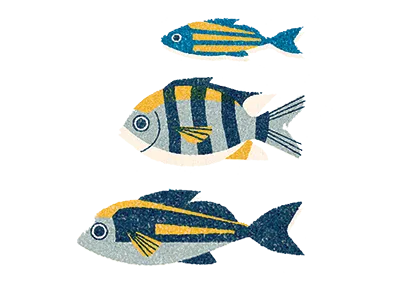
To monitor how climate change is affecting ocean ecosystems, it’s important to keep track of how fish populations are shifting over time. And who better to do that than those on the front line? In northern Madagascar, WWF works with community members—usually women—who survey and assess fish catches that help inform sustainable management of local fisheries.
Working in pairs, the women meet fishing boats as they dock and unload their catch on the beach. They count and sort the fish according to their species before weighing each group using a spring-operated hand scale. Every fish is measured from snout to tail with a measuring tape, and all the information is recorded in a logbook.
“The scientists want to know what kind of fish there are so they can know the health of the coral reef,” says Zaramina Be, a data collector from Ankingameloka, a village on the fringe of Nosy Hara National Park. She and her partner share the data with WWF on the team’s biweekly visits, and they’re given a summary of the statistics at the end of each year.
To conserve the seascape, WWF works closely with 24 local communities to sustainably manage their resources. “Communities already realize they are the stewards of these areas,” says Raparivo. “Our role as WWF is just supporting them as they develop the skills to protect and manage their ecosystems, and to give them a chance to raise their voices and understand their rights.”
WWF’s presence in Madagascar dates back to 1963 and it has long been a leader in community-led conservation: “Across the SWIO region, there was this recognition—well before it became the accepted standard for conservation work—that communities really needed to be at the heart of conservation,” reflects Mahajan.
Today, WWF-Madagascar is upheld as a model of localized conservation done well, generating positive impacts for both nature and people. The secret sauce, Mahajan says, is akin to that underlying any healthy relationship: allowing sufficient time for mutual trust to develop, showing up and doing the work together, and being attentive to the other’s needs.

© WWF-US / Mac Stone
The last factor is especially key, says Lilia Rasolofomanana, mangrove coordinator for WWF-Madagascar. “The local communities are the ones on the front line who are in direct contact with the ecosystem. So if we’re not considering their involvement, needs, and expectations, we won’t succeed.”

© WWF-US / Mac Stone
Angeline Noro Bemora, from the mangrove-lined village of Ankazomahity, bears testament to this. She is wearing her short hair in neat cornrows and her face is open with a wide smile as she bustles about her food stall, ladling generous portions of hearty beans, aromatic fish soup, and fleshy meat from zebu—the ubiquitous local humped cattle—over steaming white rice and offering them to a trio of tired-looking fishers who have just returned from sea.
On a raised platform behind the open-air hut, basketball-sized bundles of raffia hint at Bemora’s side hustle: a half-finished macramé bag-in-the-making, its neat rows of pink, purple, and straw-colored knots swaying in the breeze.
Bemora leads a 12-member women’s cooperative that weaves bags, table mats, and other handicrafts. “We chose this because WWF came to us and asked what we can do to get some money using what we have nearby,” she explains. With palms growing in abundance on the village’s edge, and the women already weaving rice sacks from the plants’ wispy fronds, raffia seemed an obvious answer.
Madagascar is a leading source for raffia fiber, producing 75% of the world’s demand, explains Santatra Razafindratsimba, who oversees WWF’s blue finance projects in Madagascar and the broader SWIO region. In 2023, the team was approached by a European manufacturer looking for a sustainable source for their raffia products.
It was a perfect fit with Ankazomahity and three other Diana villages, says Razafindratsimba: “The women had enough knowledge of weaving and there was sufficient appetite for the new work.”
The WWF team organized the women into a cooperative and helped kickstart their business by teaching them new knotting techniques, as well as providing tools such as scissors and cooking pots to dye the fibers. They also assisted co-op members with obtaining professional cards from the ministry, certifying their status as craftswomen, and connecting them with other buyers from larger towns.
Two years on, the women of Diana have created a raffia value chain that is environmentally sustainable and socially inclusive, says Razafindratsimba. “The incomes of 130 households have improved significantly, especially for women.” Bemora, for example, can now hire people to sow rice in her fields, outsourcing the often-backbreaking work while leaving time for her food stall and raffia enterprise.
© WWF-US / Jovaney Hollingsworth
Rights and recognition
One factor instrumental to successful conservation efforts in the Diana region is Madagascar’s pioneering legal framework called transfert de gestion des ressources naturelles renouvelables (TGRN). TGRN grants communities the rights to wholly manage their natural areas for three, five, or 10 years—rights that WWF helps negotiate and secure from the government. The framework was adapted to secure rights in the water and now includes four Locally Managed Marine Areas (LMMAs) covering more than 14,800 acres of coral reefs across Nosy Hara.
But communities have historically not had access to the funds needed to realize their economic and conservation goals. Enter the new Marine Biodiversity and Community Resilience Facility—an $11 million finance mechanism developed in partnership with La Fondation pour les Aires Protégées et la Biodiversité de Madagascar, a trust fund focused on financing Madagascar’s protected areas. The facility combines a long-term endowment for LMMAs with targeted funding to strengthen local governance, financial management, and reporting. It will also help develop conservation-oriented business enterprise to reduce pressure on marine ecosystems while fostering scalable, inclusive, blue economic growth.

© WWF-US / Mac Stone
Bemora isn’t alone in blending conservation with opportunity. One activity that has gained particular traction in Ankazomahity and seven other villages in Ambaro Bay is fish farming. In mid-2022, WWF introduced aquaculture as an alternative income-generating activity, and the community has since established more than 200 ponds.
Bemora’s neighbor, Lidovelo (who goes by one name), was initially skeptical of the idea. But after attending a training workshop with WWF, the 76-year-old father of eight, who has a large extended family to support, was convinced that rearing tilapia could “help his family make a better life.” After the training, Lidovelo dug out a pond in an unused section of his rice field, filled it with water, and fertilized it with a tiny amount of zebu poop for the juvenile fry WWF had provided. The team also advised the new fish farmers to avoid overcrowding the tilapia to optimize their growth and to feed them consistently with local ingredients like cassava and corn.

© WWF-US / Mac Stone
The profits, derived from sales arranged by the village’s fish co-op, came quickly—and Lidovelo soon converted a third of his rice fields into fish ponds. Today he maintains 27 ponds, each containing up to 1,000 fish, with plans for more to come. Fish farming is now proving so lucrative that many villagers are pivoting away from fishing as their main source of income.
“I’ve managed to build a new house thanks to the fish, buy some zebu, a motorbike, and gotten a loan for a rice whitening machine,” he says with a toothy smile, resting his skinny frame in the shade of Bemora’s stall.
The successes Lidovelo has enjoyed from fish farming drove home a message he learned in his initial training session with WWF—that “we shouldn’t just rely on the mangroves and natural resources but do other things,” he says. He used to cut mangrove trees for wood and charcoal but has stopped now that he earns extra income from the tilapia. “We can get clean air from mangroves and a lot of seafood. If we protect them, we can get more,” he says.
Across the Diana Seascape, WWF has helped introduce other initiatives— including ecotourism and beekeeping in the mangroves—that have similarly spurred local communities to protect their environment while supplementing their income.
But equally important to creating additional income streams, says Razafindratsimba, is managing the money well.
To address this, WWF helped establish 15 community-run microfinance banks, called Village Savings and Loans Associations or VSLAs, across four villages in 2018. Members make weekly contributions to a shared pool of funding, which allows them to obtain loans for expanding their businesses—critical because many coastal communities lack access to formal financial services. Additionally, they receive payouts in times of sickness and hardship, for instance when trade winds run through the island or during closed fishing seasons. Members also accrue a yearly interest corresponding to the amount they deposit.
People used to stash their earnings at home, says Farahy, head of the village where VSLAs were first introduced. But with WWF’s help, community members have seen a boost in their financial know-how and savings, he says. Today, nearly 2,000 households across Diana are involved in 90-plus VSLAs, each comprising 30 or so members. Collectively, VSLA members save US$6,800 to US$11,400 per year.
“My hope is to save the mangroves for the future, because nature and our marine resources provide everything we need to survive.”
VSLAs also have a social side, says Farahy. For instance, part of the funds in his village have gone toward upgrading the local school’s roof from grass to corrugated metal, and this year they’re growing a cassava and sweet potato patch to provide additional food for expectant mothers and their babies. In 2021, VSLA leaders decided to create a conservation-focused account, which uses part of the pooled fund to provide a small income to teams who patrol the mangroves for illegal activity and support reforestation exercises. In fact, each VSLA rehabilitates or plants roughly 2.5 acres of mangroves every year.
And while VSLAs are a key approach to plugging the finance gap for community-based conservation and sustainable livelihoods, Mahajan notes, “they need to be supplemented by bigger flows of finance.” In response, WWF worked with national partners to launch the Marine Biodiversity and Community Resilience Fund (MCRF) in 2025. The MCRF will support more than 20,000 coastal residents looking to grow sustainable businesses—and to finance locally managed marine areas over the long run.

© WWF-US / Mac Stone
Rabeta knows these financial benefits firsthand. Joining the local VSLA has boosted her savings enough to send her two oldest grandchildren to high-quality schools in Diana’s capital, Antsiranana. And while the salary from her monthly mangrove monitoring work is a significant perk, the real pleasure, she says, is the peace she feels walking alongside the trees and shrubs with a view of the limestone islets on the horizon, hearing birdcall and waves lapping, while watching crabs scuttle and mudskippers hop across the tidal flats.
“It’s tiring but I get to be in nature,” she says of the four-to-five-hour walks. More importantly, it’s a way of conserving the home she fiercely loves. “My hope is to save the mangroves for the future,” she says, “because nature and our marine resources provide everything we need to survive.”
—
With gratitude for the generous support of all the donors who make this work possible—and in particular for Bezos Earth Fund’s support of efforts to protect, restore, and strengthen the management of mangroves in Madagascar, and for Margaret A. Cargill Philanthropies’ support of community‑led sustainable management of marine resources across northern Madagascar.
© WWF-US / Jovaney Hollingsworth
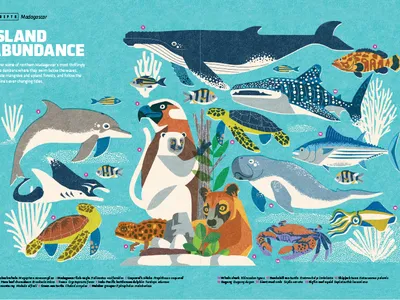
Infographic
Island Abundance
Discover some of northern Madagascar’s most thrillingly unique denizens where they swim below the waves, navigate mangrove and upland forests, and follow the coastline’s ever-changing tides.
Download
© Shutterstock/pmvtisl
Explore more
Keep reading this issue of World Wildlife magazine