Project Overview
Strengthening Capacity for Targeting Natural Resource Corruption
USAID-funded project advanced knowledge and strengthened policy and practice to address the negative impact of corruption on conservation and natural resource management objectives
Implemented from 2018-2024, the TNRC Leader with Associates award delivered knowledge, communicated learning, field-tested approaches, strengthened networks, and mainstreamed anti-corruption in conservation work. The project was delivered by WWF in consortium with the U4 Anti-corruption Resource Centre at the Chr. Michelsen Institute, the Terrorism, Transnational Crime and Corruption Center (TraCCC) at George Mason University, and TRAFFIC, in strategic collaboration with the Basel Institute on Governance. Under this USAID investment mechanism, a $10 million Leader Award advanced capacity and $20 million was invested by USAID Missions in five places to implement anti-corruption activities.
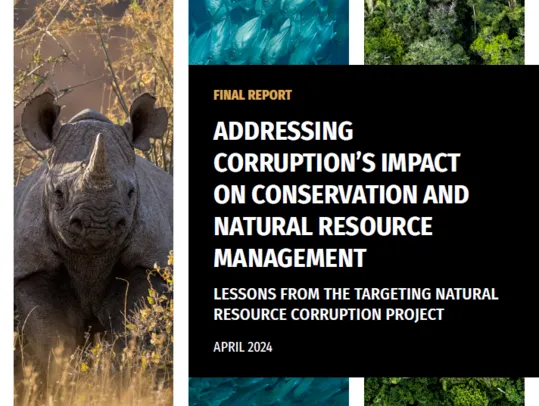
TNRC Final Report
Explore learning from TNRC’s implementation and directions that our community can follow to sustain momentum and strengthen will to integrate anti-corruption in global conservation and natural resource management.
© WWF
Project impact
Environmental corruption—the abuse of entrusted power for private gain that harms nature and those reliant upon it—jeopardizes essential global efforts to safeguard biodiversity, rights, and our climate future. Supported by USAID and led by the World Wildlife Fund (WWF) with a consortium of leading conservation, natural resource management, and anti-corruption organizations, the Targeting Natural Resource Corruption (TNRC) project focused on improving biodiversity outcomes by equipping practitioners with knowledge and tools to address the threats posed by corruption to wildlife, fisheries, and forests. The TNRC Leader Award centered on three strategic approaches: building knowledge, communicating for change, and applying knowledge and testing hypotheses.
Capacity strengthened
$10M knowledge project; $20M in country-based and regional projects in Colombia, Ecuador, Honduras, Madagascar, and the Mekong
Knowledge built
170+ resources and tools developed in 7 core programming areas; 1,200+ NGO staff trained; 140+ learning events
Approaches field-tested
Anti-corruption projects piloted in 6 countries; 1 regional initiative in Latin America and the Caribbean
Partnerships and networks forged
Countering Environmental Corruption Practitioners Forum co-founded with 600+ global members and 4 working groups; cross-sectoral collaborations on political economy analysis
Anti-corruption mainstreaming
Corruption issue elevated; Corruption lens integrated into strategies and risk tools of 2 global conservation organizations (WWF, TRAFFIC)

Strengthening knowledge
Experience shows that corruption impacts all aspects of conservation. While the development sector has focused on anti-corruption for three decades, the conservation community is just beginning to unpack corruption risks that undermine outcomes for nature and respond to them through global programming. USAID identified a critical evidence and knowledge gap, and the TNRC consortium responded by delivering a first-of-its-kind Knowledge Hub with over 150 customized resources and tools to aid the conservation community. TNRC’s open-access learning tools distill available evidence and centralize guidance for corruption-informed programming in seven areas: communities and inclusion, illicit financial flows, law enforcement and criminal justice, open governance, situation analysis, social norms and behavior change, and supply chains. Self-directed training and three-step guides help practitioners to address the impacts of corruption on wildlife trafficking, illegal, unreported and unregulated fishing, illegal logging and associated trade, protected areas and natural resource governance, community-based conservation, sustainable supply chains, and climate change.
Advancing research
To strengthen practice, research and learning should be mutually reinforcing. TNRC partners delivered new research in key areas, including on factors that condition the success and failure of anti-corruption efforts in the renewable resource sectors and new avenues for strengthening accountability in law enforcement, influencing corrupt behaviors and leveraging open data to expose red flags of corruption.
Delivering project-based learning
Strengthening capacity involves investing in learning-by-doing. TNRC supported teams in 6 countries (Argentina, Serbia, Guatemala, Kenya, Nepal, and Peru) to design and implement projects that targeted specific corruption-related problems that undermine conservation goals. Tested interventions focused on closing opportunities for corruption in community forest management, artisanal fisheries, park monitoring, and spatial planning. A regional initiative in Latin America and the Caribbean mobilized further resources for corruption risk analysis in key supply chains, supporting new strategies and tools. Resulting project-based learning, stories, and case studies support other practitioners in their anti-corruption missions.
Growing networks and bridging expertise
Environmental corruption is a systemic challenge costing trillions of dollars, affecting the lives and livelihoods of billions of people and the future of our planet. Given the scale and cross-cutting nature of this threat, conservation and governance practitioners need to work together more closely and more frequently. A growing community of over 600 conservation and anti-corruption experts have come together to find and implement solutions. Together with Transparency International, TNRC launched the Countering Environmental Practitioners Forum whose four working groups are connecting practitioners who work on follow-the-money strategies, land corruption, open data, and climate finance. TNRC investments have also supported partnerships on political economy analysis to inform and influence conservation strategies in Ukraine and wider Central and Eastern Europe. Scaling these collaborations and forging new ones will be vital in the years ahead.
Our Consortium
The TNRC Leader Award was implemented by a consortium of leading organizations in anti-corruption, natural resource management, and conservation: World Wildlife Fund (WWF), the U4 Anti-Corruption Resource Centre at the Chr. Michelsen Institute, the Terrorism, Transnational Crime and Corruption Center (TraCCC) at George Mason University, and TRAFFIC.
WWF works in 100 countries and is supported by more than one million members in the United States and close to five million globally. WWF's unique way of working combines global reach with a foundation in science, involves action at every level from local to global, and ensures the delivery of innovative solutions that meet the needs of both people and nature.
The U4 Anti-Corruption Resource Centre works to reduce the harmful impact of corruption on society, and shares research and evidence to help international development actors get sustainable results. Together with global research networks and practitioners, U4 pursues emerging topics and advances the anti-corruption field. U4 is a permanent centre at the Chr. Michelsen Institute (CMI) in Norway.
The Terrorism, Transnational Crime and Corruption Center (TraCCC) is the first center in the United States devoted to understanding the links among terrorism, transnational crime and corruption, and to teach, research, train and help formulate policy on these critical issues. TraCCC is a research center within the Schar School of Policy and Government at George Mason University.
TRAFFIC is a leading non-governmental organisation working globally on trade in wild animals and plants in the context of both biodiversity conservation and sustainable development. TRAFFIC works around the world carrying out research and analysis to compile evidence to catalyse action by governments, businesses and individuals, in collaboration with a wide range of partners, to help ensure that wildlife trade is not a threat to the conservation of nature.

Funding for the TNRC project was provided by the U.S. Agency for International Development (USAID) under the Bureau for Economic Growth, Education, and Environment (E3) Office of Forestry and Biodiversity (FAB). The FAB office is the Agency lead on biodiversity and forest issues, and provides guidance, training, and direct technical assistance to USAID colleagues engaged in developing, managing and monitoring conservation programs.
This content is made possible by the generous support of the American people through the United States Agency for International Development (USAID). The contents are the responsibility of World Wildlife Fund (WWF) and do not necessarily reflect the views of USAID, the United States Government, or individual TNRC consortium members.