Invasive species risk
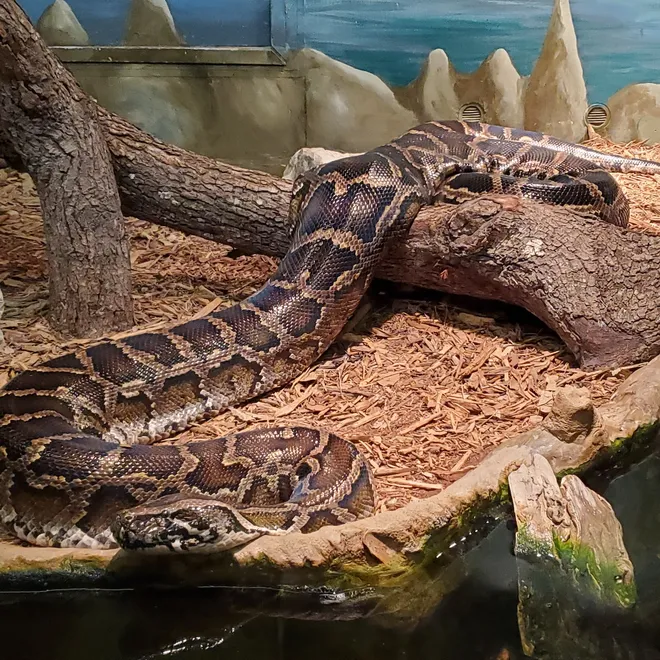
© Wikimedia Commons/JJonahJackalope
Maybe you have heard of Burmese pythons slithering throughout Florida’s Everglades. As popular pets, Burmese pythons were introduced to the United States and unprepared pet owners released the snakes into the Florida Everglades when they grew too big. Lucky for the python, but not so lucky for the local community and wildlife, the species thrived eating local wildlife with no natural predators and became invasive. The impact of this introduction on ecosystem health continues to be a massive challenge.
Most pets cannot survive in the wild and if they can, the animal has the potential to establish itself in local habitats, resulting in economic, social and ecological impacts for the community. A recent study found that the US spends about $21 billion a year on damages due to invasive species, including major damages to the agricultural sector1.
One place you can learn more about whether specific species are invasive to the United States is the US Register of Introduced and Invasive Species (US-RIIS). However, no pet should ever be released into the wild regardless of its tendency to be invasive. This is a generalized list and since climatic conditions are dramatically different across the US, a species could be invasive in your specific region even if it is not in other locations.
Just because a species is exotic and may have wild ancestors doesn’t mean it should ever be released outside. Pet owners can take steps to ensure they are not contributing to invasive species impacts in their community:
- Ensure you can properly house your pet so they cannot escape, and that you can provide housing and care for their lifetime no matter how big they might grow and what their living requirements might be.
- Should you no longer be able to keep your pet, contact your local rescue center, responsible pet store, accredited zoo, veterinarian, or other trusted home to find someone that can take it in. Though they may not be able to directly care for your animal, they should be able to direct you to someone that can. Do not post your animal for sale or adoption on social media or online since it is harder to know a buyer’s intent and ability to care for the animal in online markets. Also, never release a pet outside, into the wild.
- Keeping a pet that is unlikely to be invasive in your specific region reduces risks to your local community should it escape.
1 J.E. Fantle-Lepczyk, P.J. Haubrock, A.M. Kramer, R.N. Cuthbert, A.J. Turbelin, R. Crystal-Ornelas, C. Diagne, F. Courchamp. Economic costs of biological invasions in the United States. Sci. Total Environ., 806 (2022), 10.1016/j.scitotenv.2021.151318