Green and black poison dart frog
Dendrobates auratus
There is moderate risk associated with keeping this species as a pet, as explained below. Prospective pet owners should research if they can safely keep the animal for its lifetime, including housing, proper food and veterinary care, and be sure it came from a legal source and is allowed in their jurisdiction.
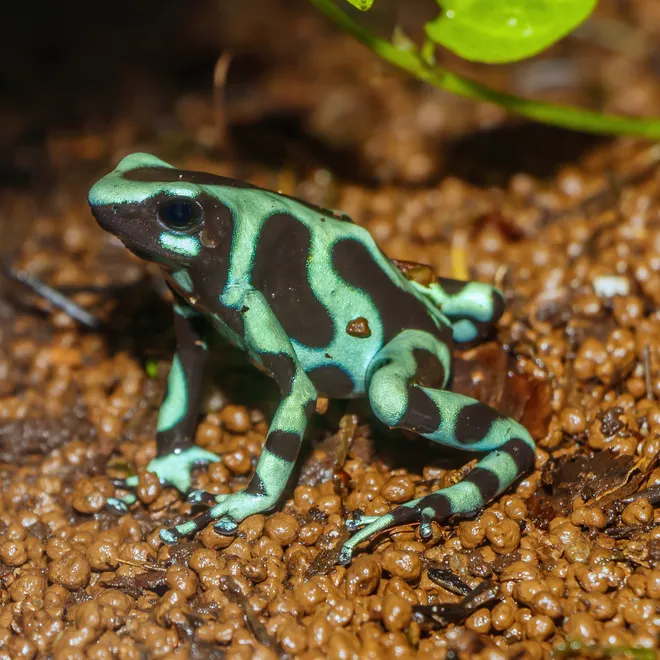
© Wikimedia Commons/H. Zell
Assessment results
Moderate risk

Conservation | Moderate risk
This animal is likely to be threatened by extinction in the wild, and/or it is subject to international trade controls due to demand in the pet trade. Please check that the animal you want comes from a reputable seller or rescue center that follows best practices when they source their animals. Learn more about wildlife conservation and the pet trade.

Legality | Low risk
This animal is not currently protected by any national laws or import restrictions. Exotic pet ownership, however, is regulated at the state, county, or city level, so check your jurisdiction to see if you can own it.

Human and public health | Low risk
It is likely that this animal is not a threat to human or public health, but make sure to practice good hygiene when handling any animal.

Invasiveness | High risk
This species could negatively impact native biodiversity of habitats. Never release this pet, or any pet, into the wild for any reason. Learn more about invasive species.

Animal welfare | Low risk
Care, diet, and housing needs of this species are relatively easy to meet for its lifetime to ensure it has a good quality of life.
⚠️ Important considerations
- Their population is declining in the wild due to habitat loss and collection for the pet trade. However, they can be captive bred with a proper setup, and legal and legitimate breeding facilities exist. Make sure to obtain a poison dart frog from a reputable captive breeding source.
- In the wild, poison dart frogs eat ants with high alkaloid levels, which are stored in the frog’s skin and make them poisonous. In captivity, if given insects without alkaloids, they will lose toxicity.
- Poison dart frog housing and diet needs are hard to provide in captivity. They need a temperature gradient of 68°F to no higher than 80°F with humidity between 70-90%. A low-level UVB light is also recommended to encourage natural behaviors and establish a normal day/night cycle.
- Poison dart frogs have delicate porous skin and should not be handled unless absolutely necessary, and if you must, wear moistened powder-free gloves. A soft net can be used to catch them for habitat cleaning.
- This species is adaptable and established a population in Hawaii after introduction by humans. Do not release your pet frog into the wild, as it may become an invasive species in your community.
- Ensure you have access to a veterinarian that specializes in amphibians and consult them about proper habitat setup, diet, and care. Find an amphibian vet near you.
Basic information
Taxonomy:
Amphibia, Dendrobatidae
Lifespan:
3-15 years in the wild, up to 20 years in captivity
Weight:
0.3 oz
Size:
1.5 in (4 cm) long
Native range and habitat:
Rainforest floors near small streams or pools in Central and South America (Nicaragua and Costa Rica to southeastern Brazil and Bolivia), they have also been introduced in Hawaii
Diet:
Carnivore and insectivore, preying on small invertebrates, insects, and non-insect arthropods; in captivity, feed mainly flightless fruit flies, gut-loaded pinhead crickets, springtails, and isopods
Activity and behavior:
- Most active during the day searching for food and caring for their young
- Frogs of the same species can be housed together if the habitat is large enough
© WWF-Japan