Tiger
Panthera tigris
There is a high risk associated with keeping this species as a pet. This is not a suitable pet.
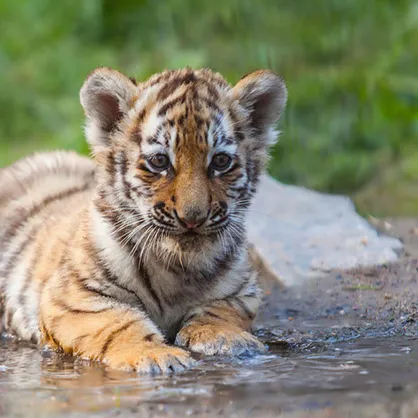
© Shutterstock/Zhiltsov Alexandr/WWF
Assessment results
High risk

Conservation | High risk
This animal is threatened by extinction in the wild, and there is global demand which is creating potentially more unsustainable and illegal poaching of the species. By having it as a pet creates more demand for these animals, which can worsen their situation in the wild. Learn more about wildlife conservation and the pet trade.

Legality | High risk
This animal is either protected by national law, is restricted to import into the US, and/or many states do not allow ownership. Keeping these protected or prohibited species can have legal consequences for the owner, including fines or bans on pet ownership or sale. Learn more about relevant exotic pet trade and ownership laws.

Human and public | High risk
It is likely that this animal is a threat to human or public health due to potential life-threatening zoonotic diseases and physical attributes that can harm humans. Learn more about animal-related illness and injuries.

Invasiveness | Low risk
This species would not likely impact native biodiversity or habitats. However, never release a pet into the wild for any reason.

Animal welfare | High risk
Care, diet, and housing needs of this species are extremely difficult to meet for its lifetime, and potential owners are unlikely to be able to provide a good quality of life. Learn more about the challenges with exotic pet welfare.
⚠️ Important considerations
- Tigers are an endangered and protected species in the wild due to habitat loss and poaching. There are currently more tigers in captivity in the U.S. than those existing in the wild globally, which is an obstacle to their recovery and protection in the wild.
- It is illegal to buy, sell, or privately own tigers in the US.
- Tigers possess the strength, large teeth, and claws that can cause life-threatening harm to humans and will show harmful behavior toward humans in close proximity to protect themselves.
- Their housing and dietary needs are very hard to meet in captivity, and are financially expensive and time consuming. They need a very large amount of outdoor space to roam.
Basic information
Taxonomy:
Carnivora, Felidae
Lifespan:
About 15 years in the wild, usually 16-18 years in captivity, although some have lived to be 26 years old.
Weight:
Male 220-570 lbs (100-260 kg)
Female 290-350lbs (130-160 kg)
Size:
Male 7-10 ft (2.2-3.1 m)
Female 8-9 ft (2.4-2.8 m)
Native range and habitat:
Tigers are distributed throughout Asia, from India to Siberia. From the warm climate of Turkey in the west, to equatorial Indonesia in the south, to the extremely cold Siberia in the north, tigers have inhabited forests in a variety of climates. However, tigers in some regions (Bali, Caspian, and Javan tigers) have already become extinct.
Diet:
In their natural environment, they feed mainly on even-toed ungulates such as deer and cattle, but may also prey on animals including large birds, reptiles, amphibians, and fish.
Activity and behavior:
- Tigers are solitary animals and territorial, interacting to mate and sometimes to share their killed prey.
- They hunt mainly in the evening and morning. Wild tigers have a large range of activity, ranging from as little as 20 square kilometers per animal to as much as 100 square kilometers.

© WWF-Japan
© WWF-US / WWFGifts
Adopt a tiger
Support WWF’s global efforts to protect wild animals and their habitats and choose from kits with plush and more.