© Casper Douma / WWF
Sea turtles
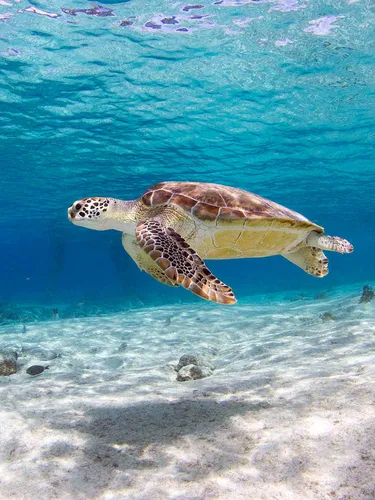
Seven different species of sea (or marine) turtles grace our ocean waters, from the shallow seagrass beds of the Indian Ocean to the colorful reefs of the Coral Triangle and the sandy beaches of the Eastern Pacific. While these highly migratory species periodically come ashore to either bask or nest, sea turtles spend the bulk of their lives in the ocean. WWF's work on sea turtles focuses on five of those species: green, hawksbill, loggerhead, leatherback, and olive ridley.
Over the last 200 years, human activities have tipped the scales against the survival of these ancient mariners. Slaughtered for their eggs, meat, skin, and shells, sea turtles suffer from poaching and over-exploitation. They also face habitat destruction and accidental capture—known as bycatch—in fishing gear. Climate change has an impact on turtle nesting sites; it alters sand temperatures, which then affects the sex of hatchlings. Five of the seven species of sea turtle are threatened with extinction, with two of those being Critically Endangered.
WWF is committed to stopping the decline of sea turtles and works for the recovery of the species. We work to secure environments in which both turtles and the people who depend upon them can survive.
Sea turtle facts
- Scientific name
- Cheloniidae and Dermochelyidae families
- Length
- 2–6 ft.
- Habitats
- Open water and coasts
The sea turtle family
© Roger Leguen / WWF-Canon
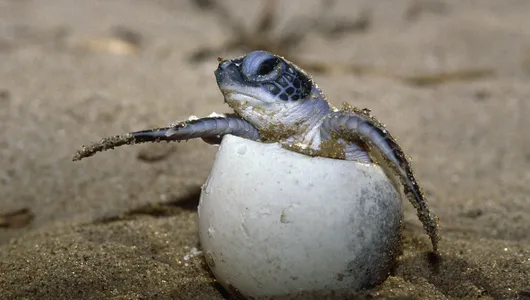
Olive ridley turtles
© Isaac VEGA / WWF-Canon
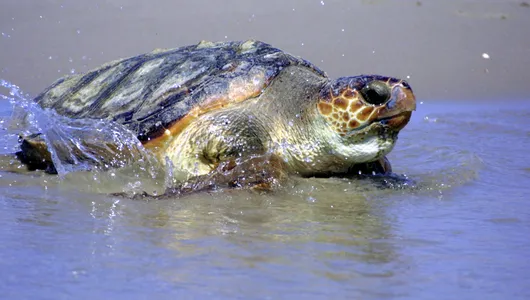
Loggerhead turtles
© naturepl.com / Konrad Wothe / WWF
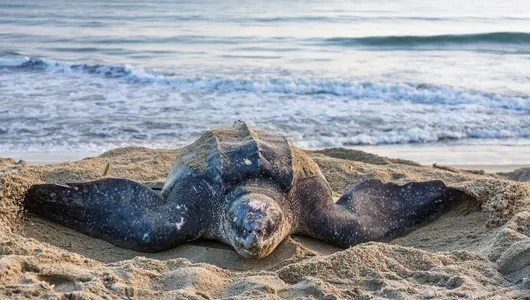
Leatherback turtles

© Philipp Kanstinger / WWF
Hawksbill turtles
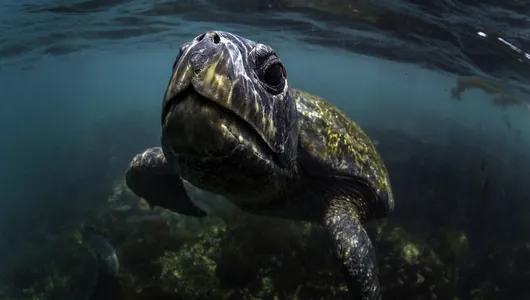
© Ashley Morgan / WWF
Green turtles
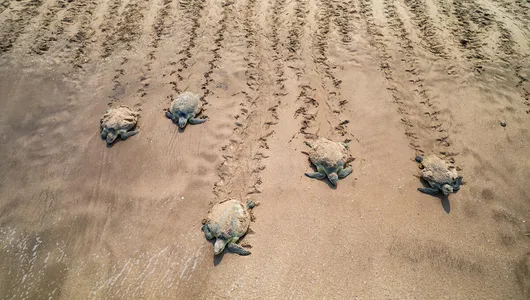
© Tui De Roy / naturepl.com / WWF
Kemp’s ridley turtle
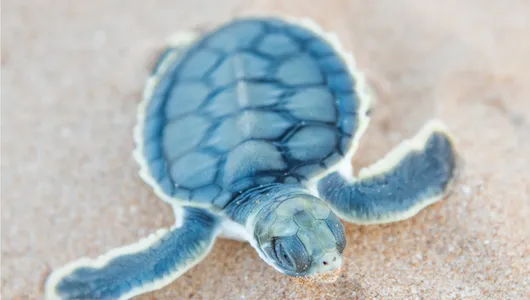
© EA Given/Shutterstock.com
Flatback turtle
News and stories
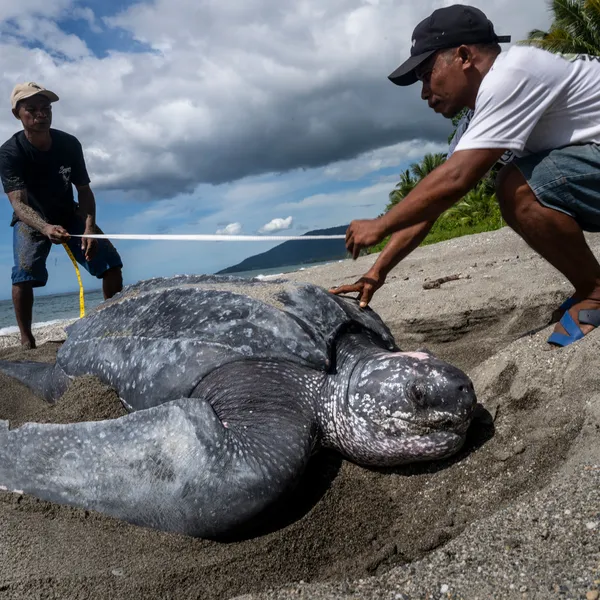
Why sea turtles matter
© Antonio Busiello / WWF-US
Fundamental link in marine ecosystems
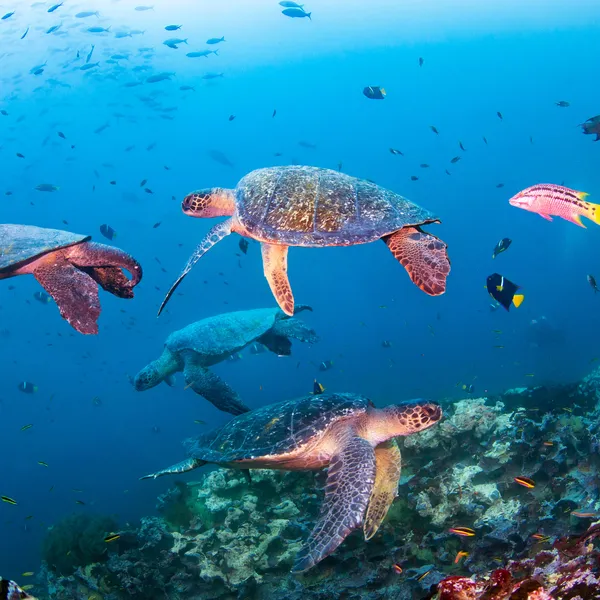
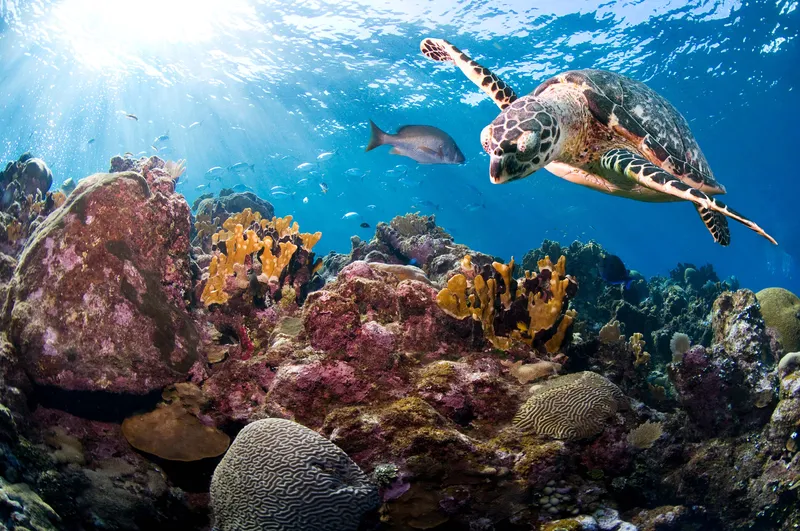
Sea turtles are a fundamental link in marine ecosystems. They help maintain the health of seagrass beds and coral reefs that benefit commercially valuable species such as shrimp, lobster, and tuna. Sea turtles are the living representatives of a group of reptiles that have existed on Earth and traveled our seas for the last 100 million years. Turtles have major cultural significance and tourism value. Five of the seven species are found around the world, mainly in tropical and subtropical waters. The remaining two species, though, have relatively restricted ranges: Kemp's ridley is found mainly off the coasts of Texas and eastern Mexico, and along the eastern US seaboard, while the flatback turtle is located around northern Australia and southern Papua New Guinea.
Threats to sea turtles

© naturepl.com / Jordi Chias / WWF
Sea turtles journey between land and sea and swim thousands of ocean miles during their long lifetimes. They wait decades until they can reproduce, returning to the same beaches where they were born to lay their eggs. Females can lay hundreds of eggs in one nesting season, yet few will yield hatchlings that survive their first year of life. Beyond these significant natural challenges, sea turtles face multiple threats caused by humans, such as bycatch in commercial fishing gear, illegal trade, consumption, and climate change.
Bycatch
Worldwide, hundreds of thousands of sea turtles are accidentally caught in shrimp trawl nets, on longline hooks, and in fishing gill nets every year. They become fisheries' bycatch—animals accidentally caught in nets intended for other species.
Sea turtles need to reach the surface to breathe, and therefore, many drown once caught. Incidental capture by fishing gear is the greatest threat to most sea turtles, especially endangered loggerheads, greens, and leatherbacks. This threat is increasing as fishing activity expands.
Overharvesting and Illegal trade
Sea turtles continue to be harvested unsustainably both for human consumption and the trade of their parts. Turtle meat and eggs are a source of food and income for many people around the world. Some also kill turtles for medicine and religious ceremonies. Tens of thousands of sea turtles are lost this way every year, devastating populations of greens and hawksbills.
Killing of turtles for both domestic and international markets continues as well. International trade in all sea turtle species and their parts is prohibited under the Convention on International Trade in Endangered Species of Wild Fauna and Flora (CITES), a global agreement among governments to regulate or ban international trade in species under threat. Still, illegal trafficking persists, and advances in technology and connectivity have led to an increased ease of buyers and sellers connecting globally online, further facilitating the trade.
Habitat loss
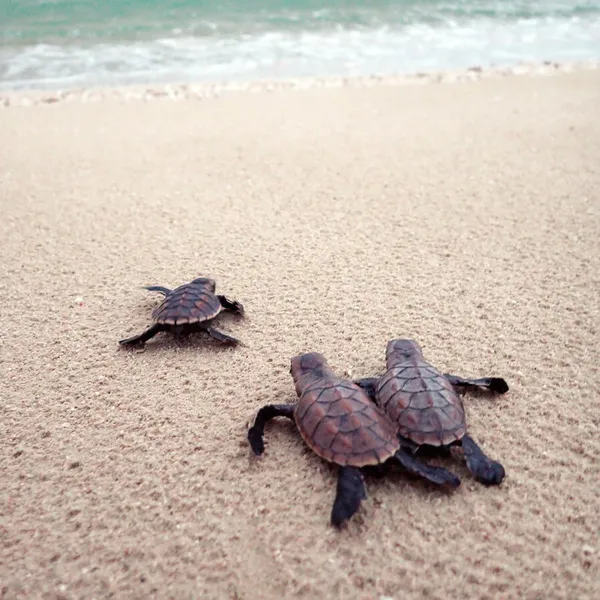
Sea turtles are dependent on beaches for nesting. Uncontrolled coastal development, vehicle traffic on beaches, and other human activities have directly destroyed or disturbed sea turtle nesting beaches around the world. For example, lights from roads and buildings disorient hatchlings away from the sea, and vehicle traffic on beaches compacts the sand, making it impossible for female turtles to dig nests. Turtle feeding grounds such as coral reefs and seagrass beds are damaged and destroyed by activities onshore, including sedimentation from the clearing of land and nutrient run-off from agriculture. Beach restoration projects for protecting seaside buildings have also been found to be harmful, through dredging and sand filling.
Climate change
All stages of a sea turtle's life are affected by environmental conditions, such as temperature, and even the sex of offspring. Unusually warm temperatures caused by climate change are disrupting the normal ratios, resulting in fewer male hatchlings.
Warmer sea surface temperatures can also lead to the loss of important foraging grounds for sea turtles, while increasingly severe storms and sea level rise can destroy critical nesting beaches and damage nests.
Pollution
Sea turtles can mistake floating plastic materials for jellyfish and choke on them when they try to eat them. These encounters are often fatal. Lost or discarded fishing gear—called ghost gear—entangles sea turtles and can drown or render a turtle unable to feed or swim. Trash on beaches can trap hatchlings and prevent them from reaching the ocean. Oil spills also poison sea turtles of all ages.
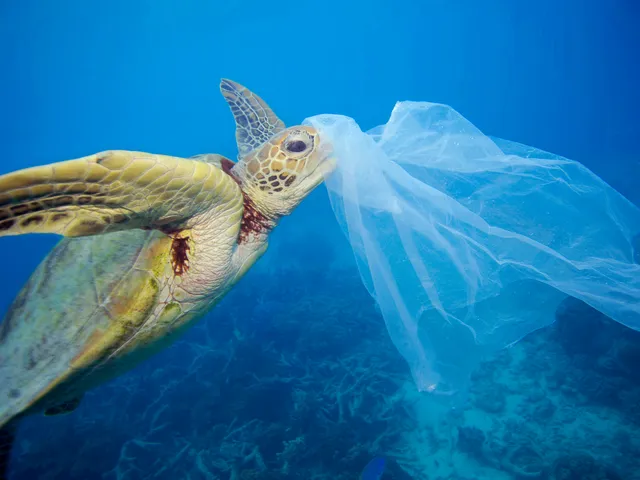
© Troy Mayne / WWF
Help stop plastic pollution
Send a message to world leaders, asking them to chart a path to a future with less plastic in nature.
How WWF is taking action to protect sea turtles

© Jürgen Freund / WWF
WWF works around the world to eliminate sea turtle bycatch from fisheries, reduce the unsustainable harvest and illegal trade in sea turtles, and stem the loss of critical sea turtle habitats. Many of these objectives are achieved by establishing and strengthening protected areas around nesting beaches, raising awareness and promoting ecotourism, lobbying for turtle-friendly fishing practices, and more.
Eliminating bycatch
WWF aims to reduce turtle bycatch by working with fisheries to switch to more turtle-friendly fishing hooks ("circle" hooks). We advocate for the use of special turtle excluder devices in nets. WWF has worked with the National Oceanic and Atmospheric Administration (NOAA) to develop lights to reduce the bycatch of turtles in gill nets. These lights have been shown to reduce turtle bycatch by 60%-70%, and we are working to introduce them to fisheries around the world. WWF also tracks turtle movements using satellites to help prevent future interactions between fisheries and turtles and works with fishermen to help them save turtles caught in fishing gear.

© Jürgen Freund / WWF-Canon
Addressing overharvesting and illegal trade
WWF works with local communities to reduce sea turtle harvesting and egg collection. Because exploitation of turtles is often driven by a lack of economic choices, we help develop alternative livelihoods so that local people are no longer dependent on turtle products for income. WWF also supports programs that promote the economic value of live sea turtles from sustainable tourism.
WWF works to stop the illegal trade of turtle shells, meat, and eggs. We also train and equip local rangers to patrol turtle nesting beaches and protect against poaching. In the western Solomon Islands, WWF supports local rangers on the beaches throughout turtle nesting and hatching seasons to protect against egg harvesting and hunting. The rangers collect important data and inform their communities about laws to protect turtles.
WWF also works with e-commerce, social media, and technology companies through the Coalition to End Wildlife Trafficking Online to address sea turtle product trade and other wildlife crimes on web-based platforms. Launched in 2018, the Coalition includes 47 member companies operating across Africa, Asia, Europe, and the Americas.
Protecting sea turtle habitat
WWF works around the world to establish marine protected areas, ensuring sea turtles have a safe place to nest, feed, and migrate freely. We encourage governments to strengthen legislation on, and provide funding for, sea turtle protection. WWF supports local turtle conservationists in many parts of the world to monitor and patrol turtle nests. These efforts often lead to ecotourism opportunities and offer alternative livelihoods.
Minimizing climate change impacts
WWF studies how sea turtles are being affected by climate change and helps determine the best ways to reduce their vulnerability to changing environmental conditions. We work around the world with communities to monitor and protect nesting beaches, helping turtles be more resilient to the future impacts of climate change. In the Eastern Pacific and Caribbean, we work to raise awareness of the threat of sea level rise on nest sites and the importance of shade for nests.
Satellite tracking
Satellite telemetry allows researchers to track sea turtles as they swim from place to place. These satellite tags do not harm the turtles in any way and are designed to eventually fall off. The data will tell us where important feeding areas are, help us understand migration patterns, and anticipate where turtles may come in contact with fisheries and their gear. These projects include tracking of hawksbill turtles in Malaysia; leatherback turtles in Panama, Suriname, French Guiana, Uruguay, Indonesia, and Gabon; loggerhead turtles in Cape Verde; green turtles in Cambodia; and olive ridley turtles in Australia.
DNA analysis
Genetic data plays a critical role in sea turtle conservation by helping researchers identify distinct populations, understand how populations are connected across regions, and determine which groups are most vulnerable to decline. To support these efforts, WWF launched and leads ShellBank, a global genetic traceability program introduced in 2022 that is transforming the way scientists study and protect marine turtles. By combining a worldwide genetic database with advanced traceability tools, ShellBank can identify turtle populations of origin and products, helping researchers better understand population connectivity, combat the illegal trade of turtles and their parts, and address unsustainable harvest and fisheries bycatch. This information allows conservationists and fisheries managers to develop more targeted strategies to protect at-risk populations and strengthen marine turtle conservation worldwide.
Wildlife Cafe
10 most asked sea turtle questions—answered by a wildlife expert
How you can help
© George Walsh
Strengthen the Endangered Species Act
More than 99% of the species listed under the Endangered Species Act have avoided extinction due to the law’s protections. Today, those protections are under threat — at the exact moment wildlife needs them most.